


Planche twintip kitesurf ROODE BOARD
€400.00
The Planche Twintip Kitesurf ROODE Board is offered in excellent condition and has been professionally inspected to confirm its quality, condition, and readiness for use. The board has been carefully checked and found to have no damage, no repairs, no cracks, no structural issues, and no significant wear. It has been well maintained and is ready for many more kiteboarding sessions and jumps.
Every component has been carefully inspected, including the board deck, bottom surface, rails, edges, fins, fin boxes, foot straps, pads, inserts, screws, and mounting hardware. The board has been checked for cracks, impact damage, delamination, damaged inserts, loose fittings, and previous repairs.
Included components:
- Planche Twintip Kitesurf ROODE Board
- Twin-tip board
- Fins
- Fin hardware
- Foot straps
- Foot pads
- Inserts and mounting hardware
- Related accessories, if included
No cracks, repairs, structural damage, or significant defects are present. The board remains clean, solid, well maintained, and ready for immediate use.
The Planche Twintip Kitesurf ROODE Board is ready to use and ready for many more kiteboarding sessions and jumps again. It is an excellent choice for freeride, carving, upwind riding, transitions, jumping, and progression. A final pre-use inspection should always be completed, with all fins and hardware properly secured before riding.
Description
Planche Twintip Kitesurf ROODE Board – Versatile Performance for Kiteboarding
The Planche Twintip Kitesurf ROODE Board has been designed for riders seeking a versatile twin-tip platform for freeride sessions, controlled edging, carving, jumping, and continued kiteboarding progression. A twin-tip format is provided, allowing the board to be ridden in either direction without requiring a traditional directional turn.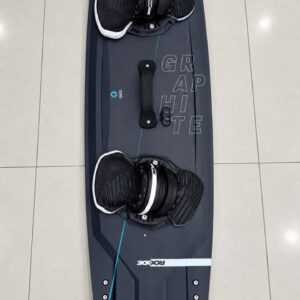
Furthermore, the symmetrical construction can make transitions more straightforward, while the board’s compact format can provide a responsive connection between rider, kite, and water Consequently, the ROODE Board can be considered by riders who want a practical board for everyday kiteboarding.
Twin-Tip Design for Versatile Riding
A twin-tip configuration is used to provide bidirectional riding. Therefore, the board can be ridden comfortably in both directions while transitions can be performed without the need to change stance permanently.
As pressure is applied through the feet, the board can be edged against the water. Consequently, controlled upwind riding and powered freeride performance can be developed.
Moreover, the twin-tip format can be particularly useful for riders who want to combine cruising, carving, jumps, and transitions within a single session.
Key Product Highlights
- Planche Twintip Kitesurf ROODE Board
- Twin-tip kiteboard design
- Bidirectional riding capability
- Responsive handling
- Freeride versatility
- Controlled edging
- Carving potential
- Jumping capability
- Suitable for transitions
- Useful for rider progression
- Practical everyday kiteboarding platform
- Suitable for a wide range of riding styles
Responsive Board Handling
Responsive handling is important when precise movements are being performed. Because of this, the ROODE Board can provide a direct connection between rider input and board response.
When pressure is transferred from one foot to the other, the board can be redirected efficiently. Consequently, tighter turns and more controlled transitions can be developed.
Furthermore, responsive handling can help riders react to changing water conditions and variations in kite power.
Freeride Performance
Freeriding is one of the most accessible disciplines within kiteboarding. Therefore, a versatile twin-tip board can be used for cruising, edging, carving, and general progression.
The Planche Twintip Kitesurf ROODE Board can provide a practical platform for riders who want to enjoy everyday sessions without being restricted to a single discipline.
As the kite generates power, the board can be edged against the water. Consequently, speed and directional control can be maintained.
Moreover, the twin-tip configuration allows the board to be ridden naturally in either direction.
Controlled Edging
Strong edging is essential for maintaining an efficient riding line and controlling kite power. Therefore, the board can be used to develop more precise edge control.
Pressure can be applied progressively through the heelside or toeside edge. Consequently, the rider can maintain direction while preparing for transitions or jumps.
Furthermore, consistent edging can help improve overall kiteboarding technique as experience increases.
Upwind Riding
Efficient upwind riding depends on several factors, including board design, rider technique, kite position, and fin configuration.
The ROODE Board can be used to support controlled edging while the rider works against the wind. Consequently, a comfortable upwind angle can be developed when the board is correctly matched to the rider and conditions.
Additionally, maintaining appropriate body position and kite control remains essential for efficient upwind performance.
Carving and Turning
Smooth carving can be developed through coordinated pressure between the feet. Therefore, the twin-tip configuration can provide an excellent platform for practicing directional changes.
As the rider moves pressure from one edge to another, the board can be redirected. Consequently, linked turns can be performed with greater control.
Moreover, the symmetrical shape allows the same general riding characteristics to be experienced in both directions.
Jumping Performance
Jumping is one of the most popular applications for twin-tip kiteboards. Therefore, the Planche Twintip Kitesurf ROODE Board can be used by riders who want to develop aerial techniques.
A controlled edge can be established before takeoff. As the kite is redirected and pressure is released from the water, the board can be lifted into the air.
Consequently, basic jumps can be developed into more advanced aerial movements as rider confidence increases.
Jumping should always be attempted only when suitable wind, water conditions, equipment, experience, and open space are available.
Transition Development
Transitions can be practiced efficiently with a twin-tip board because the board can be ridden in either direction.
During a transition, the kite can be repositioned while the rider changes direction. Consequently, less time can be spent adjusting the board after the turn.
Furthermore, the symmetrical layout can make the board suitable for riders who are developing both heelside and toeside control.
Pop and Aerial Progression
Pop is an important characteristic for riders interested in jumps and freestyle development.
By loading the edge correctly and coordinating kite movement with body position, energy can be transferred through the board. Consequently, controlled lift can be developed.
As rider technique improves, more advanced pop-based maneuvers can be introduced.
The actual level of pop will depend on board characteristics, fins, rider technique, kite power, and water conditions.
Rider Progression
The Planche Twintip Kitesurf ROODE Board can support several stages of kiteboarding development.
Beginner-to-Intermediate Progression
Basic edging, board control, transitions, cruising, and upwind riding can be practiced.
Intermediate Progression
Carving, controlled jumps, stronger edging, and faster transitions can be developed.
Advanced Progression
Higher jumps, technical transitions, freestyle movements, and more aggressive carving can be explored.
Therefore, the board can remain useful as rider ability continues to develop.
Board and Kite Compatibility
The overall performance of a twin-tip board depends heavily on the kite and riding conditions.
Kite size should be selected according to rider weight, wind strength, and intended riding style. Meanwhile, board selection should be considered according to water conditions and technical ability.
Consequently, the ROODE Board should be matched with an appropriate kite and fin setup to achieve the desired performance.
Fin and Foot-Strap Setup
Fin and foot-strap configuration can influence the board’s handling characteristics.
A suitable fin setup can provide grip and directional stability. Meanwhile, correctly adjusted foot straps can provide secure rider connection while allowing comfortable positioning.
Therefore, all hardware should be inspected and correctly secured before each session.
Suitable Riding Styles
The versatility of a twin-tip board allows several disciplines to be supported.
The ROODE Board can be considered for:
- Freeride kiteboarding
- Recreational cruising
- Upwind riding
- Carving
- Jumping
- Basic freestyle
- Transition practice
- Kiteboarding progression
Consequently, it can serve as a practical everyday board for riders who enjoy multiple aspects of the sport.
Water Conditions
Twin-tip boards can be used across a variety of water environments. Flat water can provide excellent conditions for practicing edging, transitions, and jumping.
Choppy water can require greater rider control and careful edge management. Meanwhile, moderate waves can provide opportunities for carving and dynamic freeriding.
Therefore, performance will naturally vary according to water state, wind strength, rider skill, and kite selection.
Maintenance and Care
Regular inspection should be performed before every session. The board surface, edges, fins, screws, foot straps, inserts, and bindings should be checked carefully.
Any loose hardware should be tightened appropriately. Furthermore, the board should be rinsed after salt-water use and allowed to dry before storage.
Sharp impacts should be avoided whenever possible. Any crack, delamination, damaged insert, loose fin box, or structural concern should be professionally assessed before the board is returned to use.
Main Benefits at a Glance
- Twin-tip kiteboard design
- Bidirectional riding
- Responsive handling
- Freeride versatility
- Controlled edging
- Upwind capability
- Carving potential
- Jumping performance
- Transition-friendly design
- Progression-focused platform
- Suitable for multiple riding styles
- Practical everyday kiteboarding option
Why Choose the Planche Twintip Kitesurf ROODE Board?
The Planche Twintip Kitesurf ROODE Board has been designed around versatility and accessible performance.
A twin-tip configuration allows both directions to be ridden naturally, while controlled edging can be used for upwind riding, carving, and jumping.
Furthermore, the board can be incorporated into a wide variety of sessions, from relaxed freeriding to more progressive riding.
For riders seeking a twin-tip kitesurf board for freeride, edging, carving, jumping, transitions, upwind riding, and continued progression, the ROODE Board provides a practical and versatile platform.
A Versatile Twin-Tip for Modern Kiteboarding
The Planche Twintip Kitesurf ROODE Board provides a balanced platform for riders who want versatility, control, and progression.
Freeride sessions can be enjoyed, while edging and carving can be developed. Meanwhile, jumping and transition techniques can be introduced as confidence increases.
Ultimately, the board can be used as an adaptable twin-tip platform for riders who want to explore multiple aspects of kiteboarding while maintaining a responsive and practical connection with the water.
Planche Twintip Kitesurf ROODE Board – Advanced Riding Performance
Built for Versatile Twin-Tip Riding
Greater control is required as kiteboarding techniques become more advanced. Therefore, the Planche Twintip Kitesurf ROODE Board can be used as a versatile platform for riders who want to combine freeride cruising, edging, carving, jumping, and transitions.
A twin-tip configuration is provided, allowing both directions to be ridden without the board needing to be turned around. Consequently, transitions can be performed efficiently while a consistent riding stance can be maintained.
Furthermore, the symmetrical format can make the board suitable for riders who want to develop balanced heelside and toeside skills.
Efficient Edge Control
Edge control is fundamental to modern twin-tip kiteboarding. Because of this, the ROODE Board can be used to develop a stronger and more consistent connection with the water.
As pressure is applied through the heelside or toeside edge, the board can be driven against the water. Consequently, directional control and resistance against kite power can be improved.
Moreover, controlled edging can create the foundation required for jumping, upwind riding, and more advanced maneuvers.
Upwind Performance
Efficient upwind riding requires a combination of board control, kite positioning, body posture, and edging technique.
The Planche Twintip Kitesurf ROODE Board can be used to support a controlled edge while the rider works against the wind. Consequently, an efficient upwind angle can be developed when the board and kite are correctly matched.
Furthermore, consistent edge control can help riders reduce unnecessary sideways movement and maintain forward progress.
Performance will naturally vary according to rider weight, kite size, fin configuration, wind strength, and water conditions.
Freeride Versatility
Freeride riding can be enjoyed across a broad range of conditions. Therefore, a versatile twin-tip board can be valuable for everyday kiteboarding.
The ROODE Board can be used for cruising, acceleration, carving, transitions, and jumps. Consequently, riders can move between different riding techniques without changing boards.
Furthermore, the twin-tip layout can provide a familiar platform for riders who want predictable directional changes.
Acceleration and Speed
Speed can be generated when sufficient kite power is combined with effective board edging. Therefore, the ROODE Board can be incorporated into powered freeride setups.
As pressure is applied through the board, water resistance can be managed while the kite generates forward drive. Consequently, speed can be increased progressively.
Once a comfortable riding speed has been reached, the rider can adjust kite position and edge pressure according to the desired direction.
Actual top speed will depend on board characteristics, rider technique, kite size, water state, and wind conditions.
Carving Performance
Carving can be developed by transferring pressure smoothly from one edge to the other.
As the rider enters a turn, the board can be rolled onto its new edge. Consequently, linked turns can be created while speed is maintained.
Moreover, the twin-tip configuration allows carving to be practiced in both directions, which can help develop more balanced riding skills.
Jumping and Pop
Jumping is one of the key applications associated with twin-tip kiteboarding. Therefore, the Planche Twintip Kitesurf ROODE Board can be used as a platform for aerial progression.
A controlled edge can be established before takeoff. As the kite is redirected, pressure can be released progressively from the water.
Consequently, the board can be lifted into the air while rider balance is maintained.
With increased experience, larger jumps, grabs, rotations, and other aerial techniques can be introduced.
Landing Control
Controlled landings are just as important as takeoff technique. Therefore, board positioning and kite management should be coordinated throughout the aerial phase.
As the rider prepares to return to the water, the board can be aligned with the intended direction. Consequently, impact can be managed more smoothly.
Furthermore, maintaining an appropriate amount of kite power can help support a controlled landing.
Advanced jumps should always be attempted only in suitable conditions and with sufficient rider experience.
Transition Performance
The twin-tip design provides a natural platform for transition practice.
During a gybe or direction change, the kite can be redirected while the rider changes the board’s orientation. Consequently, the opposite riding direction can be established without requiring a directional board turn.
Moreover, repeated transition practice can improve timing, balance, and kite control.
As confidence increases, faster transitions and more technical movements can be introduced.
Toeside Riding
Toeside riding can provide an important progression step for riders who want to expand their control.
By changing foot pressure and body position, the board can be driven through the water while the rider maintains a toeside edge.
Consequently, new riding lines can be explored.
Furthermore, toeside control can be valuable when approaching jumps, carving, wave sections, or technical transitions.
Freestyle Potential
Twin-tip boards are widely associated with freestyle progression because edging and pop can be combined with kite movement.
The ROODE Board can be incorporated into controlled freestyle development where suitable conditions and rider experience are available.
Basic pop techniques can be developed first. Subsequently, grabs, rotations, and more advanced aerial movements can be introduced.
The exact freestyle characteristics will depend on the board’s construction, rocker, flex, fins, rider technique, and kite configuration.
Riding in Choppy Water
Choppy water requires active board control. Therefore, riders can use the ROODE Board to develop more adaptable edging and weight-transfer techniques.
Rather than maintaining excessive pressure through one edge, the rider can adjust foot pressure as the board moves across changing water surfaces.
Consequently, greater control can be developed in variable conditions.
A suitable kite size should always be selected so that excessive power does not compromise board control.
Flat-Water Performance
Flat water can provide an excellent environment for technical progression.
Smooth water conditions can make edging easier to analyze. Consequently, riders can focus on board control, transitions, jumping, and freestyle technique.
Furthermore, flat water can provide a predictable environment for practicing new movements before they are attempted in more challenging conditions.
Rider Progression
The Planche Twintip Kitesurf ROODE Board can support multiple levels of development.
Intermediate Riders
Upwind riding, edging, carving, transitions, and controlled jumping can be developed.
Advanced Riders
Higher jumps, stronger carving, toeside riding, and technical transitions can be introduced.
Experienced Riders
Freestyle combinations, advanced aerial movements, aggressive carving, and high-speed freeriding can be explored.
Consequently, the board can remain useful as riding ability continues to progress.
Kite Selection
The board should be matched with an appropriate kite size.
A larger kite can be selected for lighter wind conditions, while a smaller kite can be used as wind strength increases.
Therefore, rider weight, local wind range, kite characteristics, and intended riding style should all be considered before selecting the complete setup.
Fin and Hardware Setup
Fin configuration can influence grip, tracking, and turning response.
A secure fin connection should be maintained before every session. Similarly, foot straps, inserts, screws, and other hardware should be checked carefully.
Consequently, a reliable connection between the rider and board can be maintained.
Any damaged or loose hardware should be replaced or professionally assessed before use.
Maintenance and Long-Term Care
The ROODE Board should be inspected before every session.
Particular attention should be given to:
- Board surface
- Rails and edges
- Fins
- Fin boxes
- Foot straps
- Inserts
- Screws
- Bindings or pads
- Signs of impact or delamination
After salt-water exposure, the board should be rinsed with fresh water. Furthermore, it should be dried thoroughly before storage.
Excessive heat, prolonged direct sunlight, and unnecessary impact should be avoided.
Key Performance Advantages
- Twin-tip bidirectional design
- Freeride versatility
- Controlled edging
- Upwind riding capability
- Responsive carving
- Jumping and pop potential
- Transition-friendly platform
- Toeside progression
- Freestyle potential
- Flat-water versatility
- Choppy-water adaptability
- Suitable for multiple skill levels
Why Choose the ROODE Board?
The Planche Twintip Kitesurf ROODE Board has been developed around versatility and practical twin-tip performance.
Its bidirectional configuration allows both riding directions to be used naturally. Consequently, freeride cruising, carving, transitions, jumping, and progression can all be incorporated into the same setup.
Furthermore, the board can be adapted to different kite sizes and riding environments, making it a practical option for riders who want one versatile twin-tip platform.
A Practical Twin-Tip for Continued Progression
The Planche Twintip Kitesurf ROODE Board provides a versatile foundation for modern kiteboarding.
Controlled edging can be developed for upwind riding, while carving and transitions can be practiced for improved board control. Meanwhile, jumping, pop, toeside riding, and freestyle techniques can be introduced as rider confidence increases.
For riders seeking a twin-tip kitesurf board for freeride, edging, carving, upwind riding, jumping, transitions, and progressive freestyle development, the ROODE Board provides a practical platform for continued progression and enjoyable sessions on the water.



Reviews
There are no reviews yet.