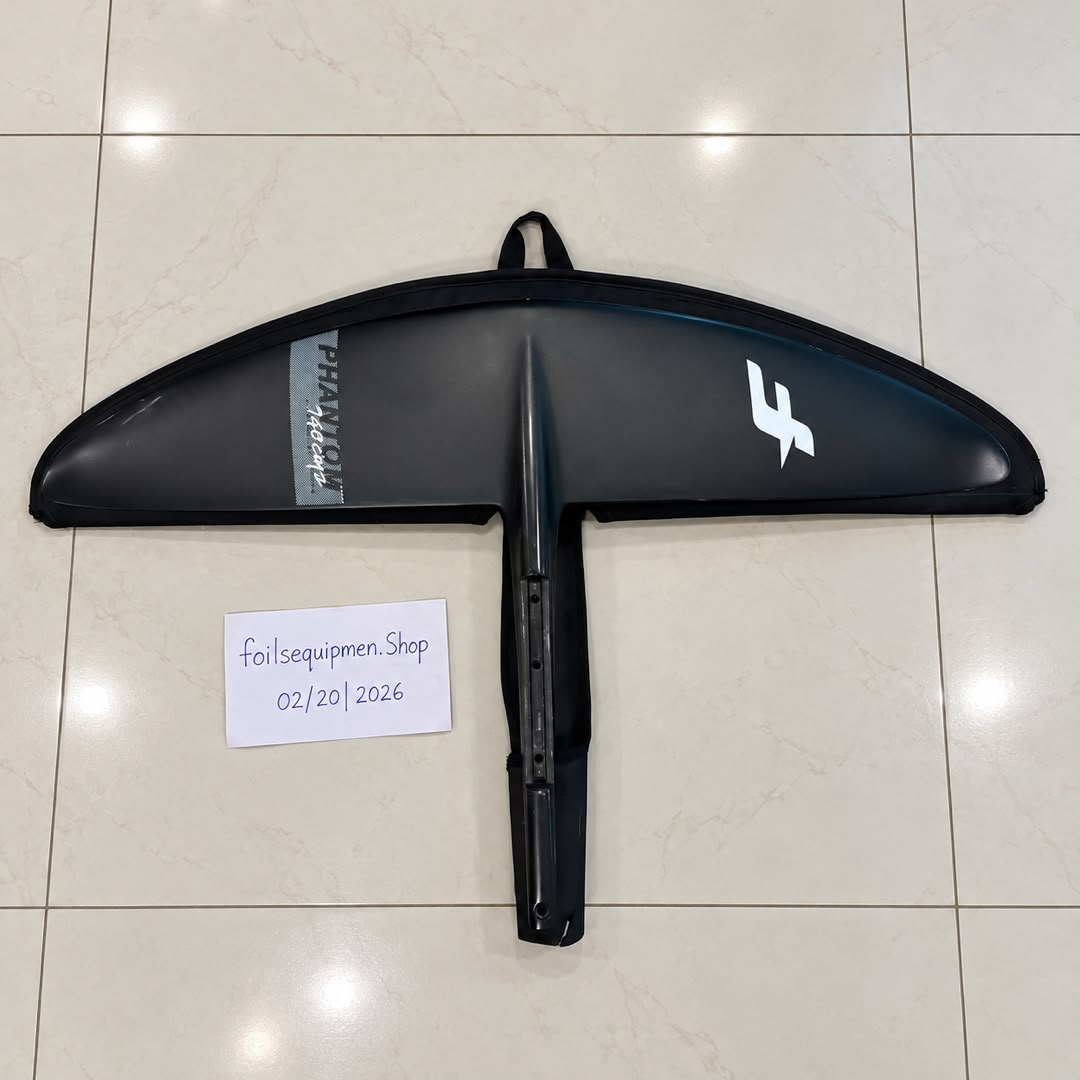

Phantom 940
€170.00
The F-One Phantom 940 is offered in excellent condition and has been professionally inspected to confirm its overall quality, condition, and readiness for use. The hydrofoil has been carefully checked and found to have no damage, no repairs, no cracks, no delamination, and no significant structural defects. It has been well maintained and is ready for many more sessions and rides.
Every component has been thoroughly inspected, including the front wing, mast, fuselage, stabilizer, mounting points, screws, bolts, washers, connection areas, and carbon surfaces. All critical components have been checked for impact marks, scratches, excessive wear, corrosion, loose hardware, and previous repairs.
Included components:
- F-One Phantom 940 front wing
- Mast
- Fuselage
- Rear stabilizer
- Mounting hardware
- Screws and bolts
- Washers and connection hardware
- Protective/storage bag, if included
- Related accessories, if included
No cracks, repairs, delamination, or significant damage are present. The carbon components remain clean, solid, and well maintained.
The F-One Phantom 940 is ready to use and ready for many more sessions and rides again. It is an excellent option for experienced riders interested in high-speed foiling, wing foiling, kite foiling, wave riding, swell riding, carving, pumping, and downwind performance. A complete professional inspection should always be performed before returning safety-critical equipment to use.
Description
F-One Phantom 940 – Speed, Glide and Carving Performance
The F-One Phantom 940 has been developed for riders seeking a high-performance hydrofoil with an emphasis on speed, glide, carving, and efficient pumping. A high-aspect design is provided so that smooth acceleration and efficient flight can be combined with responsive turning characteristics.
With a 940 cm² front wing, approximately 78 cm of span, and an aspect ratio of 6.5, the Phantom 940 has been positioned as a performance-oriented foil for experienced riders
Furthermore, the carbon construction is designed to provide a strong and rigid connection between the major foil components. Consequently, efficient power transmission and precise control can be supported during demanding riding.
High-Aspect Performance
A high-aspect front-wing profile is used to improve efficiency and speed. Therefore, the F-One Phantom 940 can be particularly appealing to riders who want faster foil performance without giving up the ability to carve.
The wing has been designed with an emphasis on refined lift distribution and efficient aerodynamic behavior. Consequently, speed can be maintained effectively during longer runs.
Moreover, the higher-aspect shape can provide a smooth feeling when connecting waves and swells.
Key Product Highlights
- F-One Phantom 940
- 940 cm² front wing
- Approximately 78 cm wingspan
- Aspect ratio of approximately 6.5
- Carbon construction
- Pre-preg carbon technology
- Monobloc construction
- High-speed performance
- Efficient glide
- Strong carving capability
- Effective pumping
- Wave and swell applications
- Wing-foiling compatibility
- Designed for experienced riders
Carbon Construction
Carbon construction has been used throughout the Phantom platform to achieve a strong and lightweight foil structure.
The monobloc construction is designed to improve stiffness and load transmission between the different sections. Consequently, unwanted flex and vibration can be reduced while direct control is maintained.
Furthermore, pre-preg carbon construction is used to provide a precise combination of carbon fiber and epoxy resin.
This construction approach can be especially valuable when the foil is being loaded during high-speed carving, pumping, and aggressive turns.
Speed and Glide
Speed is one of the defining characteristics of the Phantom 940.
As the foil accelerates, efficient water flow can be maintained across the front wing. Consequently, higher-speed riding can be achieved with relatively controlled input.
The Phantom 940 has been described as a speed-focused option within the Phantom range, with strong glide characteristics for connecting waves and swells.
Moreover, efficient glide can reduce the need for continuous pumping when the rider is moving between sections of usable swell.
Carving Performance
Speed alone does not define the Phantom 940.
A refined wing shape has been developed so that carving performance can also be maintained. Consequently, the foil can be driven through smooth and aggressive turns when sufficient rider skill is available.
Furthermore, the higher-aspect geometry can provide a distinctive combination of speed and turning control.
The Phantom 940 can therefore be particularly attractive to riders who want to combine fast straight-line riding with dynamic carving.
Pumping Efficiency
Efficient pumping is another important characteristic.
As pressure is transferred through the board and mast, the foil can be loaded and unloaded rhythmically. Consequently, forward momentum can be maintained with appropriately timed rider input.
The Phantom 940 has been described as surprisingly effective for pumping despite its performance-oriented size.
Therefore, experienced riders can use the wing for connecting sections of swell and maintaining flight through changing conditions.
Wave Riding
Wave riding can benefit significantly from efficient glide.
Once wave energy is captured, the rider can reduce reliance on external power and allow the foil to carry momentum. Consequently, multiple sections of swell can potentially be connected.
The F-One Phantom 940 has been designed with wave and swell performance in mind.
Moreover, its carving characteristics can allow the rider to redirect the foil while maintaining speed.
Swell Riding
Open-water swell riding requires efficient glide and predictable control.
As one section of swell fades, the rider may need to carry enough speed to reach another section. Therefore, an efficient foil can provide a major advantage.
The Phantom 940 can be used for this type of riding when the rider, board, mast, and stabilizer are appropriately matched.
Consequently, longer glide lines can be developed without requiring continuous pumping.
Wing Foiling
The Phantom 940 can be used within suitable wing-foil configurations.
Its relatively compact surface area is balanced by the efficient high-aspect profile. Consequently, experienced riders can achieve useful speed and maneuverability.
The wing has been identified as an option for demanding wing riders and for riding in larger waves.
However, the 940 cm² size should not be treated as a universal beginner foil. Appropriate rider experience and equipment matching are important.
Kite Foiling
The Phantom 940 has also been used in kite-foiling applications.
Its speed-oriented characteristics can be advantageous when efficient cruising and higher-speed riding are desired.
Furthermore, rider feedback has highlighted its ability to maintain speed while remaining controlled during kite-foil sessions.
Consequently, the foil can appeal to riders looking for a performance-oriented setup that can be adapted between disciplines.
Stabilizer Compatibility
The Phantom range is recommended with the C275 Surf stabilizer.
A compatible stabilizer can provide a more relaxed and loose feeling while helping the higher-aspect front wing turn effectively. Consequently, carving and surfing characteristics can be enhanced.
The exact stabilizer and fuselage combination should always be selected according to the applicable F-One system and rider requirements.
Short Fuselage Configuration
The Phantom 940 has been associated with an ultra-short or X-Short fuselage configuration depending on the version and complete foil package.
A shorter fuselage can produce a more responsive and compact feeling. Consequently, turns can be made more dynamically.
Furthermore, the published specifications for the Phantom 940 identify a carbon X-Short fuselage within the complete foil configuration.
Takeoff Characteristics
Although the Phantom 940 is designed around speed and performance, effective takeoff can still be achieved with appropriate technique.
As sufficient speed is generated, lift can be established across the front wing. Consequently, the rider can transition into stable foil flight.
Rider weight, board volume, mast length, wing power, water conditions, and technique will all influence actual takeoff performance.
Therefore, the 940 should be selected according to the complete equipment system rather than wing area alone.
Rider Level
The F-One Phantom 940 is best suited to riders with established foil experience.
Experienced riders can take advantage of its speed, glide, carving, and pumping characteristics. Consequently, its performance potential can be explored more effectively.
For newer foil riders, a larger and more forgiving front wing may be more appropriate.
Therefore, rider ability should always be considered when selecting this model.
Performance Across Conditions
The Phantom 940 can be used in a variety of suitable conditions.
Stronger Wing-Foil Sessions
The smaller surface area and high-aspect profile can provide useful speed when sufficient power is available.
Wave Riding
Efficient glide and carving can be used to connect sections of swell.
Downwind Riding
The efficient profile can help maintain speed while moving between bumps.
Kite Foiling
The speed-oriented design can be used for controlled high-speed cruising.
Consequently, the Phantom 940 can serve as a versatile performance foil for riders who already have suitable technical ability.
Handling and Stability
Despite its performance orientation, the Phantom 940 has been reported by riders as stable during maneuvers and controlled at speed.
This balance can be particularly useful when carving or transitioning.
Furthermore, the foil can provide enough glide to allow the rider additional time during maneuvers.
Pumping and Downwind Riding
Downwind riding places strong demands on glide efficiency.
As the rider moves from one bump to another, speed must be maintained while the foil remains controllable.
The Phantom 940 can support this style through its combination of speed and pumping efficiency.
Consequently, experienced riders can use it to maintain momentum across connected swell.
Maintenance and Care
Regular inspection should be performed before every session.
Particular attention should be given to:
- Front-wing leading edge
- Front-wing trailing edge
- Carbon surfaces
- Fuselage connection
- Mast connection
- Stabilizer
- Mounting hardware
- Screws and bolts
- Connection points
- Signs of impact
- Scratches or delamination
- Corrosion around hardware
Any impact or suspected carbon damage should be professionally inspected before the foil is returned to use.
Furthermore, hardware should be maintained according to the manufacturer’s recommendations.
Storage and Transportation
Carbon hydrofoils should be transported carefully.
The front wing and stabilizer should be protected from direct impacts against hard surfaces. Consequently, unnecessary damage to the leading and trailing edges can be reduced.
After use in salt water, appropriate rinsing should be performed.
Furthermore, the foil should be dried before long-term storage.
Main Benefits at a Glance
- F-One Phantom 940
- 940 cm² front wing
- 78 cm span
- 6.5 aspect ratio
- Pre-preg carbon construction
- Monobloc design
- High-speed performance
- Excellent glide potential
- Strong carving characteristics
- Efficient pumping
- Wave-riding capability
- Swell connection performance
- Wing-foil applications
- Kite-foil applications
- Performance-oriented design
Why Choose the F-One Phantom 940?
The F-One Phantom 940 has been developed for riders who want speed without sacrificing carving and glide.
Its high-aspect geometry can provide efficient flight, while the carbon construction can deliver a rigid and responsive connection.
Furthermore, its 940 cm² surface area provides a performance-focused option for riders who have progressed beyond larger front wings.
The recommended C275 Surf stabilizer can further enhance the loose, carving-oriented feel of the Phantom platform.
A High-Performance Hydrofoil for Experienced Riders
The F-One Phantom 940 offers a strong combination of speed, glide, carving, and pumping efficiency.
Its high-aspect profile is suited to riders who want to connect waves and swells efficiently while retaining the ability to make dynamic turns. Meanwhile, the pre-preg carbon construction provides the stiffness required for precise control.
For riders seeking an F-One Phantom 940 hydrofoil for high-speed wing foiling, kite foiling, wave riding, carving, pumping, downwind riding, and advanced foil progression, this front wing can provide a highly capable performance platform.
Because hydrofoiling involves significant speed and equipment loads, the foil should always be used with compatible components, appropriate rider experience, proper hardware, and conditions suited to the rider’s ability.
F-One Phantom 940 – Practical Use and Advanced Riding Applications
Built for Experienced Foil Riders
The F-One Phantom 940 is intended to be used by riders who already have a solid foundation in hydrofoiling. A high-aspect profile is provided so that speed, glide efficiency, and controlled carving can be prioritized.
Consequently, the foil can be used for more demanding sessions where efficient flight and responsive control are valued. Furthermore, its relatively compact surface area can be advantageous when higher speeds are desired.
The best results will be obtained when the front wing is matched correctly with the rider’s weight, board, mast, fuselage, stabilizer, and discipline.
High-Speed Foiling
Speed can be developed efficiently once sufficient lift has been established.
As the foil moves faster through the water, the high-aspect front wing can maintain efficient flow across its surface. Consequently, sustained high-speed riding can be achieved with controlled rider input.
Furthermore, the rigid carbon construction can provide a direct feeling when the foil is loaded during acceleration.
High-speed riding should always be performed in appropriate open water with sufficient clearance and conditions suited to the rider’s ability.
Efficient Long-Distance Gliding
Long-distance foiling requires efficient use of available energy.
Once the foil has been accelerated, the Phantom 940 can maintain forward momentum effectively. Consequently, the rider may be able to cover longer distances without continuous pumping.
This characteristic can be particularly useful during swell riding and downwind sessions.
Moreover, efficient glide can make transitions between individual sections of moving water easier to manage.
Downwind Foiling
Downwind riding requires a foil that can maintain speed while responding to constantly changing water movement.
As one bump is connected to another, the rider must adjust height, direction, and speed. Consequently, a responsive and efficient front wing can provide an advantage.
The Phantom 940 can be used by experienced riders who want to maintain momentum across suitable swell.
Furthermore, its combination of speed and glide can support active pumping when additional acceleration is required.
Swell Connection
Connecting separate sections of swell is one of the most demanding aspects of foil riding.
As the current section loses energy, speed must be maintained long enough to reach the next usable section. Therefore, glide efficiency becomes extremely important.
The Phantom 940 can carry speed effectively between sections when appropriate technique is used.
Consequently, riders can spend more time riding the movement of the water rather than relying entirely on continuous propulsion.
Pumping Technique
Foil pumping can be used to maintain or increase speed.
The rider can apply controlled pressure through the legs while coordinating movement between the board and foil. Consequently, lift and forward momentum can be maintained.
The Phantom 940 can respond effectively to well-timed pumping inputs.
However, pumping efficiency will depend heavily on rider technique, foil loading, board design, and water conditions.
Carving at Speed
Carving at higher speed requires accurate control.
As pressure is transferred through the foil, the rider can initiate a turn while maintaining forward momentum. Consequently, smooth arcs can be created across the water.
The Phantom 940 can provide a precise platform for this type of riding.
Furthermore, the high-aspect profile can allow experienced riders to combine speed with controlled directional changes.
Tight Turns
Although high-aspect foils are generally associated with efficiency, controlled turns can still be developed.
As the rider increases pressure and coordinates body movement, the foil can be redirected progressively. Consequently, tighter carving lines can be created.
The exact turning radius will depend on rider technique, stabilizer selection, mast length, and overall foil configuration.
Wave-Foiling Applications
Wave foiling places particular importance on glide and control.
Once the rider has connected with a wave or swell, external propulsion can be reduced. Consequently, the foil’s ability to carry momentum becomes increasingly valuable.
The F-One Phantom 940 can be used for wave-focused sessions where speed and efficient glide are desired.
Moreover, its carving characteristics can allow the rider to change direction while following the movement of the wave.
Wing-Foil Applications
The Phantom 940 can be incorporated into advanced wing-foil setups.
The rider can use the wing to establish initial speed before allowing the foil to generate lift. Once airborne, the front wing can provide efficient high-speed performance.
Consequently, experienced wing riders can benefit from its performance-focused design.
The 940 cm² area is more appropriate for riders who have already developed reliable foil control rather than beginners requiring maximum low-speed stability.
Kite-Foil Applications
Kite foiling can also benefit from efficient high-aspect geometry.
As the kite generates forward traction, the foil can accelerate rapidly. Consequently, the Phantom 940 can be used when speed and glide are prioritized.
The rigid construction can provide precise feedback as the rider increases pressure during turns.
Furthermore, the efficient profile can help maintain speed during longer kite-foil runs.
Board Selection
The correct board can significantly influence the behavior of the Phantom 940.
A larger board can make initial takeoff easier, while a smaller board can provide a more responsive and performance-oriented feel.
Therefore, board selection should be based on rider weight, experience, discipline, and local conditions.
For advanced riders, a compact board can complement the Phantom 940’s speed-oriented characteristics.
Mast Selection
Mast length can also influence the complete foil setup.
A longer mast can provide additional clearance from the water and can be useful in deeper conditions. Conversely, a shorter mast can provide a lower center of gravity and may be more accessible in shallow environments.
Consequently, mast selection should be based on the intended discipline and water depth.
Compatibility with the relevant F-One foil system should always be confirmed.
Stabilizer Setup
The stabilizer has a major influence on handling.
A smaller or more surf-oriented stabilizer can create a looser feeling, while a larger stabilizer can provide additional pitch stability.
The Phantom platform can be paired with an appropriate stabilizer to achieve the desired balance between speed, stability, and maneuverability.
Therefore, the complete foil configuration should be evaluated rather than judging the front wing independently.
Fuselage Configuration
Fuselage length can influence turning response and pitch behavior.
A shorter configuration can provide a more responsive feeling, while a longer configuration can provide additional stability.
Consequently, advanced riders can select an appropriate configuration according to their preferred riding style.
All components should be compatible with the specific Phantom system being used.
Takeoff Technique
Efficient takeoff is achieved through coordinated board acceleration and foil loading.
As sufficient speed is reached, the front wing can begin generating lift. Consequently, the board can rise smoothly above the water.
The rider should avoid excessive front-foot or rear-foot pressure during this phase.
Instead, progressive loading should be used so that the foil remains controlled as speed increases.
Pitch Control
Pitch control becomes increasingly important as speed rises.
Small changes in rider position can influence the angle of attack of the front wing. Consequently, height can be adjusted without excessive steering movement.
The rigid carbon structure can provide direct feedback during these adjustments.
Therefore, experienced riders can use subtle body movements to maintain a stable flight height.
Roll Control
Roll stability is influenced by rider position, stabilizer size, mast configuration, and front-wing geometry.
As pressure is applied to one side of the board, the foil can respond through the mast and fuselage. Consequently, directional changes can be initiated.
The Phantom 940 can provide a responsive platform for riders who already understand foil balance.
Wind Conditions
Wind strength should always be considered alongside the complete equipment configuration.
A larger wing or more powerful board can allow earlier takeoff, while a smaller foil configuration can become more suitable as speed increases.
Therefore, the Phantom 940 should be selected for conditions in which its performance characteristics can be used safely.
Sudden changes in wind, swell, or water movement should always be anticipated.
Rider Progression
The Phantom 940 can support advanced progression in several disciplines.
Speed Development
Higher-speed foil control can be developed progressively.
Carving
More dynamic and aggressive turns can be practiced.
Pumping
Efficient pumping techniques can be refined.
Downwind Riding
Swell connection and energy management can be developed.
Wave Foiling
Glide and carving can be combined for more fluid wave riding.
Consequently, the foil can remain valuable as technical ability continues to improve.
Pre-Ride Inspection
A complete inspection should be performed before every session.
Particular attention should be given to:
- Front wing
- Trailing edge
- Leading edge
- Mast
- Fuselage
- Stabilizer
- Mounting plates
- Screws
- Washers
- Connection points
- Carbon surfaces
- Signs of impact
- Cracks or delamination
Any suspected carbon damage should be assessed professionally before the foil is used again.
Hardware Maintenance
Foil hardware should be checked regularly.
Screws should be inspected for damage, while mounting points should be kept clean.
After salt-water sessions, the components should be rinsed appropriately and dried.
Furthermore, manufacturer-approved hardware and maintenance procedures should be followed.
Protecting the Carbon Surface
Carbon components should be protected from unnecessary impact.
The front wing should not be dropped onto hard surfaces, particularly on its leading or trailing edge.
Consequently, unnecessary damage can be avoided during transportation and setup.
A suitable protective bag can also be used when the foil is not being ridden.
Storage and Transportation
The foil should be stored in a dry and protected environment.
During transportation, the front wing, mast, fuselage, and stabilizer should be separated or protected according to the manufacturer’s recommendations.
Furthermore, sharp equipment should not be allowed to contact the carbon surfaces.
Key Performance Advantages
- F-One Phantom 940
- 940 cm² front wing
- Approximately 78 cm span
- High-aspect 6.5 profile
- Carbon construction
- High-speed capability
- Efficient glide
- Strong pumping potential
- Dynamic carving
- Wave and swell performance
- Downwind applications
- Advanced wing foiling
- Kite-foiling potential
- Performance-oriented handling
- Suitable for experienced riders
Why Choose the Phantom 940?
The F-One Phantom 940 is particularly attractive when speed and efficiency are prioritized.
A high-aspect profile allows the foil to maintain efficient water flow, while carbon construction provides a rigid connection between the major components.
Consequently, experienced riders can explore higher-speed foiling, efficient glide, dynamic carving, swell connection, pumping, and advanced wave riding.
Furthermore, its 940 cm² area provides a performance-focused alternative for riders who have progressed beyond larger and slower front wings.
A Performance Foil for Advanced Riding
The F-One Phantom 940 has been created for riders who want to move beyond basic foil cruising and explore a more efficient and dynamic style of riding.
High-speed flight can be combined with efficient glide, while carving and pumping can be used to maintain momentum. Meanwhile, wave and swell applications can take advantage of the wing’s ability to carry speed.
For riders seeking an F-One Phantom 940 for high-speed wing foiling, kite foiling, wave riding, downwind riding, swell connection, carving, pumping, and advanced foil progression, this front wing can provide a capable performance platform.
The foil should always be paired with compatible components and used within the rider’s demonstrated ability. Because hydrofoiling can involve substantial speed and impact forces, proper equipment inspection, appropriate protective equipment, suitable water conditions, and progressive skill development should always be prioritized.


Reviews
There are no reviews yet.