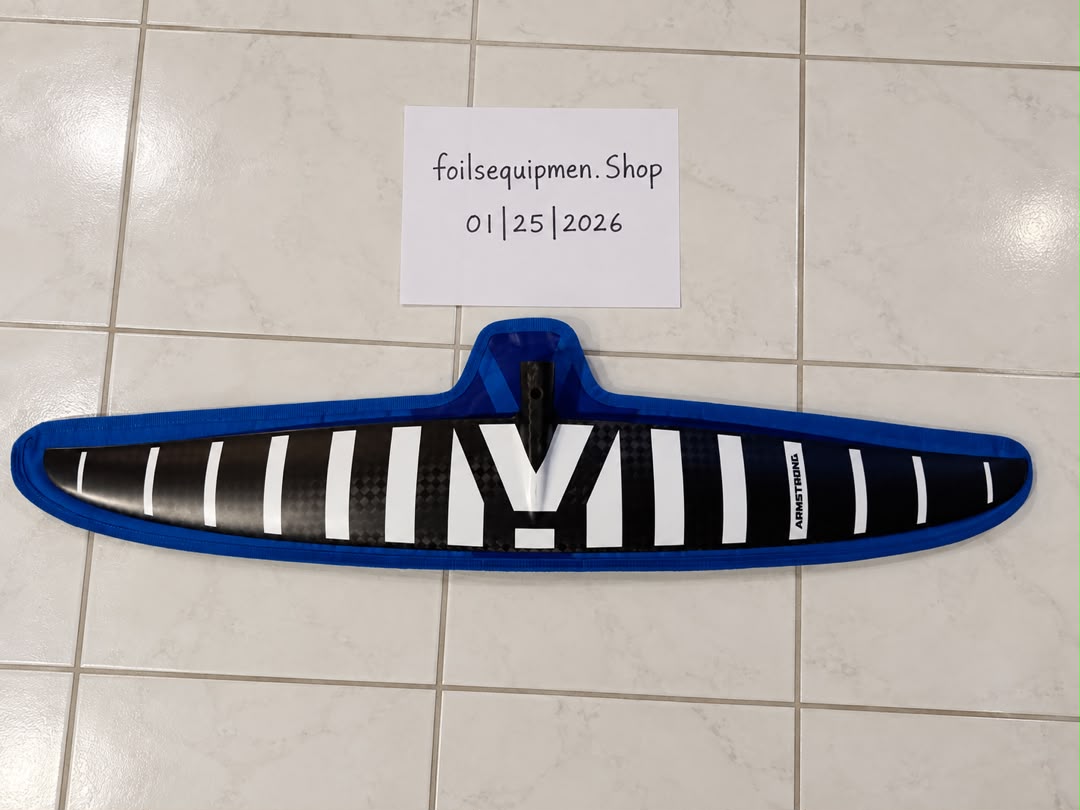

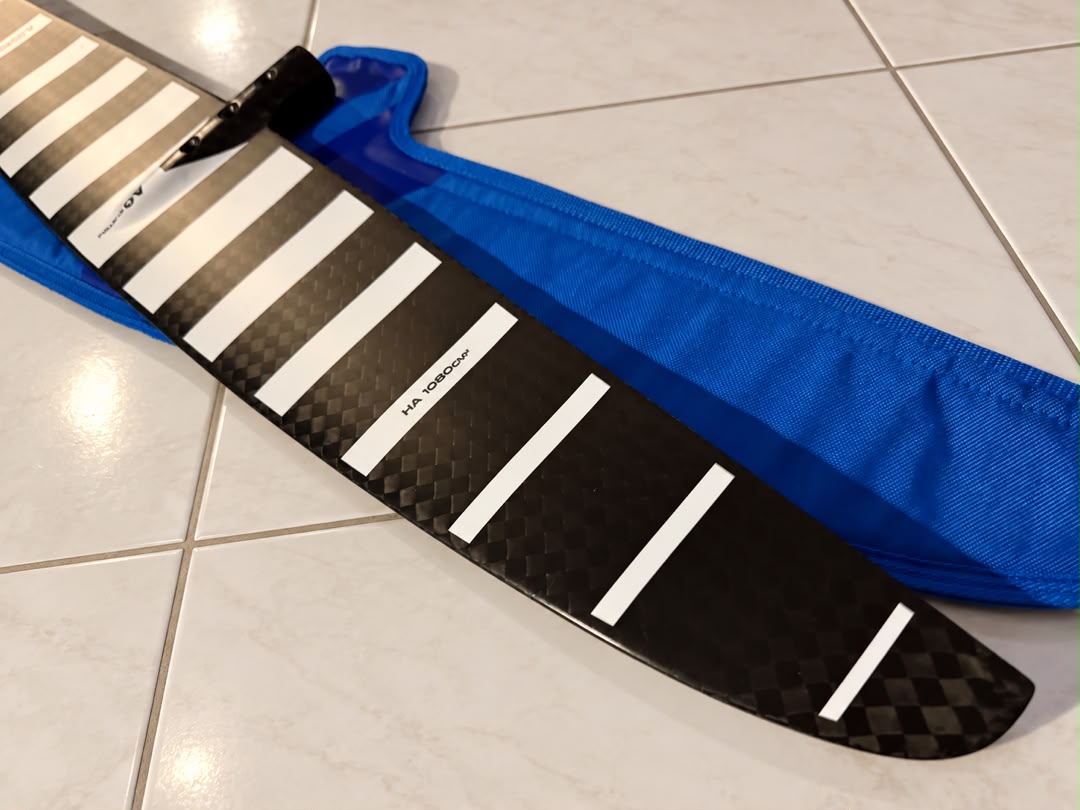
HA1080
€300.00
The Armstrong HA1080 front foil is offered in excellent condition and has been carefully inspected by a professional to confirm its overall quality, condition, and readiness for use. No damage, repairs, cracks, tears, or structural issues have been identified. The foil has been well maintained and is ready to be used again.
Every included component has been carefully checked, including the front wing, mounting areas, connection points, and hardware. The leading edge, trailing edge, surface, and attachment areas have been inspected for signs of impact, excessive wear, or previous repairs. The overall condition has been found to be excellent.
Included components:
- Armstrong HA1080 front foil
- Front-wing mounting interface
- Compatible connection hardware
- Mounting screws and bolts
- Fittings and attachment hardware included with the foil
No cracks, repairs, tears, or significant structural damage are present. The foil remains clean, well maintained, and ready for its next sessions.
The Armstrong HA1080 is ready to use again and can provide many more sessions when correctly assembled and maintained. A final pre-use inspection should always be completed before entering the water, ensuring that all hardware is properly secured and the complete foil configuration is compatible.
This is an excellent opportunity to obtain a professionally inspected Armstrong HA1080 in outstanding condition, ready for continued use and many more sessions.
Description
Armstrong HA1080 Front Foil – High-Aspect Performance for Surf, Wing and Downwind Foiling
Designed for riders who are seeking an efficient combination of glide, low-speed lift, pumping ability, and responsive turning, the HA1080 has been developed as a high-aspect front foil within the Armstrong HA range. A versatile performance platform is provided for intermediate to expert riders, while a balance between early lift and efficient high-speed flight is maintained
With an area of 1080 cm², a 1020 mm wingspan, and a 9.63 aspect ratio, the HA1080 has been positioned toward the larger end of the HA range. Consequently, useful low-speed support can be achieved while the high-aspect outline is retained for efficient glide and responsive handling.
High-Aspect Design for Efficient Foiling
The Armstrong HA1080 has been engineered around the principle that high-aspect performance does not have to mean difficult low-speed handling. Instead, substantial lift and efficient glide have been combined with a responsive turning character.
An evolutive foil section is incorporated across the span, allowing water flow to be optimized at different points along the wing. Furthermore, a relatively flat profile is used to support responsive turning during carves.
As a result, the HA1080 can be used for riders who want to connect turns smoothly while maintaining efficient foil flight. Armstrong positions the HA range for surf, wing, and downwind foiling, making the HA1080 a versatile option for riders who want one front wing capable of covering multiple disciplines.
Key Product Highlights
- Armstrong HA1080 high-aspect front foil
- 1080 cm² front-wing area
- 1020 mm wingspan
- 9.63 aspect ratio
- Carbon construction
- High-aspect performance profile
- Early lift for its size
- Efficient long-distance glide
- Responsive carving and turning
- Designed for pumping and wave connection
- Suitable for surf, wing, and downwind foiling
- Armstrong A+ System compatibility
- Developed for intermediate to expert riders
Early Lift With Efficient Glide
Low-speed performance is particularly important when a rider is trying to get onto foil efficiently. Therefore, the HA1080 has been designed to provide strong lift for its size while retaining the advantages associated with a high-aspect profile.
Because substantial lift is generated at relatively low speeds, a rider can be provided with a wider usable range. Consequently, less time can be spent waiting for ideal conditions, while more time can be dedicated to riding and progressing.
Once airborne, the high-aspect geometry becomes increasingly valuable. Efficient glide can be maintained between power sources, allowing the foil to carry speed and momentum with reduced reliance on continuous pumping.
This characteristic can be particularly beneficial during downwind and surf sessions, where maintaining connection with moving swell or wave energy is important.
Responsive Turning and Carving Performance
High-aspect foils are often selected for their glide efficiency, but maneuverability is equally important for riders who enjoy dynamic foiling. For this reason, the HA1080 has been designed with a profile intended to provide smooth and responsive turning.
During a carve, controlled pressure can be applied through the rider’s stance, allowing the foil to roll progressively. As a result, smoother arcs and more connected turns can be achieved.
Furthermore, the wing’s high-aspect outline can provide efficient flight between turns. Instead of losing substantial speed during every maneuver, momentum can be retained more effectively when the rider’s technique and conditions are suitable.
The result is a front foil that is intended to combine the glide associated with high-aspect designs with a more engaging turning experience.
Advanced Pumping Capability
Pumping is another area where the HA1080 can provide significant value. A well-designed high-aspect foil can retain energy efficiently, allowing rider input to be converted into continued forward movement.
Through coordinated movements of the legs and body, pumping can be used to maintain foil height and speed. Moreover, the efficient foil section can help reduce energy losses between movements.
This makes the HA1080 particularly attractive for riders who want to develop more efficient pumping technique. As skills improve, longer connections between waves or swell lines can be attempted.
Toray Carbon Construction
A high-aspect foil is subjected to significant forces during aggressive carving and high-speed riding. Therefore, stiffness and structural integrity are particularly important.
The HA range has been constructed from premium Toray high- and intermediate-modulus carbon fibre. As a result, a combination of stiffness, strength, and relatively low weight is provided.
The carbon construction is intended to create a direct and responsive feeling beneath the rider. Furthermore, the consistency of the construction is designed to support predictable performance during repeated use.
Armstrong A+ System Integration
The HA1080 has been developed around Armstrong’s A+ System, which is used to connect the mast, fuselage, front foil, and stabilizer. This modular approach allows compatible components to be combined into different foil configurations.
Consequently, riders can adjust their setup according to discipline, conditions, and personal preference. A suitable mast and stabilizer can be selected to influence stability, maneuverability, speed, and overall handling.
The modular construction also makes the HA1080 a useful component for riders who are building or expanding an Armstrong foil quiver.
Ideal Applications for the HA1080
Versatility is one of the strongest characteristics of this front foil. Therefore, the HA1080 can be considered for several forms of advanced foiling.
Surf Foiling
In surf conditions, efficient glide and smooth turning can be highly valuable. The HA1080 has been designed to remain efficient between sections while providing responsive handling through turns.
As a result, riders can be supported when connecting wave energy and maintaining flight through smaller or less powerful sections.
Wing Foiling
For wing foiling, the HA1080 can provide a combination of lift, glide, and maneuverability. Once adequate speed has been generated, efficient flight can be maintained while carving and transitioning.
The appropriate board, mast, stabilizer, and wing should nevertheless be selected according to rider weight and conditions.
Downwind Foiling
Downwind foiling places strong emphasis on glide efficiency and energy retention. Therefore, the HA1080 can be particularly attractive for experienced riders who want to connect swell lines with less pumping.
The high-aspect profile is intended to maintain efficient flight, while the available low-speed lift can make the foil more accessible across a broader range of conditions.
Suitable Rider Profile
The HA1080 is primarily intended for riders who have already developed a reliable foundation in foil control. Intermediate and expert riders can benefit from its combination of lift, glide, and maneuverability.
Beginners may find a smaller high-aspect wing or a more stability-focused foil easier to control depending on body weight, board selection, and conditions. Therefore, rider ability should always be considered before selecting a performance front wing.
For experienced riders, however, the HA1080 can provide substantial room for progression.
Why Choose the Armstrong HA1080?
The Armstrong HA1080 has been designed to deliver a distinctive combination of characteristics that are not always found together in high-aspect foils. Strong low-speed lift is combined with efficient glide, while responsive turning and pumping capability are also emphasized.
Its 1080 cm² area, 1020 mm span, and 9.63 aspect ratio provide a clear performance profile, while the carbon construction and A+ System integration create a strong foundation for a modular foil setup.
For riders who want to surf longer lines, connect swell efficiently, improve pumping technique, or explore more dynamic wing foiling, the HA1080 provides a versatile performance option.
A High-Performance Front Foil for Progressive Riders
The Armstrong HA1080 represents a refined approach to high-aspect foil design. Rather than focusing exclusively on speed or glide, a broader performance balance has been created.
Early lift is provided for easier takeoff, while efficient glide is maintained once the foil is airborne. Meanwhile, responsive turning allows the wing to remain engaging during carving and dynamic maneuvers.
With its carbon construction, high-aspect geometry, and Armstrong A+ System compatibility, the HA1080 is well suited to riders who are ready to progress toward more efficient and technically rewarding foiling.
For intermediate and experienced riders seeking glide, lift, pumping efficiency, stability, and responsive carving in one front foil, the Armstrong HA1080 can be a highly capable addition to a performance-oriented foil setup.
Armstrong HA1080 Front Foil – Glide Efficiency, Control and Advanced Riding
Designed for Efficient Long-Distance Foiling
Longer and more efficient foil rides are being sought by riders who want to travel farther while using less energy. Therefore, the Armstrong HA1080 has been designed around efficient glide, responsive handling, and useful low-speed lift.
A high-aspect planform is incorporated into the wing, allowing reduced induced drag to be achieved during flight. As a result, speed can be maintained more efficiently once the foil has been lifted from the water.
Furthermore, the relatively large 1080 cm² surface area provides useful support during takeoff and lower-speed riding. This combination allows the wing to be used across different conditions while still retaining the performance characteristics expected from a high-aspect foil.
Smooth Takeoffs and Controlled Acceleration
Getting onto foil efficiently can make a significant difference to the overall riding experience. Because of this, the HA1080 has been designed to provide substantial lift without requiring excessive speed.
During takeoff, the front wing is able to generate lift as acceleration is developed. Consequently, a controlled transition from displacement mode to foil flight can be achieved when the setup has been correctly matched to the rider.
Once the foil has risen clear of the water, acceleration can be maintained progressively. Moreover, the efficient profile allows speed to be carried forward without requiring constant rider input.
This characteristic can be particularly useful for riders who are developing advanced foil techniques and want a front wing that can provide both accessible lift and efficient flight.
High-Aspect Geometry for Improved Glide
The defining characteristic of the Armstrong HA1080 is its high-aspect geometry. A long wingspan is combined with a relatively narrow chord, creating an efficient platform for sustained foil flight.
Because drag can be reduced through high-aspect geometry, longer glides can be achieved when suitable conditions are available. Consequently, riders can remain airborne across greater distances between sources of energy.
This efficiency is especially valuable during downwind foiling. Swell lines can be connected more effectively, while momentum can be preserved between bumps.
Additionally, efficient glide can benefit surf and wing foiling. When wave energy decreases, the foil can continue moving forward while the rider searches for the next usable section.
Responsive Handling During Carving
Efficiency does not have to come at the expense of maneuverability. Therefore, the HA1080 has been shaped to provide a responsive feeling during turns while maintaining its high-aspect characteristics.
As pressure is shifted through the rider’s stance, the foil can be rolled into a carve. Smooth control inputs can then be used to regulate the turn radius and maintain foil height.
Furthermore, the wing can be used for linking turns where speed retention is important. Instead of allowing excessive energy to be lost through every maneuver, efficient flight can be maintained when appropriate technique is applied.
For experienced riders, this can create a more fluid and connected riding style.
Pumping Efficiency for Extended Connections
Pumping can be used to maintain foil flight when external energy becomes limited. Because of its efficient design, the HA1080 can be suited to riders who want to develop this technique.
Controlled movements can be transferred through the foil, allowing energy to be generated and retained during repeated pumping cycles. As a result, longer connections can potentially be achieved between waves, swell lines, or other sources of energy.
Moreover, efficient pumping can reduce the physical effort required to maintain flight over distance. This can be particularly valuable during longer sessions where energy conservation becomes increasingly important.
Progressive technique should nevertheless be used, as effective pumping depends heavily on rider timing, foil setup, and environmental conditions.
Performance Across Multiple Foiling Disciplines
Versatility is an important advantage of the Armstrong HA1080. Rather than being restricted to one specific style of riding, the wing can be considered for several advanced foil disciplines.
Wing Foiling
During wing foiling, a balance between lift and glide is required. The HA1080 can provide strong support during takeoff while its high-aspect profile can be used for efficient cruising.
Furthermore, carving and transitions can be incorporated as rider experience develops.
Surf Foiling
Surf foil riders can benefit from efficient glide when wave energy becomes weaker. The HA1080 can be used to connect sections and maintain flight between more powerful areas of the wave.
Its responsive characteristics can also be appreciated during controlled carving.
Downwind Foiling
Downwind riding places particularly strong demands on glide efficiency. Therefore, the HA1080 can be an attractive option for experienced riders who want to maintain momentum while connecting moving swell.
Its larger surface area can also provide useful lift when speeds vary during a downwind run.
Importance of Matching the Complete Foil Setup
Front-wing performance is influenced by more than the front wing itself. Therefore, the HA1080 should be matched carefully with the appropriate mast, fuselage, stabilizer, board, and riding conditions.
A stabilizer can significantly influence pitch stability and turning response. Meanwhile, mast length and stiffness can affect control and overall riding characteristics.
Board volume and dimensions should also be considered. A larger board may provide greater stability during takeoff, whereas a smaller performance board can offer a more responsive experience once sufficient skill has been developed.
Consequently, the best results will be achieved when the complete foil system is selected as one integrated configuration.
Suitable for Rider Progression
Progression is often achieved when equipment is capable of supporting increasingly advanced techniques. Because of this, the Armstrong HA1080 can be valuable for riders who want to continue developing their skills.
Initially, attention can be placed on controlled takeoffs and stable foil flight. Once those fundamentals have been established, carving, pumping, transitions, and longer glides can be introduced.
Furthermore, the efficient nature of the wing can encourage riders to improve their energy management. Instead of relying entirely on constant power, greater attention can be placed on maintaining speed and using available environmental energy efficiently.
Stability Without Excessive Bulk
A larger front-wing area can provide useful lift, but excessive size can sometimes reduce responsiveness. Therefore, the HA1080 has been positioned as a performance-oriented option where lift and maneuverability are intended to remain balanced.
The high-aspect geometry allows substantial area to be provided without creating an excessively wide chord. As a result, useful lift can be combined with a relatively efficient planform.
This design can be particularly appealing to riders who want more lift than smaller high-aspect wings provide while still maintaining a performance-oriented handling character.
Construction and Handling Quality
High-performance foil components are subjected to considerable forces during takeoffs, landings, carving, and impacts. Therefore, proper equipment care should always be prioritized.
The HA1080 is built around a performance-focused carbon construction, with stiffness being an important characteristic of the design. A stiff front wing can provide more direct feedback and more precise transfer of rider input.
Before every session, the leading edge, trailing edge, mounting interface, and surrounding structure should be inspected. Additionally, all compatible hardware should be installed and secured according to manufacturer recommendations.
Maintenance for Consistent Performance
Proper maintenance should be performed after each session. Salt and sand should be removed from the equipment, while all components should be allowed to dry before storage.
Particular attention should be given to mounting screws and connection points. Furthermore, the front wing should be protected from unnecessary impacts when it is being transported or stored.
Any crack, deformation, unusual movement, or structural damage should be treated as a reason to stop using the equipment until it has been appropriately assessed.
Through careful maintenance, the intended performance and service life of the foil can be better preserved.
Key Advantages at a Glance
- 1080 cm² front-wing area
- High-aspect 9.63 geometry
- 1020 mm wingspan
- Efficient long-distance glide
- Strong lift for its performance category
- Responsive carving characteristics
- Effective pumping potential
- Suitable for wing, surf, and downwind foiling
- Performance-oriented carbon construction
- Designed for experienced and progressing riders
- Compatible with the Armstrong A+ System
- Versatile foundation for customized foil setups
A Versatile Tool for Advanced Foil Progression
The Armstrong HA1080 has been designed for riders who want to combine efficient glide with useful lift and responsive handling. Its high-aspect geometry provides a foundation for long-distance efficiency, while its 1080 cm² area supports controlled takeoffs and lower-speed flight.
Furthermore, carving and pumping performance are incorporated into the overall design philosophy, allowing the wing to remain engaging during dynamic riding.
Whether downwind runs are being explored, surf connections are being extended, or wing-foil progression is being pursued, the HA1080 can provide a versatile platform for experienced riders.
When matched correctly with a compatible mast, fuselage, stabilizer, and board, a balanced and highly capable foil system can be created. Consequently, the Armstrong HA1080 can serve as a valuable performance front wing for riders who are seeking greater glide efficiency, improved energy retention, and continued progression on the water.
Armstrong HA1080 Front Foil – Advanced Performance, Versatility and Riding Applications
Refined Performance for Experienced Foil Riders
Greater efficiency is often demanded as foil-riding skills continue to develop. Consequently, the Armstrong HA1080 has been created to provide a high-performance balance between lift, glide, maneuverability, and pumping efficiency.
A high-aspect planform is used to reduce drag and promote efficient flight. At the same time, a substantial 1080 cm² area is provided so that useful lift can be generated at comparatively lower speeds.
Because of this combination, the HA1080 can be used across several advanced foiling disciplines. Furthermore, its characteristics can be adapted through mast, stabilizer, board, and rider setup.
Efficient Glide Between Energy Sources
Long-distance foil riding is strongly influenced by how efficiently momentum can be preserved. Therefore, the HA1080 has been designed to carry speed effectively between sources of power.
When a wave or swell begins to lose energy, the efficient foil profile can help maintain forward movement. As a result, the rider can be provided with additional time to identify and connect with the next available section.
This characteristic can be especially valuable during downwind foiling. Instead of relying exclusively on continuous pumping, available swell energy can be used more efficiently.
Moreover, glide efficiency can be appreciated during surf foiling and wing foiling when gaps between sections need to be crossed.
Dynamic Carving for Progressive Riders
Carving performance is an important part of advanced foiling. Because of this, the Armstrong HA1080 has been developed with a responsive profile that can support controlled turning.
When weight is transferred progressively, the foil can be rolled into a turn. The rider’s stance can then be adjusted to control pitch and direction.
Furthermore, the high-aspect design allows speed to be retained effectively when a carve is exited. Consequently, linked turns can be developed with less interruption to the overall flow of the ride.
The precise response will depend on the complete foil system and rider technique, but the HA1080 provides a strong platform for riders who want to develop more dynamic handling.
Downwind Foiling Applications
Downwind foiling requires efficient glide, controlled acceleration, and the ability to connect moving energy sources. Therefore, the HA1080 can be considered for experienced riders who are developing this discipline.
Its high-aspect configuration is designed to support efficient flight between bumps. Meanwhile, the 1080 cm² surface area can provide useful lift when speeds vary.
As the rider moves across the water, subtle pumping and weight transfers can be used to maintain foil height. Furthermore, the efficient profile can help preserve momentum when the next swell is being approached.
Because downwind conditions can change rapidly, suitable experience, safety equipment, and appropriate environmental conditions should always be maintained.
Surf Foiling and Wave Connection
In surf foiling, the ability to remain airborne through weaker sections can be extremely valuable. Consequently, the Armstrong HA1080 can be used as part of a setup intended for efficient wave connection.
After takeoff, the foil can be guided through the wave using controlled weight shifts. When a section becomes less powerful, the high-aspect design can assist with maintaining forward momentum.
Additionally, the responsive handling can be used for carving across the face of suitable waves. As experience increases, longer connections and more complex lines can be explored.
Wave size and power should always be matched to rider ability and foil configuration.
Wing Foiling Performance
The HA1080 can also be incorporated into an advanced wing-foil setup. Because lift, glide, and maneuverability are combined, a broad range of riding possibilities can be supported.
During takeoff, the relatively large wing area can provide useful lift. Once foil height has been established, efficient cruising can be maintained while the rider manages the wing and board.
Furthermore, carving and transitions can be developed as experience increases. The high-aspect geometry can provide an efficient platform for riders who prefer longer glides and responsive handling.
The final characteristics will depend on the rider’s weight, board volume, wing size, mast selection, stabilizer, and environmental conditions.
Pumping and Energy Conservation
Efficient pumping can be particularly valuable when external power becomes limited. Therefore, the HA1080 can be used by riders who want to improve their ability to maintain foil flight through controlled body movements.
A high-aspect foil can retain energy efficiently between pumping movements. Consequently, less effort may be required to maintain forward momentum once the correct technique has been established.
Moreover, pumping can be combined with wave or swell energy to create longer connections. This can make the HA1080 an interesting option for riders who want to explore more efficient movement across the water.
Customization Through the Armstrong A+ System
The performance of a front foil is strongly influenced by the rest of the equipment. Therefore, the HA1080 can be integrated into an Armstrong A+ System configuration using compatible components.
Different mast and stabilizer combinations can alter the overall handling characteristics. For example, a stabilizer can influence pitch control, turning response, and stability, while mast selection can influence clearance and leverage.
Board characteristics also have an important role. A stable board can make takeoffs easier, whereas a smaller board may provide a more responsive riding experience.
Consequently, the HA1080 can serve as a foundation around which a personalized foil system can be developed.
Transport and Storage Considerations
Performance equipment should be protected carefully when it is not being used. Therefore, the Armstrong HA1080 should be transported using suitable protective equipment.
The front wing should be protected from hard surfaces and accidental impacts, particularly around the leading and trailing edges. Furthermore, unnecessary pressure should not be placed on the wing during storage.
After salt-water use, the foil should be rinsed with fresh water and dried thoroughly. Hardware and connection points should also be checked before the next session.
These simple practices can help maintain the equipment’s appearance and performance over time.
Pre-Session Inspection
A complete inspection should be performed before every use. Particular attention should be given to the leading edge, trailing edge, mounting points, screws, and connection surfaces.
Any visible crack, deformation, unusual movement, or impact damage should be addressed before the foil is used. Additionally, all mounting hardware should be installed and tightened according to the appropriate manufacturer’s specifications.
Because high-performance foil equipment can experience substantial loads, proper inspection should never be overlooked.
Benefits for Progressive Riders
The Armstrong HA1080 can provide several advantages for riders who have already developed reliable foil fundamentals.
- Efficient high-aspect glide for longer connections
- 1080 cm² surface area for useful lift
- 1020 mm wingspan for efficient foil performance
- 9.63 aspect ratio for a performance-oriented profile
- Responsive turning for carving and dynamic riding
- Pumping potential for maintaining foil flight
- Versatile applications across wing, surf, and downwind foiling
- A+ System integration for compatible Armstrong setups
- Carbon construction for stiffness and direct handling
- Progression-focused design for experienced riders
Who Should Consider the HA1080?
The Armstrong HA1080 is best suited to riders who have already developed dependable foil control and are ready to explore greater glide efficiency and responsiveness.
Intermediate riders with solid fundamentals may use it as a progression platform, while experienced riders can take advantage of its performance characteristics across multiple disciplines.
Beginners may benefit from a more stability-oriented foil before moving to a high-aspect design. Therefore, rider experience and body weight should always be considered before equipment selection.
A Complete Performance-Oriented Front Wing
The Armstrong HA1080 has been developed to provide more than simple lift. A combination of efficient glide, responsive carving, pumping capability, and multi-discipline versatility is offered.
For downwind riders, efficient energy retention can be valuable. For surf foilers, longer wave connections can be pursued. Meanwhile, wing foilers can benefit from a combination of lift and efficient cruising.
Furthermore, the foil can be integrated with compatible Armstrong components to create a setup tailored to individual preferences.
Final Product Overview
The Armstrong HA1080 represents a high-aspect front foil designed for riders who want to progress toward more efficient and dynamic foiling. Its 1080 cm² area, 1020 mm wingspan, and 9.63 aspect ratio provide a performance-oriented platform where lift and glide are balanced with maneuverability.
Through its efficient geometry, responsive handling, and pumping potential, the HA1080 can support a variety of advanced applications. Moreover, compatibility with the Armstrong A+ System allows the complete setup to be customized through appropriate mast, stabilizer, and board selection.
For riders seeking efficient glide, useful lift, responsive carving, and versatile performance, the Armstrong HA1080 provides a capable foundation for continued progression and exploration on water.


Reviews
There are no reviews yet.