

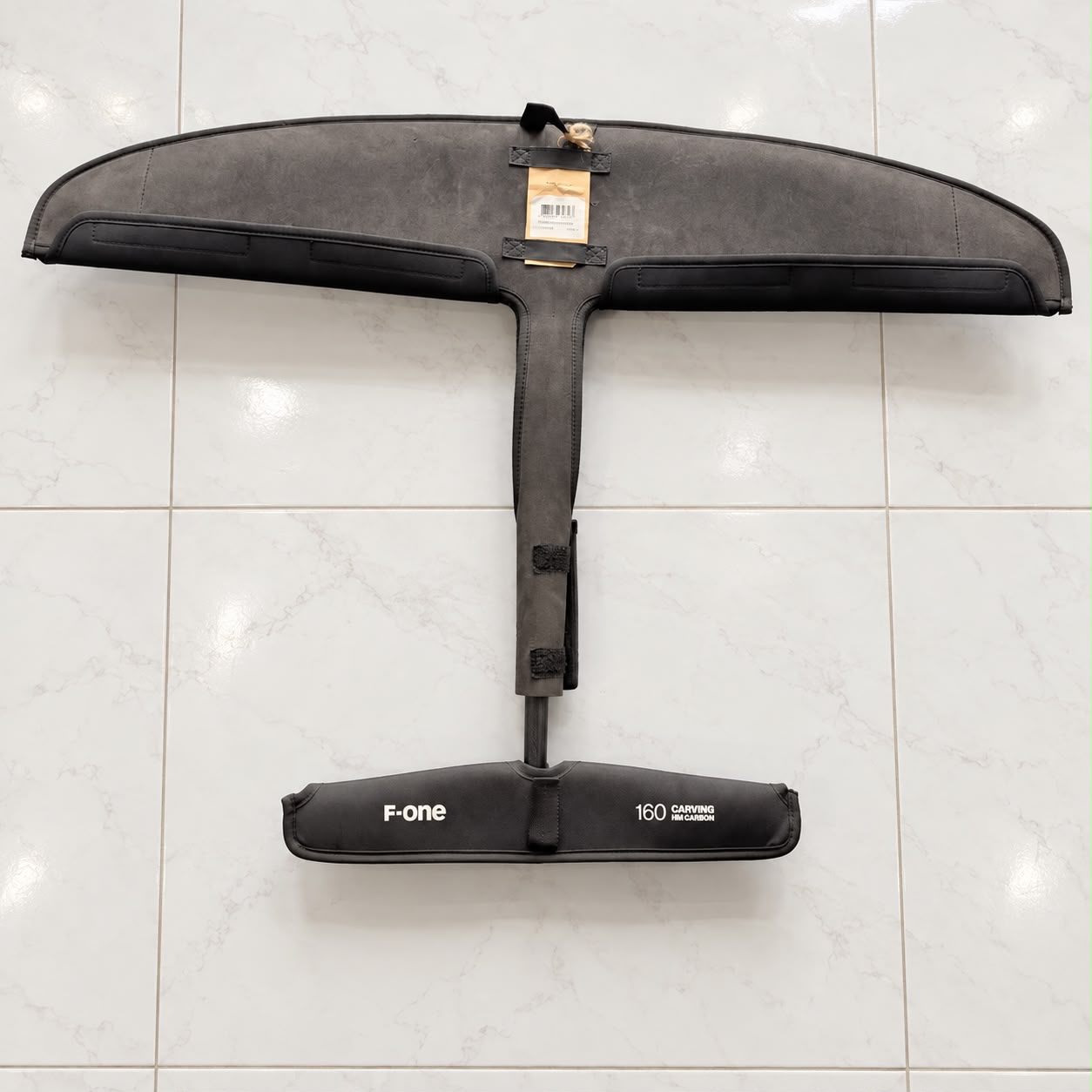
F One SK8 850 / C160 Foil Set
€600.00
The F-One SK8 850 / C160 Foil Set is offered in excellent condition and has been professionally inspected to confirm its overall quality, condition, and readiness for use. It has been carefully checked and is reported to have no damage, no repairs, no cracks, no tears, and no significant structural defects. It has been well maintained and is ready for many more foiling sessions and jumps again.
Every major component has been carefully inspected, including the SK8 850 front wing, C160 component, mast, fuselage, stabilizer, mounting surfaces, connection points, bolt holes, threads, and hardware. The complete setup has also been checked for previous repairs, impact marks, excessive wear, deformation, corrosion, and other visible issues.
Included components:
- F-One SK8 850 front wing
- C160 foil component
- Mast
- Fuselage
- Rear stabilizer
- Mounting hardware
- Bolts and connection hardware
- Protective/storage bag, if included
- Other included accessories
No tears, repairs, cracks, or significant damage have been identified. The foil remains clean, solid, well maintained, and ready for use.
The F-One SK8 850 / C160 Foil Set is ready to use and ready for many more foiling sessions, carving, pumping, wave riding, and jumps again. It is an excellent option for riders looking for a responsive and versatile foil setup. A qualified professional should always complete the appropriate pre-use inspection before returning safety-critical equipment to the water.
Description
F One SK8 850 / C160 Foil Set
F-One SK8 850 / C160 Foil Set
The F-One SK8 850 / C160 Foil Set has been designed for riders seeking an efficient, responsive, and versatile foil configuration for modern water foiling. By combining the SK8 850 front wing with the C160 configuration, a balanced platform can be provided for riders who value glide, acceleration, maneuverability, and precise control
A performance-oriented setup is offered for riders who want to progress beyond basic foiling while maintaining a manageable and responsive feel. Furthermore, the configuration can be considered for wing foiling, freeride sessions, carving, pumping, wave riding, and other suitable foil disciplines.
Performance-Oriented Foil Design
The SK8 platform has been developed around efficient hydrodynamics and responsive handling. As the front wing moves through the water, lift is generated progressively, allowing the rider to transition from board contact into controlled foil flight.
Consequently, the foil can provide an engaging connection between rider and water. Smooth control inputs can then be used to influence direction, pitch, roll, and speed.
Key Product Highlights
- F-One SK8 850 / C160 Foil Set
- SK8 850 front wing
- C160 foil configuration
- Performance-oriented foil system
- Efficient lift generation
- Responsive handling
- Smooth acceleration
- Strong glide potential
- Precise carving
- Pumping capability
- Wing-foiling applications
- Wave-riding potential
- Freeride versatility
- Suitable for progression
- Compact performance-focused setup
SK8 850 Front Wing
The SK8 850 provides the primary lifting surface of the foil system.
As water flows across the front wing, hydrodynamic lift is generated. Consequently, the board can rise above the water once sufficient speed has been achieved.
The 850-class configuration can provide a useful balance between lift and maneuverability. Therefore, it can be attractive to riders who want a responsive setup without moving toward an excessively large front wing.
Efficient Lift
Efficient lift is important for maintaining controlled foil flight.
As the rider accelerates, the front wing begins producing increasing amounts of lift. Consequently, takeoff can be achieved progressively.
Once airborne, the rider can maintain foil height through careful weight distribution and pitch control.
Acceleration
Acceleration contributes significantly to foil performance.
As forward speed increases, the foil can become increasingly efficient. Consequently, the rider can establish stable flight and maintain momentum.
The final acceleration characteristics will depend on rider weight, board design, mast configuration, stabilizer choice, and environmental conditions.
Glide Performance
Glide is particularly valuable when propulsion becomes inconsistent.
As the rider moves across the water with reduced power, the front wing can continue producing lift while forward momentum is preserved.
Consequently, longer connections can be achieved during suitable freeride, swell, and wave sessions.
Responsive Handling
Responsive handling allows the rider to make precise directional changes.
As pressure is transferred through the board and mast, the foil responds to the rider’s movements.
Consequently, carving, transitions, and controlled direction changes can be performed more naturally.
Carving
Carving is one of the areas where a responsive foil setup can become particularly rewarding.
As the rider leans into a turn, the foil can roll progressively.
Consequently, smooth arcs can be maintained while speed is carried through the maneuver.
The final turning response will be influenced by the complete foil configuration and rider technique.
Tight Turns
Tighter turns require greater control over roll and pitch.
As the rider increases pressure through the board, the foil can be directed more aggressively.
Consequently, tighter riding lines can be developed by experienced riders.
Pumping
Pumping can be used to maintain momentum when external propulsion decreases.
As the rider coordinates movements through the board and foil, additional acceleration can be generated.
Consequently, flight can potentially be maintained through weaker sections.
Pumping performance depends heavily on rider technique and the complete foil configuration.
Wing Foiling
The F-One SK8 850 / C160 Foil Set can be incorporated into a suitable wing-foiling setup.
As the hand-held wing provides forward propulsion, the board accelerates.
Consequently, the front foil can generate enough lift to establish flight.
Once airborne, the rider can depower or reposition the wing while the foil provides the majority of the hydrodynamic lift.
Freeride Foiling
Freeride foiling requires a useful combination of stability, glide, and maneuverability.
As the rider cruises across the water, the foil can provide consistent lift.
Consequently, carving, transitions, pumping, and general exploration can be incorporated into the same session.
Wave Riding
Wave riding places greater emphasis on glide and turning response.
As the rider approaches a wave, the foil can be used to generate speed and establish flight.
Once wave energy becomes available, the rider can reduce reliance on the wing.
Consequently, the foil becomes the primary tool for maintaining movement across the wave.
Swell Riding
Swell riding requires efficient momentum management.
As one swell section weakens, the rider needs to carry sufficient speed toward the next section.
Consequently, efficient foil glide can become extremely valuable.
The SK8 850 can be considered for suitable swell-oriented riding when matched appropriately to rider weight and conditions.
Downwind Applications
Downwind foiling requires efficient glide and precise control.
As the rider connects moving water sections, the foil must maintain sufficient speed and lift.
Consequently, an efficient front-wing configuration can help preserve momentum.
Downwind riding should only be undertaken by suitably experienced riders in appropriate conditions.
Transitions
Foil transitions require accurate coordination.
As the rider changes direction, the foil is rolled while the board follows the new course.
Consequently, gybes and tacks can be developed progressively.
Gybing
During a gybe, the rider must coordinate board movement, foil roll, and wing position.
As the direction changes, the foil can remain engaged beneath the board.
Consequently, a controlled exit can be achieved when the rider maintains appropriate speed.
Jumping
Experienced riders may incorporate suitable foil jumping into their sessions.
As sufficient speed and lift are generated, the board can leave the water.
Consequently, aerial progression can be explored.
Jumping should only be attempted by appropriately trained riders using suitable equipment and adequate water depth.
Pitch Control
Pitch control is essential for maintaining consistent foil height.
As the rider shifts weight forward or backward, the angle of the foil changes.
Consequently, lift and altitude can be adjusted.
Smooth movements should be favored because abrupt corrections can destabilize the system.
Roll Control
Roll control determines how the foil responds during turns.
As lateral pressure is transferred through the board, the foil can roll into the desired direction.
Consequently, carving and directional changes can be controlled accurately.
Mast Integration
The mast provides the structural connection between the board and foil assembly.
As loads are transferred through the mast during acceleration, carving, and jumping, compatibility is essential.
Consequently, the SK8 850 front wing and C160 configuration should be assembled only with compatible components and appropriate hardware.
Board Selection
Board characteristics can strongly influence foil performance.
A larger board can provide greater stability and easier takeoff.
Meanwhile, a smaller board can produce a more dynamic riding experience.
Consequently, the board should be selected according to rider weight, ability, foil configuration, and intended discipline.
Rider Weight
Rider weight should always be considered when configuring the foil.
As rider weight increases, additional lift may be required for comparable takeoff performance.
Consequently, front-wing selection and board choice should be matched to the rider’s complete equipment setup.
Wind Conditions
Wind strength influences the performance of a wing-foil system.
As wind increases, less propulsion may be required from the hand-held wing.
Conversely, lighter conditions may require greater foil efficiency and stronger pumping technique.
Consequently, the SK8 850 / C160 should be matched to appropriate wind and water conditions.
Water Conditions
Flat water can make learning and acceleration easier.
Meanwhile, chop, swell, and waves can require more active control.
Consequently, riders should adjust their technique according to the environment.
Pre-Session Inspection
The complete foil system should be inspected before every session.
Particular attention should be given to:
- Front wing
- C160 component
- Mast connection
- Fuselage connection
- Stabilizer
- Mounting surfaces
- Bolt holes
- Threads
- Hardware
- Leading edge
- Trailing edge
- Wing tips
Consequently, potential equipment problems can be identified before entering the water.
Hardware Maintenance
Foil hardware should be checked regularly.
As repeated loading can affect connections, loose or damaged hardware should not be ignored.
Consequently, appropriate bolts and tightening procedures should always be used according to manufacturer requirements.
Impact Protection
Hard impacts can damage foil components.
As rocks, concrete, shallow water, and other obstacles can cause significant damage, careful handling should be maintained.
Consequently, the foil should be carried carefully and protected during transportation.
Salt-Water Care
After salt-water use, the foil should be rinsed with fresh water.
Furthermore, mounting interfaces should be dried appropriately.
Consequently, salt accumulation around hardware and connections can be reduced.
Sand Protection
Sand should be kept away from threaded connections and mounting interfaces.
As abrasive particles can interfere with proper assembly, mounting areas should be cleaned before installation.
Consequently, reliable component connections can be maintained.
Transportation
The SK8 850 / C160 Foil Set should be transported using suitable protective equipment.
Sharp objects should not be placed directly against the foil.
Consequently, scratches, impact marks, and unnecessary surface damage can be minimized.
Storage
The foil should be stored in a clean and dry location.
Excessive heat, moisture, and prolonged exposure to direct sunlight should be avoided.
Consequently, the components can be better preserved between sessions.
Practical Applications
The F-One SK8 850 / C160 Foil Set can be considered for:
- Wing foiling
- Freeride foiling
- Carving
- Pumping
- Wave riding
- Swell riding
- Downwind foiling
- Foil transitions
- Gybing
- Tacking
- Suitable jumping
- Rider progression
Main Benefits at a Glance
- F-One SK8 850 / C160 Foil Set
- SK8 850 front wing
- C160 configuration
- Efficient lift
- Smooth acceleration
- Strong glide potential
- Responsive carving
- Pumping capability
- Wave-riding potential
- Swell-riding versatility
- Freeride performance
- Wing-foiling applications
- Progression-oriented design
- Performance-focused configuration
Why Choose the F-One SK8 850 / C160?
The F-One SK8 850 / C160 Foil Set can be an excellent choice for riders seeking a responsive foil system that can be used across several modern foiling disciplines.
A practical balance between lift, glide, acceleration, and maneuverability can be achieved when the complete setup is correctly matched.
Furthermore, the 850-class front wing can provide a versatile platform for riders who want to develop more advanced carving, pumping, wave, and freeride techniques.
A Versatile Foil Set for Modern Riders
The F-One SK8 850 / C160 Foil Set offers a performance-oriented configuration for riders who value responsive handling, efficient glide, controlled lift, and versatile application.
Whether it is being used for wing foiling, freeride, carving, pumping, wave riding, swell riding, downwind foiling, or suitable jumping, performance will depend on rider ability, equipment compatibility, water conditions, and correct setup.
For riders seeking an F-One SK8 850 / C160 Foil Set that can support progression while providing an engaging connection with the water, this configuration can be a strong option for a compatible foil system.
Before every session, the front wing, mast, fuselage, stabilizer, mounting surfaces, hardware, and connection points should be inspected carefully. Correct assembly and manufacturer-approved hardware should always be used, and advanced maneuvers should only be attempted when the rider has appropriate training and experience.
F-One SK8 850 / C160 Foil Set – Practical Use and Performance
Practical Riding Experience
A well-matched foil setup can significantly influence the way a rider experiences the water. With the appropriate board, mast position, stabilizer, and riding technique, a responsive foil can be made to feel predictable while still allowing considerable freedom to maneuver.
As speed is gradually developed, the front wing begins generating sufficient lift to raise the board from the surface. Consequently, water resistance is reduced and a smoother sensation can be created.
Once stable flight has been established, the rider can begin concentrating on balance, pitch control, direction, and efficient energy management.
Takeoff Characteristics
Takeoff is one of the first areas where foil configuration becomes noticeable.
As the board accelerates, increasing hydrodynamic lift is generated beneath the front wing. Consequently, the board can rise progressively from the water.
A controlled takeoff should always be preferred over an aggressive launch. By maintaining an appropriate body position and allowing the foil to generate lift naturally, unnecessary instability can be reduced.
Early Flight
During the first moments above the water, pitch control becomes especially important.
As the board rises, the rider should avoid making excessive movements. Consequently, the foil can be allowed to settle into a stable flight attitude.
Small movements through the front and rear foot can then be used to maintain the desired height.
Maintaining Foil Height
Once airborne, consistent foil height can be maintained through subtle weight distribution.
As pressure is transferred toward the front foot, the foil can be encouraged downward. Conversely, additional rear-foot pressure can increase the tendency to rise.
Consequently, the rider can regulate altitude without relying on large movements.
Smooth Acceleration
Acceleration should be developed progressively.
As speed increases, lift increases as well. Consequently, an overly aggressive acceleration can result in excessive rise if the rider is not prepared for the change in lift.
Smooth power application allows the rider to understand how the foil responds.
Slowing Down
Controlled deceleration is equally important.
As speed decreases, lift also changes. Consequently, the rider may need to adjust body position to maintain stable foil flight.
A gradual reduction in speed is generally easier to manage than a sudden loss of power.
Carving Performance
Carving is a major advantage of a responsive foil system.
As the rider leans into a turn, lateral pressure is transferred through the board and mast. Consequently, the foil begins rolling toward the desired direction.
With appropriate technique, a smooth arc can be maintained while speed is carried through the turn.
Long Carves
Long sweeping turns can be used during freeride sessions.
As the rider applies progressive pressure, the foil can follow a broad turning line.
Consequently, speed can be maintained without requiring abrupt steering movements.
This type of riding can be particularly enjoyable on open water and gentle swell.
Tight Carves
Tighter turns require more precise control.
As the rider increases the amount of roll, the foil responds more strongly.
Consequently, tighter arcs can be produced by experienced riders.
However, aggressive turning should only be attempted when sufficient water clearance and rider control are available.
Linking Turns
Turns can be connected into continuous flowing movements.
As one turn is completed, the rider can transfer pressure smoothly into the opposite direction.
Consequently, momentum can be maintained while the foil changes from one side to another.
This technique can improve overall riding efficiency.
Pumping Technique
Pumping can be used to maintain momentum when external power is reduced.
As the rider moves the board through controlled pitch and pressure changes, additional acceleration can be generated.
Consequently, the foil can continue moving through weaker sections of water.
Effective pumping requires timing and coordination rather than excessive force.
Pumping in Flat Water
Flat-water pumping can be used to develop technique.
As the rider repeatedly loads and unloads the foil, momentum can be generated without relying entirely on the wing.
Consequently, balance, timing, and pitch control can be improved.
Pumping Through Swell
Swell provides another environment for pumping practice.
As the foil rises and falls with the water movement, the rider can synchronize body movement with the natural energy of the swell.
Consequently, speed can be maintained through multiple sections.
Wave Riding
Foiling in waves places greater emphasis on glide and turning ability.
As the rider catches a suitable wave, propulsion from the wing can be reduced.
Consequently, the foil becomes the primary source of lift while the rider follows the wave’s energy.
Entering a Wave
Wave entry should be approached with appropriate speed.
As the rider approaches the wave, maintaining a controlled foil height becomes important.
Consequently, the rider can transition onto the wave without allowing the foil to breach the surface.
Riding the Wave Face
Once established on the wave, smooth weight shifts can be used to control direction.
As the rider moves across the wave face, the foil can be carved through changing lines.
Consequently, a fluid riding experience can be created.
Exiting the Wave
An efficient exit can preserve momentum.
As the rider approaches the end of the wave section, the foil can be directed toward open water.
Consequently, another wave or swell section can potentially be connected.
Swell Riding
Swell riding requires the rider to anticipate water movement.
As each swell approaches and passes beneath the board, the foil’s height and direction need to be adjusted.
Consequently, momentum can be maintained without unnecessary pumping.
Downwind Riding
Downwind foiling requires careful speed and energy management.
As the rider travels with moving water, the objective is often to connect one energy source with another.
Consequently, glide efficiency becomes particularly important.
Suitable downwind conditions should be selected according to rider experience and local safety considerations.
Windy Conditions
Wind strength affects the entire foiling system.
As wind increases, the rider may be able to accelerate more quickly when using a compatible wing.
Consequently, foil control becomes increasingly important.
Strong wind should only be approached when the rider has suitable experience and appropriate equipment.
Light-Wind Riding
Light-wind conditions place greater emphasis on efficient takeoff and pumping.
As available propulsion decreases, the rider needs to generate speed efficiently.
Consequently, a suitable foil configuration can help make the most of limited power.
Flat Water
Flat water provides an excellent environment for developing basic foil control.
As surface disturbance is reduced, the rider can focus on pitch, roll, balance, and turning.
Consequently, technique can be developed with fewer environmental variables.
Choppy Water
Choppy water requires more active control.
As the board moves through uneven surface conditions, the foil can experience changing loading.
Consequently, the rider must respond continuously to maintain a stable flight height.
Open-Water Riding
Open water provides space for longer runs and broader turns.
As the rider gains confidence, more advanced carving, pumping, and transition techniques can be introduced.
Consequently, the equipment can be used for a wide range of recreational sessions.
Gybing
Foil gybing requires coordination between the rider, board, foil, and wing.
As the direction is changed, the rider must maintain sufficient speed while controlling foil height.
Consequently, the turn can be completed without allowing the front wing to lose stable water flow.
Foiling Through the Gybe
The most important part of a foil gybe is maintaining controlled flight throughout the direction change.
As the board rolls, the rider should maintain appropriate pitch.
Consequently, the foil can remain submerged and continue generating lift.
Tack Practice
Tacking presents another technical challenge.
As the rider changes direction through the wind, speed and balance must be maintained.
Consequently, the transition can be completed with less risk of touching down.
Tacking should be developed progressively in suitable open-water conditions.
Touchdown Recovery
Occasional touchdowns can occur during learning or changing conditions.
As the board approaches the water, the rider should maintain balance and avoid sudden movements.
Consequently, a controlled return to the surface can be achieved.
Developing the ability to recover from touchdowns is an important part of foil progression.
Breaching Recovery
If the foil rises too high, the front wing may approach the surface.
As water flow becomes disturbed, stability can be reduced.
Consequently, the rider should respond with appropriate pitch control rather than making abrupt corrections.F One SK8 850 / C160 Foil Set
Board Control
The board provides the primary interface between rider and foil.
As foot pressure changes, the foil responds through the mast.
Consequently, precise board control is essential.F One SK8 850 / C160 Foil Set
Foot Position
Foot placement can strongly influence foil behavior.F One SK8 850 / C160 Foil Set
As the rider moves the front or rear foot, pitch and lift can change.F One SK8 850 / C160 Foil Set
Consequently, a balanced stance should be established before attempting advanced maneuvers.
Mast Position
The mast position on the board can influence balance and takeoff characteristics.
As the mast is positioned farther forward or backward, the relationship between the rider’s weight and the foil’s lift changes.F One SK8 850 / C160 Foil Set
Consequently, mast placement should be adjusted carefully and according to the board manufacturer’s recommendations.F One SK8 850 / C160 Foil Set
Stabilizer Influence
The stabilizer contributes to pitch stability and overall foil behavior.F One SK8 850 / C160 Foil Set
As stabilizer size and geometry change, turning response, pitch sensitivity, and cruising characteristics can also change.F One SK8 850 / C160 Foil Set
Consequently, compatible components should be selected for the intended riding style.
Compatibility
All components should be confirmed as compatible before assembly.
The front wing, mast, fuselage, stabilizer, board mounting system, and hardware must work together correctly.F One SK8 850 / C160 Foil Set
Consequently, proper compatibility should always be confirmed rather than assumed.
Hardware Installation
Hardware should be installed using the manufacturer’s recommended specifications.
As foil connections experience repeated loading, incorrect installation can create unnecessary stress.
Consequently, the correct screws, washers, tools, and tightening procedures should be used.
Bolt Inspection
Bolts should be checked before every session.F One SK8 850 / C160 Foil Set
As repeated assembly and disassembly can affect threads and fasteners, unusual resistance, corrosion, or damage should be investigated.F One SK8 850 / C160 Foil Set
Consequently, reliable connections can be maintained.F One SK8 850 / C160 Foil Set
Fuselage Connection
The fuselage connection should be inspected carefully.F One SK8 850 / C160 Foil Set
As the fuselage connects major foil components, its interface is structurally important.
Consequently, loose hardware or visible damage should be addressed before entering the water.
Leading Edge Care
The leading edge should be protected from hard impacts.F One SK8 850 / C160 Foil Set
As the front section of the foil meets the water first, it can be exposed to significant forces during touchdowns.F One SK8 850 / C160 Foil Set
Consequently, shallow-water contact and contact with solid objects should be avoided.
Trailing Edge Care
The trailing edge should also be handled carefully.F One SK8 850 / C160 Foil Set
As it is relatively thin, unnecessary impacts can cause damage.
Consequently, the foil should not be dragged across hard surfaces.F One SK8 850 / C160 Foil Set
Wingtip Protection
Wingtips can be particularly vulnerable during transportation.F One SK8 850 / C160 Foil Set
As they can contact the ground when the foil is placed down, protective handling should be maintained.F One SK8 850 / C160 Foil Set
Consequently, unnecessary scratches and deformation can be prevented.
Fresh-Water Rinsing
After salt-water use, the complete system should be rinsed with fresh water.
As salt can accumulate around hardware and connections, regular rinsing can help reduce corrosion-related problems.F One SK8 850 / C160 Foil Set
Consequently, maintenance can be simplified.
Drying
The foil should be allowed to dry appropriately after rinsing.
As moisture can remain around bolts and mounting interfaces, proper drying can help preserve hardware.F One SK8 850 / C160 Foil Set
Consequently, storage can be performed under better conditions.
Cleaning
Only appropriate cleaning methods should be used.
As abrasive materials can damage surfaces, harsh tools and unnecessary scraping should be avoided.F One SK8 850 / C160 Foil Set
Consequently, the finish can be preserved.F One SK8 850 / C160 Foil Set
Transportation
The foil should be transported in a suitable protective bag or case.
As the front wing and mast can be damaged by hard impacts, they should be protected from other equipment.F One SK8 850 / C160 Foil Set
Consequently, transportation damage can be minimized.F One SK8 850 / C160 Foil Set
Storage
The complete foil set should be stored in a dry and protected location.
As prolonged moisture and heat exposure can affect equipment, appropriate storage conditions should be maintained.F One SK8 850 / C160 Foil Set
Consequently, the foil can remain in better condition between sessions.F One SK8 850 / C160 Foil Set
Professional Inspection
Professional inspection should be considered if the foil has experienced a major impact.
As structural damage may not always be obvious from a visual inspection, qualified assessment can provide additional assurance.F One SK8 850 / C160 Foil Set
Consequently, questionable components should not be returned to use without appropriate evaluation.F One SK8 850 / C160 Foil Set
Safety Preparation
A pre-session inspection should always be completed.F One SK8 850 / C160 Foil Set
Particular attention should be given to:
- Front wing
- Mast
- Fuselage
- Stabilizer
- Mounting plate
- Screws
- Threads
- Wing edges
- Connection points
- Board interface
Consequently, potential problems can be identified before launching.F One SK8 850 / C160 Foil Set
Rider Progression
The foil set can support progression across several stages of riding.F One SK8 850 / C160 Foil Set
Initial Foiling
Balance and pitch control can be developed.F One SK8 850 / C160 Foil Set
Freeride
Longer foil runs and basic carving can be practiced.F One SK8 850 / C160 Foil Set
Carving
More precise turns can be introduced.F One SK8 850 / C160 Foil Set
Pumping
Momentum-management skills can be developed.F One SK8 850 / C160 Foil Set
Wave Riding
Natural water movement can be incorporated.F One SK8 850 / C160 Foil Set
Advanced Foiling
More technical transitions and maneuvers can be explored when appropriate.F One SK8 850 / C160 Foil Set
Consequently, the setup can remain useful as rider ability develops.F One SK8 850 / C160 Foil Set
Who Can Benefit From This Setup?
The F-One SK8 850 / C160 Foil Set can be considered by riders who want a versatile performance-oriented foil configuration.F One SK8 850 / C160 Foil Set
It can be particularly appealing to riders who already have basic foiling skills and want to develop:
- Better carving
- Improved glide
- Pumping technique
- Wave-riding ability
- Swell riding
- Foil transitions
- Directional control
- Overall foil confidence
Important Considerations
The correct equipment configuration depends on rider weight, board volume, water conditions, wind strength, skill level, and intended discipline.F One SK8 850 / C160 Foil Set
As these factors vary considerably between riders, no single setup will perform identically for everyone.F One SK8 850 / C160 Foil Set
Consequently, the front wing, mast, stabilizer, and board should be selected as a complete system.
Why Choose the F-One SK8 850 / C160 Foil Set?
A responsive and versatile foil configuration can be provided through the combination of an 850-class front wing and compatible components.F One SK8 850 / C160 Foil Set
As the rider accelerates, efficient lift can be generated. Once airborne, the system can provide opportunities for carving, pumping, wave riding, swell riding, and freeride progression.F One SK8 850 / C160 Foil Set
Consequently, the setup can be suitable for riders seeking a foil that can evolve with their technique.
Performance With Control
Performance is most useful when it can be controlled.F One SK8 850 / C160 Foil Set
The F-One SK8 850 / C160 Foil Set can provide an engaging balance between lift, glide, responsiveness, and maneuverability when correctly matched to the rider.F One SK8 850 / C160 Foil Set
As technique improves, the rider can explore more efficient takeoffs, longer glides, smoother turns, controlled pumping, and more advanced transitions.F One SK8 850 / C160 Foil Set
A Versatile Foiling Platform
The F-One SK8 850 / C160 Foil Set can be used across a broad range of suitable water-foiling applications.F One SK8 850 / C160 Foil Set
Whether it is being used for wing foiling, freeride sessions, carving, pumping, wave riding, swell riding, downwind riding, transitions, or progression, the overall experience will depend on the rider’s ability, complete equipment configuration, and environmental conditions.F One SK8 850 / C160 Foil Set
Its practical versatility makes it an attractive option for riders who want to develop their foiling skills while maintaining an efficient and responsive connection with the water.F One SK8 850 / C160 Foil Set
Before every session, the front wing, mast, fuselage, stabilizer, mounting hardware, board connection, and all structural interfaces should be inspected carefully. Any component showing cracks, deformation, significant impact damage, abnormal wear, or compromised hardware should be professionally assessed before further use.



Reviews
There are no reviews yet.