
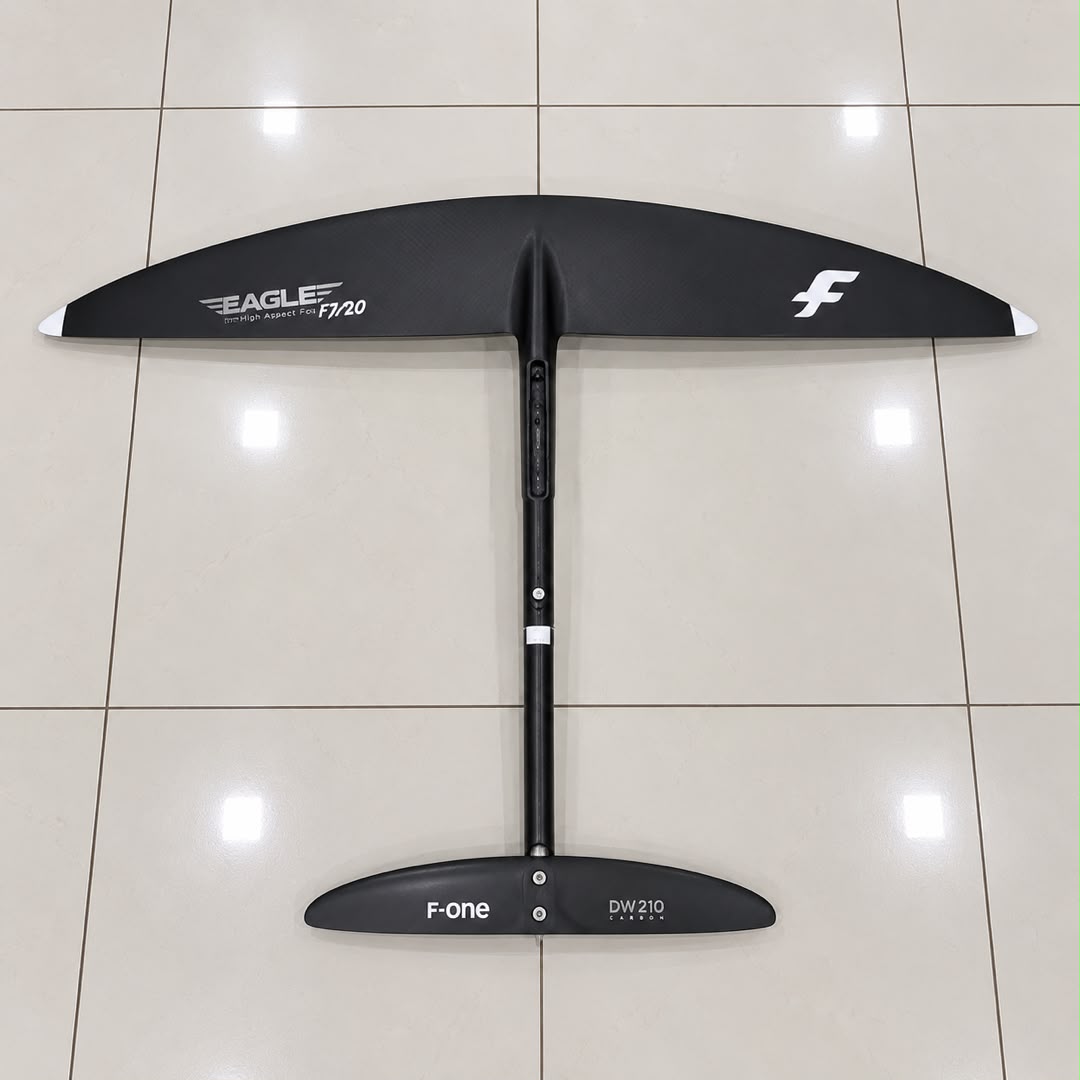

Eagle 1290 + DW HM210
€400.00
The Eagle 1290 + DW HM210 is offered in excellent condition and has been professionally inspected to ensure it is ready for many more foil sessions, jumps, carving, pumping, and adventures on the water. It has been carefully examined and has been confirmed to have no cracks, dents, tears, structural damage, or repair work. The complete setup has been well maintained and handled with care.
Every major component has been thoroughly inspected, including the Eagle 1290 front wing, DW HM210 stabilizer, fuselage connection areas, mounting surfaces, screws, fittings, and included hardware. No tears, cracks, significant damage, or repairs have been identified. The components remain clean, well preserved, and ready to be used again.
Included components:
- Eagle 1290 front wing
- DW HM210 stabilizer
- Fuselage and connection hardware, where included
- Mounting screws and fittings
- Original accessories supplied with the setup
- Protective bag or cover, where included
The Eagle 1290 + DW HM210 is ready to use and can be taken directly to the water for new wingfoil sessions, jumps, carving, pumping, freeride, downwind, and wave-riding adventures. It has been professionally inspected and carefully maintained, making it ready for many more rides and enjoyable sessions.
Description
Eagle 1290 + DW HM210 – High-Performance Foil Setup for Glide, Stability, and Downwind Riding
Efficient Foiling Performance for Progressive Riders
The Eagle 1290 + DW HM210 has been developed as a performance-oriented foil combination for riders seeking efficient glide, controlled lift, speed, and responsive handling. Through the combination of the Eagle 1290 front wing and DW HM210 stabilizer, a balanced platform can be created for advanced wingfoil, downwind, surf foil, and freeride applications
Because efficient flight and long-distance glide are important within modern foiling, the setup can be used when reduced drag, speed retention, and precise control are being prioritized. Furthermore, the combination can be adapted to different riding styles when a compatible mast, fuselage, board, and power source are selected.
Whether long glides, downwind connections, carving, pumping, or performance-oriented wingfoiling are being pursued, the Eagle 1290 + DW HM210 can provide a responsive foundation for demanding sessions.
Product Highlights
- Front Wing: Eagle 1290
- Stabilizer: DW HM210
- Category: Performance foil setup
- Primary focus: Glide, speed, efficiency, stability, and maneuverability
- Suitable applications: Wingfoil, downwind, surf foil, freeride, and pumping
- Riding character: Efficient, responsive, smooth, and performance-oriented
- Ideal for: Riders seeking longer glide and advanced foil control
Eagle 1290 Front Wing
The Eagle 1290 front wing has been designed for riders who want efficient flight while useful lift and stability are maintained. Through its performance-oriented profile, smooth water flow can be achieved while forward momentum is preserved.
Because the wing provides a substantial amount of surface area, controlled lift can be generated without requiring excessive speed. At the same time, the design can remain responsive enough for carving and directional changes.
Consequently, the Eagle 1290 can provide a versatile balance between accessibility and performance.
It can be particularly useful for:
- Early foil takeoffs
- Efficient cruising
- Downwind riding
- Pumping
- Wingfoil freeride
- Wave connections
- Long-distance foiling
DW HM210 Stabilizer
The DW HM210 stabilizer has been selected to complement the Eagle front wing and provide balanced pitch and directional control.
When the stabilizer is combined with the front wing, a predictable flight attitude can be maintained. Furthermore, controlled rider input can be translated into smooth directional adjustments.
The stabilizer can contribute to:
- Pitch stability
- Controlled carving
- Smooth transitions
- Predictable flight
- Efficient cruising
- Responsive handling
As a result, a balanced connection between the front wing and the rest of the foil system can be maintained.
Efficient Glide Performance
Glide efficiency is one of the most important characteristics of a performance foil. The Eagle 1290 + DW HM210 combination can be used when maintaining momentum with minimal unnecessary resistance is desired.
Once sufficient speed has been established, the foil can continue moving efficiently through the water. Consequently, longer unpowered sections can be explored.
This can be especially valuable during:
- Downwind runs
- Freefly riding
- Wave connections
- Pumping
- Wind-swell sessions
- Long foil runs
Furthermore, efficient glide can allow riders to focus more on reading the water and less on continuously generating power.
Downwind Foiling
The Eagle 1290 + DW HM210 can be particularly useful for downwind-focused riding.
During a downwind run, momentum needs to be maintained between bumps and swell sections. Through efficient glide characteristics, the foil can be used to connect moving-water sections while minimizing unnecessary speed loss.
Downwind applications can include:
Swell Connections
The foil can be allowed to glide between moving-water sections.
Pumping
Controlled pumping can be used when additional speed is required.
Directional Control
The stabilizer can help maintain a predictable flight attitude during directional changes.
Long-Distance Riding
Efficient glide can support extended foil runs.
Pumping and Speed Recovery
Pumping can be used to maintain or recover speed when natural energy temporarily decreases.
The Eagle 1290 can provide useful support for pumping because sufficient lift can be maintained while the rider applies controlled movements.
This can be useful during:
- Connecting bumps
- Recovering speed after turns
- Wave riding
- Light-power sections
- Freefly riding
- Downwind transitions
Furthermore, pumping can be developed progressively as riders become more familiar with foil pitch and pressure management.
Stable and Predictable Flight
Controlled foil flight is essential during long sessions. The Eagle 1290 + DW HM210 combination can provide a balanced platform in which lift and pitch control are coordinated.
When rider weight is shifted forward or backward, controlled feedback can be experienced. Consequently, height can be adjusted progressively rather than through abrupt corrections.
This can be beneficial for:
- Long-distance foiling
- Downwind riding
- Wingfoil freeride
- Wave connections
- Pumping
- Carving
Carving Performance
Despite its glide-focused characteristics, the setup can also be used for carving and directional riding.
When pressure is transferred through the board, the foil can be guided progressively through the turn. Furthermore, the stabilizer can provide predictable support as the rider changes direction.
Carving applications can include:
- Flowing turns
- S-turns
- Direction changes
- Wave carving
- Freeride turns
- Technical transitions
As confidence increases, more dynamic turns can be introduced.
Wingfoil Applications
The Eagle 1290 + DW HM210 can be incorporated into a wingfoil setup where efficient glide and responsive control are prioritized.
When paired with a suitable board, mast, and wing, the foil can provide a performance-oriented platform for:
- Freeride wingfoiling
- Light-to-moderate wind sessions
- Freefly
- Carving
- Pumping
- Wave riding
The appropriate wing and board should be selected according to rider weight, wind conditions, and riding ability.
Wave and Surf Foiling
Wave energy can be used effectively when a foil provides sufficient glide and responsive directional control.
The Eagle 1290 can be incorporated into wave-focused setups where connecting sections and maintaining momentum are prioritized.
During wave riding, the foil can support:
- Down-the-line movement
- Wave connections
- Pumping
- Carving
- Speed recovery
- Freefly riding
Moreover, efficient glide can allow riders to remain connected to the wave even when its energy changes.
Speed and Efficiency
Performance foiling often requires a balance between speed and control. The Eagle 1290 + DW HM210 has been designed around efficient forward movement while useful stability is retained.
Once speed has been established, the foil can maintain momentum effectively. Therefore, riders can explore faster riding without sacrificing predictable handling.
This combination can be useful for riders who want:
- Efficient acceleration
- Strong glide
- Controlled high-speed riding
- Reduced drag
- Smooth directional response
Rider Profile
The Eagle 1290 + DW HM210 can be considered by riders who already have established foil-control skills and want to progress toward more performance-oriented riding.
It can be particularly suitable for:
- Intermediate to advanced wingfoilers
- Downwind riders
- Surf foilers
- Freeride foilers
- Pumping enthusiasts
- Long-distance foil riders
Because foil sizing is highly dependent on rider weight and equipment configuration, the complete setup should always be matched to the individual rider.
Complete Foil System Considerations
The final performance of the Eagle 1290 + DW HM210 will depend on the other components being used.
Important factors include:
- Mast length
- Fuselage compatibility
- Board volume
- Board shape
- Wing size
- Rider weight
- Wind conditions
- Intended discipline
Consequently, compatibility should be confirmed before assembly.
Maintenance and Care
Proper maintenance should be provided to preserve the performance and condition of the Eagle 1290 + DW HM210.
After saltwater sessions, freshwater rinsing should be performed. Furthermore, the front wing and stabilizer should be dried thoroughly before storage.
Regular inspections should be made of:
- Front-wing leading edge
- Wing tips
- Stabilizer
- Mast connection
- Fuselage connection
- Mounting hardware
- Screws and fittings
Hard impacts against rocks, concrete, or other solid surfaces should be avoided whenever possible. Additionally, all mounting hardware should be checked before each session.
Key Benefits at a Glance
- Eagle 1290 front wing
- DW HM210 stabilizer
- Efficient glide
- Strong speed retention
- Downwind capability
- Pumping potential
- Responsive carving
- Stable flight characteristics
- Wingfoil versatility
- Wave and surf foil applications
- Performance-oriented design
- Suitable for advanced foil progression
Final Overview
The Eagle 1290 + DW HM210 has been designed for riders who want an efficient combination of glide, lift, stability, speed, and maneuverability.
Through the combination of the Eagle 1290 front wing and DW HM210 stabilizer, a balanced foil platform can be provided for demanding riding. Furthermore, the setup can be adapted to wingfoil, downwind, surf foil, freeride, pumping, and wave-focused applications.
Whether longer glides, improved pumping efficiency, downwind connections, responsive carving, or performance-oriented wingfoil sessions are being pursued, the Eagle 1290 + DW HM210 can provide a capable platform for riders seeking efficient and progressive foil performance.
Eagle 1290 + DW HM210 – Technical Performance, Glide Efficiency, Stability, and Advanced Handling
Refined Hydrodynamic Efficiency
The Eagle 1290 + DW HM210 has been designed as a performance-oriented foil combination in which efficient glide, controlled lift, speed retention, and responsive handling are brought together. Through the interaction between the Eagle 1290 front wing and DW HM210 stabilizer, a balanced flight attitude can be maintained while forward momentum is preserved.
Because efficient water flow is prioritized, reduced resistance can be experienced once suitable speed has been established. Furthermore, the combination can remain responsive during directional changes, making it suitable for riders who want to progress beyond basic foil cruising.
Consequently, the setup can be incorporated into wingfoil, downwind, surf foil, freeride, pumping, and wave-riding applications.
Eagle 1290 Front Wing Characteristics
The Eagle 1290 provides the primary source of lift within the configuration. Its generous surface area allows controlled lift to be generated while relatively moderate speeds are maintained.
Rather than being restricted to high-speed riding, the wing can provide useful support during takeoff, pumping, and slower sections of a foil run.
Key characteristics can include:
- Efficient lift generation
- Smooth acceleration
- Strong glide potential
- Controlled low-speed flight
- Responsive directional handling
- Pumping support
- Downwind versatility
Furthermore, the wing can remain useful as speed increases, allowing riders to transition from controlled cruising toward more dynamic riding.
DW HM210 Stabilizer Characteristics
The DW HM210 has been selected to complement the Eagle 1290 front wing and provide a balanced rear stabilizing surface.
When the stabilizer is correctly matched with the front wing, pitch control can be maintained while directional input remains responsive. Moreover, the stabilizer can help maintain a consistent flight attitude during acceleration, carving, and transitions.
This can contribute to:
- Predictable pitch response
- Smooth directional changes
- Controlled flight height
- Efficient cruising
- Stable carving
- Progressive handling
As a result, a more connected feeling can be provided between rider input and foil response.
Glide Efficiency
Long-distance foiling can be made considerably more efficient when momentum is retained between powered sections.
The Eagle 1290 + DW HM210 can be used when sustained glide is a priority. Once the foil has been accelerated, forward movement can be maintained efficiently while the rider reduces external power.
This characteristic can be particularly useful for:
- Downwind foiling
- Freefly
- Wave riding
- Wind-swell sessions
- Pumping
- Long-distance foil runs
Furthermore, efficient glide can reduce the amount of constant power input required during extended sessions.
Downwind Performance
Downwind foiling places strong demands on a foil because continuous acceleration and speed recovery are often required.
The Eagle 1290 can be used to connect swell sections while the DW HM210 provides controlled rear stabilization.
During a downwind run, the combination can be used for:
Bump Connection
Glide can be maintained while moving from one section of swell toward another.
Speed Recovery
Pumping can be introduced when momentum begins to decrease.
Directional Changes
Controlled steering can be maintained while the rider moves between bumps.
Extended Runs
Efficient flight can support longer periods of continuous foiling.
Consequently, the setup can be incorporated into performance-focused downwind equipment configurations.
Pumping Efficiency
Pumping can be used to recover speed when natural energy becomes insufficient.
With the Eagle 1290 + DW HM210, controlled body and board movements can be used to influence foil height and forward momentum. Furthermore, the front wing can provide useful lift during repeated pumping movements.
Pumping can be practiced during:
- Downwind riding
- Wave connections
- Wind lulls
- Freefly sessions
- Speed recovery
- Long foil runs
As technique improves, more efficient pumping patterns can be developed.
Stability During Long Runs
Stable flight becomes increasingly valuable during extended foil sessions.
The Eagle 1290 + DW HM210 can provide predictable support while rider position, speed, and foil height are adjusted. Because the front wing and stabilizer work together, controlled pitch management can be maintained.
This can be useful during:
- Long-distance riding
- Downwind sessions
- Wingfoil freeride
- Wave riding
- Freefly
- Pumping
Therefore, attention can remain focused on the water rather than constant foil corrections.
Carving and Directional Response
The combination can also be used for progressive carving.
When pressure is transferred between the rider’s feet, the foil can be guided into a turn. Furthermore, the DW HM210 can provide rear stabilization while directional pressure is changed.
Carving can include:
- Wide flowing turns
- S-turns
- Linked turns
- Wave-face carving
- Freeride turns
- Technical transitions
As rider confidence develops, tighter and more dynamic turns can be explored.
Speed Management
Performance foiling requires speed to be managed carefully. The Eagle 1290 + DW HM210 can provide efficient forward movement while predictable handling is maintained.
When speed increases, rider input should remain progressive. Additionally, the complete foil configuration should be selected according to rider ability and intended application.
The setup can therefore support:
- Controlled acceleration
- Efficient cruising
- High-speed glide
- Speed recovery
- Smooth deceleration
Consequently, the foil can be used across a broad range of performance-oriented sessions.
Wingfoil Performance
When incorporated into a compatible wingfoil system, the Eagle 1290 + DW HM210 can provide a balance between lift and glide.
The setup can be used for:
- Freeride
- Light-to-moderate wind foiling
- Freefly
- Carving
- Pumping
- Wave riding
The wing size should be matched to rider weight and wind conditions. Similarly, board volume and foil position should be selected according to the rider’s experience.
Surf Foil and Wave Applications
Wave energy can be exploited effectively when a foil is capable of maintaining momentum through changing conditions.
The Eagle 1290 can be used for wave connections where glide and pumping are important. Meanwhile, the DW HM210 can provide controlled rear stabilization during turns.
Potential applications include:
- Surf foiling
- Wind-swell riding
- Down-the-line riding
- Wave connections
- Pumping
- Freefly
Furthermore, efficient glide can allow sections of a wave to be connected without continuous external power.
Rider Progression
The Eagle 1290 + DW HM210 can be considered by riders who have developed fundamental foil skills and are moving toward more advanced techniques.
Progression can include:
- Longer foil runs
- Improved pitch control
- Efficient pumping
- Faster carving
- Downwind connections
- Freefly
- Wave riding
- Advanced transitions
Because the foil can provide useful lift while retaining performance characteristics, a broad range of techniques can be developed.
Complete Setup Compatibility
The final riding characteristics will depend on the complete foil system.
| Component | Main consideration |
|---|---|
| Front wing | Eagle 1290 |
| Stabilizer | DW HM210 |
| Mast | Length and compatibility |
| Fuselage | Correct connection and balance |
| Board | Volume, shape, and foil position |
| Wing | Rider weight and wind range |
Therefore, all components should be checked for compatibility before assembly.
Maintenance and Storage
After saltwater use, freshwater rinsing should be performed. Furthermore, all components should be dried thoroughly before storage.
Regular inspections should be made of:
- Eagle 1290 leading edge
- Wing tips
- DW HM210 stabilizer
- Mast connection
- Fuselage
- Mounting surfaces
- Screws and hardware
Hard impacts should be avoided because damage to a foil can affect both performance and structural integrity. Additionally, protective bags should be used during transportation whenever available.
Key Technical Benefits
The Eagle 1290 + DW HM210 provides:
- Eagle 1290 front wing
- DW HM210 stabilizer
- Efficient glide
- Strong momentum retention
- Controlled lift
- Downwind potential
- Pumping efficiency
- Responsive carving
- Predictable pitch control
- Wingfoil versatility
- Wave and surf foil applications
- Performance-focused handling
Final Technical Perspective
The Eagle 1290 + DW HM210 has been designed for riders seeking a balance between efficient glide and responsive performance.
Through the combination of the Eagle 1290 front wing and DW HM210 stabilizer, controlled lift, efficient speed retention, and predictable pitch management can be achieved. Furthermore, the setup can be used across downwind, wingfoil, surf foil, freeride, pumping, and wave-focused disciplines.
For riders who want to explore longer glides, efficient pumping, dynamic carving, and advanced foil control, the Eagle 1290 + DW HM210 can provide a capable performance-oriented platform.
Eagle 1290 + DW HM210 – Practical Riding Scenarios, Setup Guide, and Complete Buyer Overview
Designed for Efficient and Progressive Foiling
The Eagle 1290 + DW HM210 has been designed for riders who want a combination of efficient glide, controlled lift, stability, and responsive handling. Through the combination of the Eagle 1290 front wing and DW HM210 stabilizer, a balanced platform can be provided for demanding foil sessions.
Furthermore, the configuration can be incorporated into several disciplines, including wingfoil, downwind, surf foil, freeride, pumping, and wave riding. Because equipment selection can strongly influence foil behavior, the complete system should be matched carefully to rider weight, experience, water conditions, and intended use.
Practical Riding Scenarios
Downwind Foiling
The Eagle 1290 + DW HM210 can be particularly useful for riders focused on downwind foiling.
During a downwind run, speed needs to be maintained while moving between swell sections. Through efficient glide characteristics, momentum can be carried from one bump toward the next.
The setup can support:
- Swell connections
- Speed recovery
- Pumping
- Directional changes
- Long-distance foil runs
- Freefly sections
Consequently, longer and more fluid downwind runs can be explored when appropriate conditions and riding skills are present.
Wingfoil Freeride
The Eagle 1290 + DW HM210 can also be incorporated into a wingfoil freeride setup.
Once adequate speed has been generated, controlled foil flight can be maintained while the rider explores turns, transitions, and longer glides.
During freeriding, the setup can be used for:
Cruising
Efficient forward movement can be maintained across longer sections.
Carving
Controlled directional changes can be performed while lift is retained.
Transitions
Jibes and other direction changes can be practiced with predictable foil feedback.
Freefly
The wing can be depowered while the foil continues to glide.
Wave and Swell Riding
Wave energy can be used effectively when sufficient glide and pumping ability are available.
The Eagle 1290 can be used to connect sections of wave or swell, while the DW HM210 can provide predictable rear stabilization during directional changes.
Potential applications include:
- Down-the-line riding
- Wave connections
- Pumping
- Carving
- Freefly
- Swell exploration
Furthermore, the foil can continue moving efficiently when external power is temporarily reduced.
Pumping Practice
Pumping can be used to maintain or recover speed during a foil session.
The Eagle 1290 + DW HM210 can provide useful lift while controlled pumping movements are being performed. Consequently, riders can practice generating additional momentum without depending entirely on continuous wing power.
Pumping can be practiced during:
- Downwind runs
- Wind lulls
- Wave connections
- Freefly sessions
- Speed recovery
- Long-distance riding
As technique improves, pumping movements can become smoother and more efficient.
Freefly Riding
Freefly riding can be explored once sufficient speed has been established.
The external power source can be reduced while the Eagle 1290 + DW HM210 continues to provide controlled foil flight. Furthermore, the glide characteristics can allow momentum to be carried through longer sections.
Freefly riding can include:
- Open-water gliding
- Wave connections
- S-turns
- Pumping
- Direction changes
- Swell exploration
As a result, riders can experience longer periods of foil flight without continuous power input.
Carving and Turning
The setup can be used for progressive carving when appropriate board and mast configurations are selected.
During a turn, pressure can be transferred between the rider’s feet. Moreover, the stabilizer can help maintain a controlled pitch attitude as the foil changes direction.
Carving practice can include:
- Wide turns
- S-turns
- Linked turns
- Wave-face carving
- Freeride turns
- Technical transitions
Consequently, riders can gradually increase turning intensity as confidence develops.
Takeoff and Lift Management
Consistent takeoff technique can be developed through controlled practice.
With the Eagle 1290, useful lift can be generated as speed builds. Therefore, the rider can focus on maintaining board control while allowing the foil to rise progressively.
A consistent takeoff sequence can involve:
- Building sufficient speed.
- Maintaining a balanced stance.
- Applying controlled front-foot pressure.
- Allowing the foil to generate lift.
- Establishing a comfortable flight height.
Furthermore, correct mast and board positioning can contribute significantly to takeoff behavior.
Rider Profile
The Eagle 1290 + DW HM210 can be considered by riders who have already developed fundamental foil skills.
It can be particularly suitable for:
- Intermediate wingfoilers
- Advanced wingfoilers
- Downwind riders
- Surf foilers
- Freeride riders
- Pumping enthusiasts
- Long-distance foil riders
For newer riders, a larger and more stability-focused configuration may be easier to learn on. Therefore, rider ability should be considered before selecting this performance-oriented setup.
Board Selection
The board can significantly influence how the Eagle 1290 + DW HM210 performs.
A higher-volume board can provide additional stability during takeoff. Conversely, a smaller board can provide a more responsive experience once the rider has developed sufficient skill.
Important considerations include:
- Rider weight
- Board volume
- Board length
- Foil mounting position
- Board width
- Intended riding discipline
Consequently, board selection should be made as part of the complete foil system.
Mast Selection
Mast length can influence stability, water clearance, and turning characteristics.
A shorter mast can be useful in shallow water and during progression. Meanwhile, a longer mast can provide additional clearance during carving, wave riding, and downwind sessions.
The mast should therefore be selected according to:
- Water depth
- Rider experience
- Board configuration
- Riding discipline
- Local conditions
Compatibility with the Eagle 1290 and DW HM210 should also be confirmed before use.
Building a Foil Quiver
The Eagle 1290 + DW HM210 can be used as part of a broader foil quiver.
A smaller front wing can be selected when:
- Higher speed is desired
- Wind strength increases
- More aggressive carving is preferred
- Reduced lift is required
The Eagle 1290 can then be used when:
- Greater lift is desired
- Longer glide is prioritized
- Pumping is important
- Downwind riding is being performed
- Wave connections are being explored
As a result, riders can select equipment according to changing conditions.
Maintenance and Storage
Proper care should be provided after every session.
Following saltwater use, freshwater rinsing should be performed. Furthermore, all components should be dried completely before storage.
Regular inspections should be made of:
- Eagle 1290 leading edge
- Wing tips
- DW HM210 stabilizer
- Fuselage
- Mast connection
- Mounting surfaces
- Screws and hardware
Hard impacts should be avoided whenever possible. Additionally, protective bags or covers should be used during transportation.
Frequently Asked Questions
What is the Eagle 1290 + DW HM210?
It is a foil configuration consisting of the Eagle 1290 front wing and DW HM210 stabilizer, intended for efficient and performance-oriented foiling.
What is it suitable for?
The combination can be used for wingfoil, downwind, surf foil, freeride, pumping, freefly, and wave riding.
Is it suitable for beginners?
It is generally better suited to riders who have already developed basic foil-control skills and are ready for more performance-focused riding.
Can it be used for downwind foiling?
Yes. Efficient glide, pumping potential, and directional control can make the setup suitable for downwind applications.
Can it be used for wingfoiling?
Yes, when compatible mast, fuselage, board, stabilizer, and wing components are selected.
Is it suitable for wave riding?
It can be used for wave and swell riding where glide, pumping, and controlled carving are desired.
Can the Eagle 1290 be used for pumping?
Yes. The configuration can provide useful lift and glide characteristics for riders developing pumping techniques.
Key Benefits at a Glance
The Eagle 1290 + DW HM210 provides:
- Eagle 1290 front wing
- DW HM210 stabilizer
- Efficient glide
- Controlled lift
- Strong momentum retention
- Downwind capability
- Pumping potential
- Responsive carving
- Predictable pitch control
- Wingfoil versatility
- Wave and surf foil applications
- Freefly potential
- Performance-oriented handling
Final Conclusion
The Eagle 1290 + DW HM210 has been designed for riders who want efficient glide, controlled lift, responsive handling, and versatile foil performance.
Through the combination of the Eagle 1290 front wing and DW HM210 stabilizer, a balanced platform can be provided for downwind riding, wingfoil freeride, surf foiling, pumping, freefly, and wave connections. Furthermore, the configuration can be adapted to different riding styles when the mast, board, fuselage, and power source are appropriately matched.
For riders seeking a performance-oriented foil setup capable of supporting long glides, efficient pumping, controlled carving, and progressive downwind riding, the Eagle 1290 + DW HM210 can provide a versatile platform for continued development on the water.


Reviews
There are no reviews yet.