
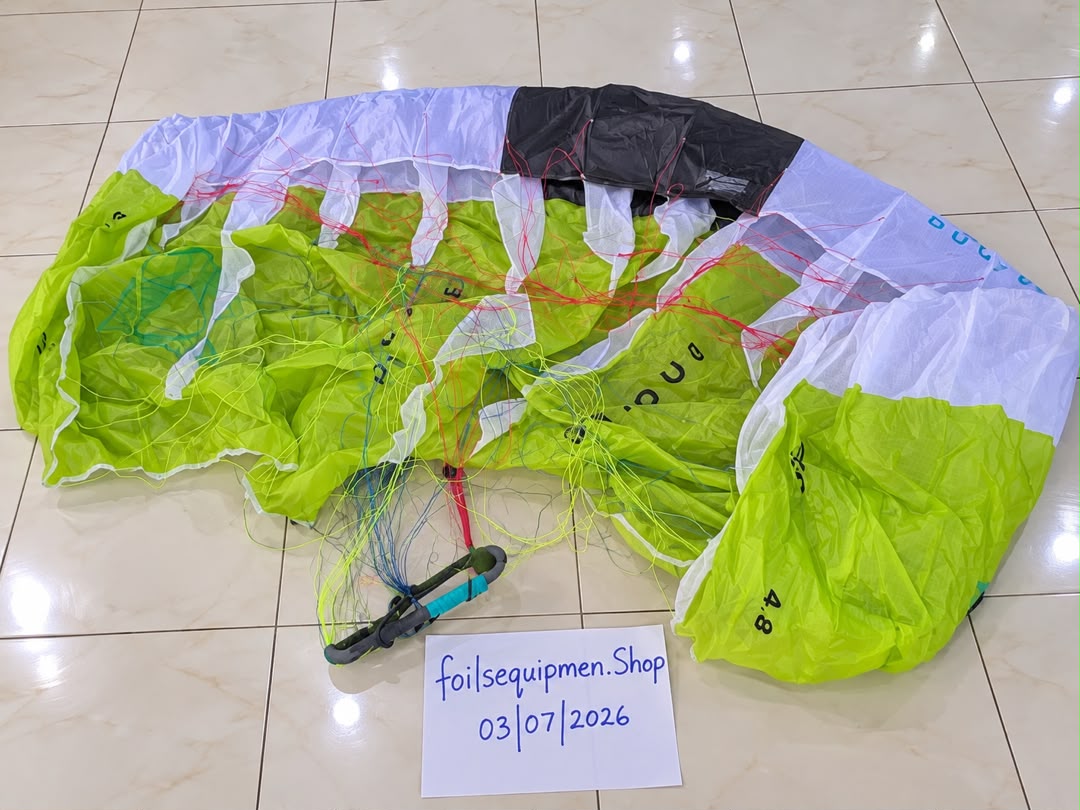

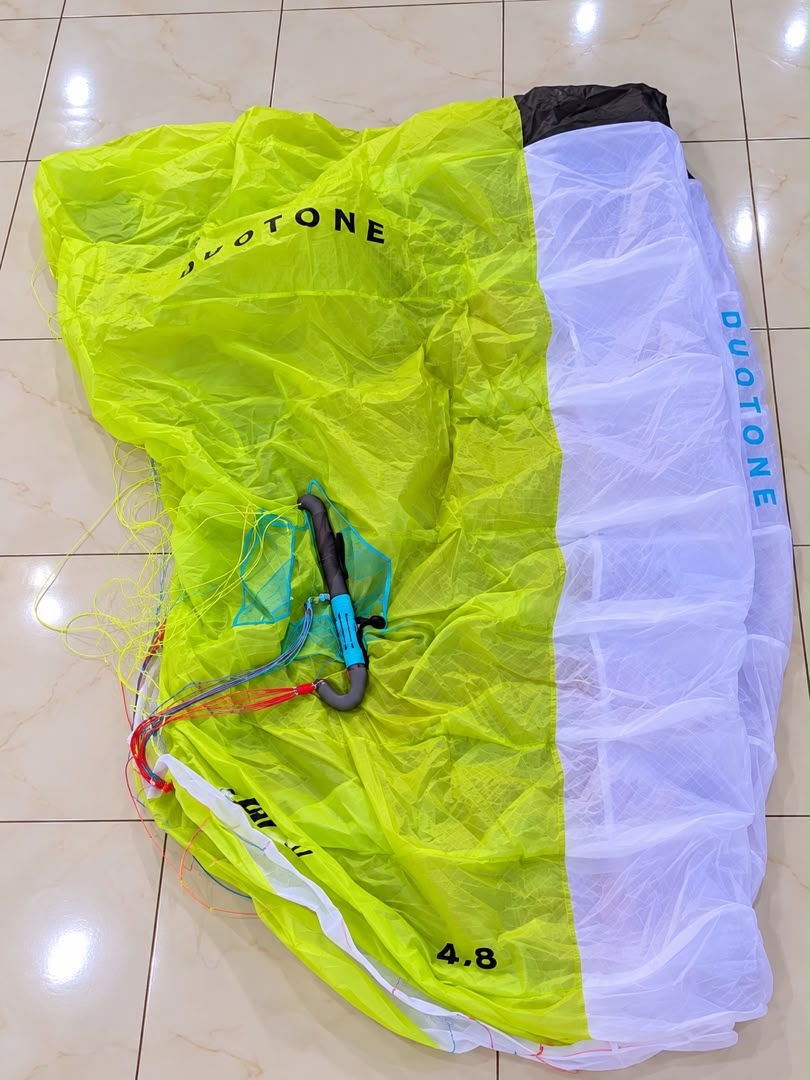
Duotone stash v2 4,8m 2026
€500.00
The Duotone Stash V2 4.8m 2026 is offered in excellent condition and has been professionally inspected to confirm its overall condition, quality, and readiness for use. It has been carefully checked and is reported to have no tears, no punctures, no damage, and no previous repairs. The wing has been well maintained and is ready to be used again for many more foiling sessions.
Every major component has been inspected, including the main canopy, stabilized leading edge, bridle and line system, ergonomic handle, line connections, attachment points, reinforced sections, and control components. The canopy and lines have also been checked for abrasion, excessive wear, deformation, damaged stitching, and other visible defects.
Included components:
- Duotone Stash V2 4.8m 2026 wing
- Main canopy
- Stabilized leading edge
- Bridle and flying lines
- Ergonomic handle
- Integrated line connections
- Harness-line attachment
- Storage/transport bag, if included
- Other included accessories, if applicable
No tears, repairs, or significant damage have been identified during inspection. The wing remains clean, well cared for, and in excellent overall condition.
The Duotone Stash V2 4.8m 2026 is ready to use again for downwind foiling, freeride, swell riding, carving, pumping, and suitable jumps. A qualified professional should complete the appropriate pre-use inspection before returning safety-critical equipment to the water.
Description
Duotone Stash V2 4.8m 2026
A new level of accessibility for pure foiling has been created with the Duotone Stash V2 4.8m 2026. As the second generation of Duotone’s all-round single-skin parawing, significant improvements have been introduced in flying stability, power delivery, depower, upwind efficiency, and rider comfort.
A lightweight and highly packable platform has been retained, while the aerodynamic profile and leading edge have been substantially refined. Consequently, a responsive parawing has been produced for riders who want greater freedom during downwind foiling while still benefiting from improved control and usability
4.8m Performance Configuration
The 4.8m configuration has been positioned as a versatile size for riders looking for a useful balance between power, handling, and portability.
A published wind range of approximately 12–21 knots has been provided for this size. Furthermore, a weight of approximately 752 g including the handle, a projected wingspan of 278 cm, and a 35 cm handle have been specified. Actual suitability will be influenced by rider weight, foil size, board configuration, riding style, and local conditions.
Key Product Highlights
- Duotone Stash V2 4.8m 2026
- 4.8 m² parawing
- Second-generation Stash design
- All-round single-skin parawing
- Approximately 12–21 knot published wind range
- Approximately 752 g including handle
- Approximately 278 cm projected wingspan
- 35 cm ergonomic handle
- 30 g lightweight ripstop canopy
- Segmented and stabilized leading edge
- Upgraded sheathed low-tangle lines
- Improved flying stability
- Increased power
- Optimized power distribution
- Enhanced depower
- Improved upwind angles
- Easy stashing
- Intuitive steering
- Integrated line connections
- Harness-line option
- Three-way color coding
- Easy setup and untangling
- Downwind foiling capability
- Freeride potential
- Wave and swell applications
- Lightweight performance-focused construction
Second-Generation Stash Design
A substantial refinement has been introduced with the second-generation Stash.
As the leading edge has been segmented and stabilized, improved consistency can be achieved throughout the flight. Furthermore, the profile thickness and angle of attack have been finely tuned.
Consequently, lower drag, stable flight, useful power, and stronger depower characteristics can be provided across changing wind conditions.
Lightweight 30g Ripstop Canopy
A lightweight 30 g ripstop canopy has been retained within the 2026 design.
As reduced canopy weight is provided, the wing can remain responsive in lighter airflow. Furthermore, compact packing can be achieved without requiring a conventional inflated wing structure.
Consequently, the Stash can be carried conveniently and deployed quickly when required.
Stabilized Leading Edge
A newly segmented and stabilized leading edge has been incorporated.
As the front section is supported more effectively, a more stable arc can be maintained while the wing is being flown.
Consequently, smoother flight and more predictable depower behavior can be achieved.
Improved Flying Stability
Flying stability has been substantially improved for 2026.
As the leading edge and profile have been refined, the wing can remain more composed through changing wind speeds and riding angles.
Consequently, greater confidence can be provided during downwind runs, upwind sections, and transitional riding.
Improved Upwind Performance
Upwind efficiency has been significantly enhanced.
As a new aspect ratio and arc have been incorporated, improved upwind angles can be achieved.
Consequently, the Stash can be used not only for downwind riding but also for returning upwind and positioning efficiently between runs.
Enhanced Depower
A stronger depower range has been developed for the 2026 generation.
As the leading-edge bridle triangle maintains a positive angle at the front of the wing, a stable open arc can be preserved while the rear portion is depowered.
Consequently, power can be reduced without the wing being allowed to collapse as easily.
Increased Power
More usable power has been incorporated into the new Stash.
As power distribution has been optimized, useful traction can be generated when required.
Consequently, acceleration and foil engagement can be supported without sacrificing the ability to depower.
Ergonomic Handle
A newly developed ergonomic handle has been integrated into the 2026 Stash.
As the front hand can be positioned beneath the A-lines, improved comfort and power distribution can be achieved.
Consequently, longer riding sessions can be made more comfortable while control can remain intuitive.
Integrated Line Connections
The line connections have been integrated into the handle system.
As the connections are kept within the handle area, a cleaner control arrangement can be created.
Consequently, easier handling, deployment, and stashing can be achieved.
A harness-line option has also been provided for riders who prefer additional support during longer runs.
Low-Tangle Sheathed Lines
Upgraded sheathed lines have been introduced.
As the lines have been designed with lower tangle behavior, setup can be simplified.
Consequently, less time can be spent sorting lines before a session.
Three-Way Color Coding
A three-way color-coding system has been incorporated across the wing and line layout.
As the main canopy, leading edge, center leading-edge panel, and three rows of lines are visually differentiated, identification can be made more easily.
Consequently, untangling and deployment can be performed more intuitively.
Easy Stashing
Compact stashing has remained one of the defining characteristics of the Stash.
As the single-skin construction is lightweight and the lines are kept relatively short, the wing can be brought in efficiently.
Consequently, storage and transportation can be simplified during downwind sessions.
Easy Redeployment
Quick redeployment has been supported through the compact construction and visual identification system.
As the wing is brought back out, the color-coded structure can help with line organization.
Consequently, less preparation can be required before the next section of a ride.
Downwind Foiling
Downwind foiling has been identified as a primary application.
As the wing can be depowered and stashed when sufficient swell energy is available, the rider can concentrate more heavily on the foil.
Consequently, natural water movement can be utilized more effectively.
Swell Riding
Swell riding can be performed when suitable conditions are available.
As the rider moves between swell sections, the wing can be depowered when additional propulsion is unnecessary.
Consequently, a more fluid connection between foil, swell, and rider can be created.
Wave Applications
The lightweight construction can also be useful during wave-oriented riding.
As the wing is allowed to drift while the rider follows the wave, reduced interference can be provided.
Consequently, more freedom can be achieved during turns and wave connections.
Freeride Foiling
Freeride applications can be supported by the Stash’s improved stability and power management.
As the wing is actively controlled, forward traction can be generated.
Consequently, cruising, transitions, upwind riding, and downwind sections can be incorporated into the same session.
Power Management
Power can be adjusted according to changing riding requirements.
As the wing is sheeted and repositioned, traction can be increased or reduced.
Consequently, the rider can respond more effectively to changes in wind strength.
Light-Wind Performance
The lightweight construction can be particularly valuable when wind becomes lighter.
As the canopy weighs relatively little, it can remain airborne more readily through temporary reductions in airflow.
Consequently, opportunities for continued foiling can be improved when conditions remain suitable.
Gust Management
Variable wind conditions can be managed through the improved depower range.
As gusts arrive, the wing can be depowered progressively.
Consequently, more controlled riding can be maintained across changing wind strength.
The published wind range should always be treated as a reference rather than a universal safe limit.
Upwind Laps
Upwind riding has been made more practical through the improved arc and aspect ratio.
As the wing tracks efficiently against the wind, useful progress can be achieved.
Consequently, the rider can return toward the desired starting area more effectively after downwind sections.
Foil Compatibility
The Stash should be paired with a suitable foil and board combination.
As foil size, board volume, and rider weight influence takeoff and cruising speed, the complete system should be matched carefully.
Consequently, the 4.8m configuration can be used more effectively when the complete equipment setup is appropriately selected.
Board Selection
Board selection can significantly affect performance.
As larger boards can provide additional stability while smaller boards can offer greater maneuverability, the board should be selected according to rider experience and intended discipline.
Consequently, the overall setup can be balanced around the rider rather than the wing alone.
Foil Selection
Foil size should be matched to wind strength and rider requirements.
As larger foils generate lift at lower speeds, they can support earlier takeoff.
Conversely, smaller foils can encourage faster riding.
Consequently, the appropriate foil should be selected according to the complete riding objective.
Rider Weight
Rider weight should be considered when selecting the 4.8m size.
As heavier riders generally require more power to achieve equivalent acceleration, wind strength and foil configuration become increasingly important.
Consequently, the published wind range should not be applied identically to every rider.
Takeoff
A controlled takeoff can be achieved when sufficient wind and foil speed are available.
As the wing generates forward traction, the board can be accelerated.
Consequently, the foil can be brought onto a stable flight path.
Foil Height Control
Stable foil height should be maintained through controlled body positioning.
As pressure is transferred between the front and rear foot, foil pitch can be adjusted.
Consequently, the desired riding height can be maintained more efficiently.
Carving
Carving can be incorporated into freeride and swell sessions.
As pressure is transferred through the board and foil, the direction of travel can be changed.
Consequently, smooth turns can be produced while the wing remains under control.
Transitions
Transitions can be performed once sufficient riding confidence has been developed.
As the rider changes direction, the wing can be repositioned to the opposite side.
Consequently, continuous foil flight can be maintained when timing and speed are appropriate.
Pumping
Pumping can be used when additional momentum is required.
As the rider coordinates movement between the foil, board, and wing, additional forward energy can be generated.
Consequently, weaker sections can potentially be crossed more efficiently.
Jumping
Suitable jumps can be incorporated by appropriately experienced riders.
As sufficient speed and lift are generated, the board can leave the water.
Consequently, aerial progression can be explored.
However, advanced jumps should only be attempted with suitable training, equipment, water depth, and conditions.
Handle Comfort
Comfort has been given particular attention in the second-generation design.
As the ergonomic handle allows alternative hand positioning, pressure distribution can be improved.
Consequently, fatigue can be reduced during longer sessions.
Harness-Line Option
A harness-line option has been incorporated into the handle system.
As additional support can be provided during longer powered sections, rider endurance can be improved.
Consequently, extended freeride and upwind sessions can be made more comfortable.
Pre-Session Inspection
A complete inspection should be performed before every session.
Particular attention should be given to:
- Canopy fabric
- Leading edge
- Center panel
- Bridle lines
- A, B, and C lines
- Sheathed line sections
- Handle
- Line connections
- Harness-line attachment
- Reinforced areas
Consequently, potential problems can be identified before launching.
Canopy Care
The lightweight canopy should be handled carefully.
As 30 g ripstop material is used, unnecessary abrasion against rocks, shells, rough surfaces, and sharp objects should be avoided.
Consequently, unnecessary material wear can be reduced.
Line Care
Lines should be kept free from knots and excessive abrasion.
As the line system is essential to steering and flight stability, damaged sections should be professionally assessed.
Consequently, reliable control can be maintained.
Salt-Water Care
After salt-water use, appropriate fresh-water rinsing should be performed.
As salt residue can accumulate on fabric and hardware, regular cleaning can help preserve the equipment.
Consequently, long-term deterioration can be reduced.
Sand Protection
The Stash should not be dragged unnecessarily across sand.
As abrasive particles can contribute to canopy and line wear, careful handling should be maintained.
Consequently, the lightweight construction can be better preserved.
Drying
The parawing should be dried thoroughly before extended storage.
As moisture can remain within fabric and line areas, wet storage should be avoided.
Consequently, material condition can be preserved more effectively.
UV Protection
Prolonged exposure to direct sunlight should be minimized.
As ultraviolet radiation can affect lightweight canopy materials over time, appropriate shade and storage should be provided.
Consequently, material longevity can be supported.
Packing
The wing should be packed according to the manufacturer’s recommended procedure.
As the lightweight canopy and line system require careful handling, excessive compression and unnecessary creasing should be avoided.
Consequently, the wing can remain in better condition between sessions.
Transportation
The Stash can be transported conveniently because of its compact design.
As the wing can be stashed into a small package, carrying requirements can be reduced.
Consequently, it can be suitable for downwind adventures where equipment portability is important.
Storage
A clean, dry, and protected storage environment should be used.
As moisture, excessive heat, chemicals, and prolonged sunlight can affect lightweight materials, these conditions should be avoided.
Consequently, the wing can be preserved more effectively.
Professional Inspection
Professional inspection should be considered after significant impacts, abnormal loading, suspected line damage, or other unusual events.
As some damage may not be immediately visible, qualified assessment can provide additional assurance.
Consequently, safety-critical concerns can be addressed before the next session.
Suitable Applications
The Duotone Stash V2 4.8m 2026 can be considered for:
- Downwind foiling
- Swell riding
- Wave riding
- Freeride foiling
- Upwind laps
- Carving
- Pumping
- Foil transitions
- Suitable jumping
- Light-wind foil sessions
- Long-distance foiling
- Rider progression
Main Benefits
- 4.8m² configuration
- Second-generation Stash design
- Highly improved flying stability
- Improved upwind angles
- Increased power
- Optimized power distribution
- Enhanced depower
- Lightweight 30 g ripstop canopy
- Segmented stabilized leading edge
- Upgraded sheathed lines
- Low-tangle line behavior
- Ergonomic 35 cm handle
- Integrated line connections
- Harness-line option
- Three-way color coding
- Easy stashing
- Easy redeployment
- Intuitive steering
- Downwind-oriented performance
- Freeride versatility
- Wave and swell applications
- Approximately 752 g including handle
- Approximately 278 cm projected wingspan
- Published 12–21 knot wind range
Why Choose the Duotone Stash V2 4.8m 2026?
The Duotone Stash V2 4.8m 2026 has been created for riders who want greater freedom during modern foil sessions without being burdened by the weight and bulk of a conventional inflatable wing.
Improved stability, power distribution, depower, and upwind efficiency have been introduced while the lightweight and highly packable character has been retained. Consequently, a more capable all-round parawing can be provided for riders who want to explore downwind foiling, swell riding, freeride, and extended foil adventures.
A New Level of Foiling Freedom
The second-generation Stash represents a substantial development of Duotone’s parawing concept.
As the leading edge has been stabilized, the profile refined, the lines upgraded, and the handle redesigned, improved control and comfort can be achieved.
Consequently, the Duotone Stash V2 4.8m 2026 can be positioned as a highly practical choice for riders seeking lightweight construction, compact storage, improved upwind ability, responsive steering, and greater control across changing wind conditions.
For suitable riders and conditions, an engaging combination of lightweight performance, efficient power, improved depower, intuitive handling, and easy stashing can be provided.
Duotone Stash V2 4.8m 2026 – Practical Use and Riding Scenarios
Designed for Modern Foiling
A different approach to powered foiling has been provided by the Duotone Stash V2 4.8m 2026. Instead of being dependent on a conventional inflatable structure, a lightweight single-skin parawing has been used.
Consequently, substantially less equipment bulk can be carried during a downwind adventure. Furthermore, the wing can be deployed when additional propulsion is required and then stashed when the rider wants to focus entirely on the foil.
Downwind Adventures
Downwind foiling has been established as one of the primary applications for the Stash.
As the rider moves with wind and swell energy, the wing can be depowered when sufficient forward momentum has been generated.
Consequently, greater attention can be given to swell selection, foil control, and linking sections of moving water.
Long-Distance Runs
Long-distance sessions can be made more practical through the compact nature of the design.
As the wing can be packed down considerably smaller than a conventional inflatable wing, transportation requirements can be reduced.
Consequently, more equipment flexibility can be provided when launching from one location and finishing at another.
Sourcing Wind on a Downwinder
Wind strength can vary considerably during a downwind run.
As weaker sections are encountered, the Stash can be redeployed to provide additional propulsion.
Consequently, momentum can be rebuilt before the next section of swell is reached.
This ability can make the wing particularly useful when the available energy is inconsistent.
Stashing During Stronger Sections
When sufficient swell or wind-generated energy is available, the wing can be depowered and stashed.
As the wing is removed from active use, the rider can concentrate more closely on foil control.
Consequently, a more unobstructed downwind experience can be created.
Redeployment
Redeployment can be performed when additional power becomes necessary.
As the wing is brought back into the airflow and the line system is organized correctly, traction can be restored.
Consequently, another section of the run can be approached with additional propulsion.
Upwind Positioning
Although the Stash is strongly associated with downwind foiling, improved upwind performance has been incorporated into the 2026 design.
As the refined arc and aspect ratio are utilized correctly, more efficient upwind angles can be achieved.
Consequently, the rider can reposition more effectively before beginning a downwind section.
Returning to the Launch Area
Upwind capability can be valuable when a rider needs to return toward a launch point.
As the wing is powered appropriately, progress against the wind can be maintained.
Consequently, the overall session can become more flexible.
Freeride Foiling
Freeride use can be supported by the improved stability and power delivery.
As the wing is held actively, forward traction can be generated.
Consequently, cruising, carving, transitions, pumping, and moderate aerial maneuvers can be incorporated.
Flat-Water Sessions
Flat water can be used for learning the fundamentals of parawing handling.
As external water movement is reduced, attention can be focused on line management, wing positioning, steering, and foil balance.
Consequently, a controlled environment can be created for developing technique.
Learning to Fly the Stash
A gradual learning process should be followed.
As the rider becomes familiar with the line arrangement and steering response, greater confidence can be developed.
Consequently, more dynamic applications can be introduced without immediately attempting difficult maneuvers.
Line Familiarization
The line system should be understood before the wing is used in demanding conditions.
As the three-way color coding provides visual differentiation, individual line groups can be identified more easily.
Consequently, setup and untangling can be made more intuitive.
Launching
A suitable launch area should be selected.
As the Stash does not require a conventional inflated leading edge, sufficient space for line deployment remains important.
Consequently, obstacles, other riders, vegetation, rocks, and equipment should be kept away from the setup area.
Pre-Launch Organization
The wing should be laid out carefully before deployment.
As the lines are organized and checked, potential tangles can be identified.
Consequently, a cleaner launch can be achieved.
Wind Awareness
Wind direction and strength should be assessed before launching.
As parawing behavior can change with gusts and turbulence, appropriate conditions should be selected.
Consequently, greater control can be maintained from the beginning of the session.
Beach Handling
The lightweight canopy should be protected from unnecessary contact with abrasive surfaces.
As sand, shells, rocks, and rough ground can damage lightweight materials, careful handling should be maintained.
Consequently, avoidable wear can be minimized.
Water Entry
The wing should be controlled carefully when entering the water.
As lines can become exposed to water movement and other equipment, organization should be maintained.
Consequently, unnecessary tangles can be avoided.
Starting a Foil Run
A smooth start can be achieved when adequate wind and foil speed are available.
As the wing provides forward traction, the board can be accelerated until sufficient foil speed is reached.
Consequently, the rider can transition from displacement mode into stable flight.
Early Flight
Initial foil flight should be maintained at a manageable height.
As the rider becomes airborne, appropriate wing positioning can be used to stabilize speed.
Consequently, the transition into sustained flight can be made more controlled.
Stable Cruising
Once foil flight has been established, the wing can be held at an efficient angle.
As the rider maintains balance and the wing provides consistent traction, speed can be controlled.
Consequently, longer reaches can be completed with reduced physical effort.
Accelerating
Additional speed can be generated when conditions permit.
As the wing is positioned more actively into the airflow, greater forward traction can be produced.
Consequently, the foil can be accelerated into a faster riding state.
Depowering
Depowering can be used when less traction is required.
As the wing is sheeted and repositioned appropriately, power can be reduced.
Consequently, the rider can maintain greater control when speed becomes excessive.
Handling Gusts
Gust management should be practiced before entering challenging conditions.
As wind pressure increases, the wing can be depowered progressively.
Consequently, sudden increases in traction can be managed more effectively.
If wind becomes excessive or unpredictable, the safest response should be selected rather than attempting to maintain the session.
Carving
Carving can be performed by coordinating wing positioning with foil movement.
As the rider initiates a turn, the wing can be repositioned to support the new direction.
Consequently, smooth arcs can be maintained.
Tight Turns
More aggressive turns can be introduced as experience increases.
As the rider applies additional pressure through the board and foil, tighter trajectories can be created.
Consequently, more dynamic riding can be achieved.
Pumping
Pumping can be used to maintain speed through weaker sections.
As the wing, board, and foil are coordinated, additional momentum can be produced.
Consequently, the rider may be able to cross short areas of reduced wind more efficiently.
Foil Pumping
Foil pumping can be combined with wing pumping.
As the rider transfers pressure rhythmically through the foil, forward momentum can be maintained.
Consequently, less reliance can be placed on continuous wing power.
Swell Connections
Connecting multiple swell sections can be one of the most rewarding applications.
As each swell is approached, the wing can be positioned according to the available energy.
Consequently, the rider can transition between powered and unpowered sections.
Reading Swell
Successful swell riding depends heavily on water awareness.
As the rider observes wave spacing, direction, height, and speed, better lines can be selected.
Consequently, fewer unnecessary corrections may be required.
Freefly
Freefly riding can be performed when adequate swell energy is available.
As the wing is depowered and stashed, the rider can focus primarily on foil movement.
Consequently, a more natural connection with the swell can be experienced.
Reconnecting the Wing
When energy begins to decrease, the wing can be redeployed.
As traction is restored, additional speed can be generated.
Consequently, the next section can be reached without necessarily returning to displacement mode.
Wave Riding
Suitable waves can also be approached using the Stash.
As the wing supplies initial power, the rider can establish foil speed.
Once the wave begins providing sufficient energy, the wing can be reduced in power.
Consequently, attention can be shifted toward the wave face.
Wave Carving
Wave carving requires careful management of both foil and wing.
As the rider changes direction across the wave face, the wing can be positioned more neutrally.
Consequently, unwanted pull can be minimized.
Surf-Focused Riding
The lightweight character can be advantageous when the wing needs to remain unobtrusive.
As the rider follows the wave, reduced wing interference can be provided.
Consequently, the foil can become the primary source of movement.
Freestyle Potential
The Stash can also be used for suitable freestyle progression.
As the rider develops confidence with the control system, transitions and aerial techniques can be explored.
Consequently, the wing can provide more than purely downwind functionality.
Jumping
Suitable jumps can be attempted by experienced riders.
As speed and lift are generated, the rider can leave the water.
Consequently, aerial techniques can be developed.
However, jumping should only be performed when sufficient experience, water depth, equipment compatibility, and environmental conditions are available.
Aerial Transitions
Aerial transitions require accurate coordination.
As the rider changes direction while airborne, the wing must remain appropriately controlled.
Consequently, stable landings can be supported.
Landing
Landing control should be prioritized during every jump.
As the board approaches the water, foil height and wing positioning should be managed.
Consequently, impact can be reduced and control can be maintained.
Rider Weight Considerations
Rider weight should be considered carefully when selecting the 4.8m configuration.
As power requirements increase with rider mass, the same wind conditions can produce different results for different riders.
Consequently, the published wind range should be used only as a general reference.
Foil Selection
Foil selection can strongly influence the performance of the complete setup.
As larger foils generate lift at lower speeds, they can facilitate earlier takeoff.
Conversely, smaller foils can support higher-speed riding.
Consequently, foil selection should be matched to rider experience and intended conditions.
Board Selection
Board choice should also be considered.
As higher-volume boards provide additional stability, they can be useful during learning.
Meanwhile, smaller boards can provide a more dynamic experience.
Consequently, the board should be selected according to skill level and intended use.
Safety Equipment
Appropriate safety equipment should always be used.
A suitable leash and other required equipment should be selected according to the manufacturer’s recommendations and local riding practices.
Consequently, emergency situations can be managed more effectively.
Leash Management
The leash connection should be inspected before every session.
As repeated loading can affect attachment points, visible wear should not be ignored.
Consequently, reliable connection can be maintained.
Line Safety
Lines should always be kept clear of obstacles and other people.
As tensioned lines can move rapidly under load, sufficient space should be maintained around the wing.
Consequently, unnecessary hazards can be reduced.
Emergency Preparation
An emergency plan should be understood before beginning a downwind journey.
As conditions can change rapidly, riders should know how they will return safely if the wing cannot be redeployed.
Consequently, preparation can be maintained even when circumstances become challenging.
Professional Inspection
Professional inspection should be considered after significant impact, abnormal loading, suspected line damage, or other unusual events.
As lightweight materials and lines can sustain damage that is not immediately obvious, qualified assessment can provide additional assurance.
Consequently, safety-critical issues can be addressed before the next session.
Maintenance Routine
A simple maintenance routine can help preserve the Stash.
After Every Session
The wing should be inspected and cleaned as required.
After Salt-Water Use
Fresh-water rinsing should be performed appropriately.
Before Storage
The wing should be dried completely.
Before Long-Term Storage
The canopy and line system should be inspected carefully.
Consequently, equipment condition can be maintained more effectively.
Canopy Protection
The lightweight ripstop canopy should be protected from unnecessary abrasion.
As lightweight materials can be more vulnerable to sharp surfaces, the wing should be handled carefully.
Consequently, avoidable punctures and fabric wear can be reduced.
Line Protection
Lines should be kept clean, untangled, and free from excessive abrasion.
As the line system plays an important role in flight behavior, damaged or heavily worn sections should be professionally assessed.
Consequently, reliable control can be supported.
Cleaning
Gentle cleaning should be performed when required.
As harsh chemicals can affect technical materials, manufacturer-approved cleaning methods should be followed.
Consequently, unnecessary material deterioration can be avoided.
Drying
Complete drying should be ensured before packing the wing for extended storage.
As trapped moisture can contribute to deterioration, damp storage should be avoided.
Consequently, the canopy and line system can be better preserved.
UV Protection
Direct sunlight should be avoided whenever the wing is not being used.
As ultraviolet exposure can gradually affect lightweight materials, shaded storage should be preferred.
Consequently, long-term material condition can be supported.
Packing
The Stash should be packed according to the manufacturer’s recommended method.
As unnecessary compression and poor line organization can create problems during the next setup, careful packing should be maintained.
Consequently, redeployment can be made easier.
Transportation
One of the strongest practical advantages of the Stash is its portability.
As the single-skin structure can be packed into a compact form, transportation can be simplified.
Consequently, the wing can be carried during longer approaches, downwind missions, and multi-location sessions.
Travel
The compact design can also be useful during travel.
As less storage space can be required than for many conventional inflatable wings, equipment organization can be simplified.
Consequently, riders can potentially travel with a more compact foil setup.
Storage Between Sessions
A dry and ventilated location should be used.
As moisture, excessive heat, chemicals, and prolonged sunlight can affect technical materials, these conditions should be avoided.
Consequently, the equipment can remain in better condition.
Seasonal Storage
Before extended periods without use, the wing should be cleaned, dried, inspected, and stored appropriately.
As unused equipment can still deteriorate when exposed to poor environmental conditions, preparation should not be overlooked.
Consequently, the Stash can be better preserved for the next season.
Who Is the Stash V2 4.8m For?
The Stash V2 4.8m can be considered by riders who already have a solid foundation in foil control and want to explore a lightweight parawing system.
As the handling characteristics differ from those of conventional inflatable wings, an adjustment period can be expected.
Consequently, riders should develop familiarity gradually rather than immediately entering demanding conditions.
Beginners
Complete beginners should approach parawing use cautiously.
As the line system and flight characteristics require specific handling skills, appropriate instruction and controlled practice are recommended.
Consequently, confidence can be developed in a safer progression.
Intermediate Riders
Intermediate riders can benefit from the Stash as new techniques are learned.
As control improves, downwind riding, swell connections, and wing redeployment can be introduced progressively.
Consequently, the equipment can support meaningful progression.
Advanced Riders
Advanced riders can take advantage of the wing’s lightweight construction and refined control.
As the rider becomes comfortable with depower, stashing, redeployment, and swell management, more demanding downwind routes can be explored.
Consequently, the Stash can become a highly capable component of an advanced foil setup.
Product Specification Summary
The 4.8m configuration has been published with the following reference specifications:
- Size: 4.8 m²
- Generation: 2026 V2
- Type: Single-skin parawing
- Published wind range: approximately 12–21 knots
- Approximate weight: 752 g including handle
- Projected wingspan: approximately 278 cm
- Handle length: approximately 35 cm
- Canopy: 30 g ripstop
- Control: ergonomic handle
- Line system: upgraded sheathed low-tangle lines
- Power: increased and more evenly distributed
- Depower: enhanced
- Upwind: improved
- Stashing: optimized for compact storage
What Makes the 4.8m Configuration Useful?
A 4.8m size can provide a useful middle ground between portability and usable power.
As enough canopy area is provided for a broad range of foiling applications while the overall structure remains extremely light, the wing can be carried conveniently without sacrificing practical propulsion.
Consequently, the 4.8m Stash can be particularly attractive for riders who want one compact option for varied foil adventures.
Advantages for Downwinders
- Very low equipment weight
- Compact stashing
- Quick redeployment
- Improved depower
- Useful upwind ability
- Stable flight
- Efficient power delivery
- Easy line identification
- Ergonomic handle
- Reduced equipment bulk
Consequently, the wing can be used as both a primary propulsion tool and a compact backup source of power during longer foil journeys.
Advantages for Freeriders
Freeride riders can benefit from the improved stability and intuitive steering.
As the wing can be powered, depowered, or repositioned according to the riding situation, a range of riding styles can be supported.
Consequently, the Stash can be used beyond dedicated downwind missions.
Advantages for Wave Riders
Wave-oriented riders can benefit from the wing’s ability to become less intrusive when power is not required.
As the wing is depowered or stashed while the wave provides propulsion, the rider can concentrate more heavily on foil and wave movement.
Consequently, a more fluid riding experience can be created.
Advantages for Travelers
The compact construction can be particularly useful for riders who travel frequently.
As the wing can occupy relatively little space when packed, transportation can be simplified.
Consequently, additional foil equipment can be carried more easily.
Final Buying Considerations
Before purchasing a Duotone Stash V2 4.8m 2026, the rider’s weight, normal wind conditions, foil size, board setup, experience, and intended discipline should be considered.
As parawing performance depends heavily on the complete system, the wing should not be evaluated independently of the foil and board.
Consequently, the best results can be achieved when all components are matched appropriately.
Why the Duotone Stash V2 4.8m 2026 Stands Out
The Duotone Stash V2 4.8m 2026 has been developed around a clear objective: providing a lightweight, controllable, and highly packable source of propulsion for modern foiling.
A stabilized leading edge, revised profile, improved depower, increased power, refined upwind performance, upgraded lines, and ergonomic handle have been incorporated.
Consequently, a significantly more versatile parawing platform has been created.
Final Product Overview
The Duotone Stash V2 4.8m 2026 can be viewed as a practical bridge between powered wing foiling and the freedom of pure downwind foiling.
Its lightweight construction allows convenient transportation, while the improved flight stability and depower provide greater control once deployed. Furthermore, the refined upwind performance allows the wing to be used for repositioning rather than being limited exclusively to downwind travel.
For riders seeking lightweight performance, compact storage, intuitive steering, improved depower, efficient upwind riding, swell connection, freeride capability, and downwind freedom, the 4.8m Stash V2 can provide a compelling modern foiling solution.
Before every session, the canopy, lines, handle, connections, attachment points, and surrounding environment should be inspected carefully. Appropriate instruction, compatible equipment, suitable weather, and conservative judgment should always be prioritized.


Reviews
There are no reviews yet.