
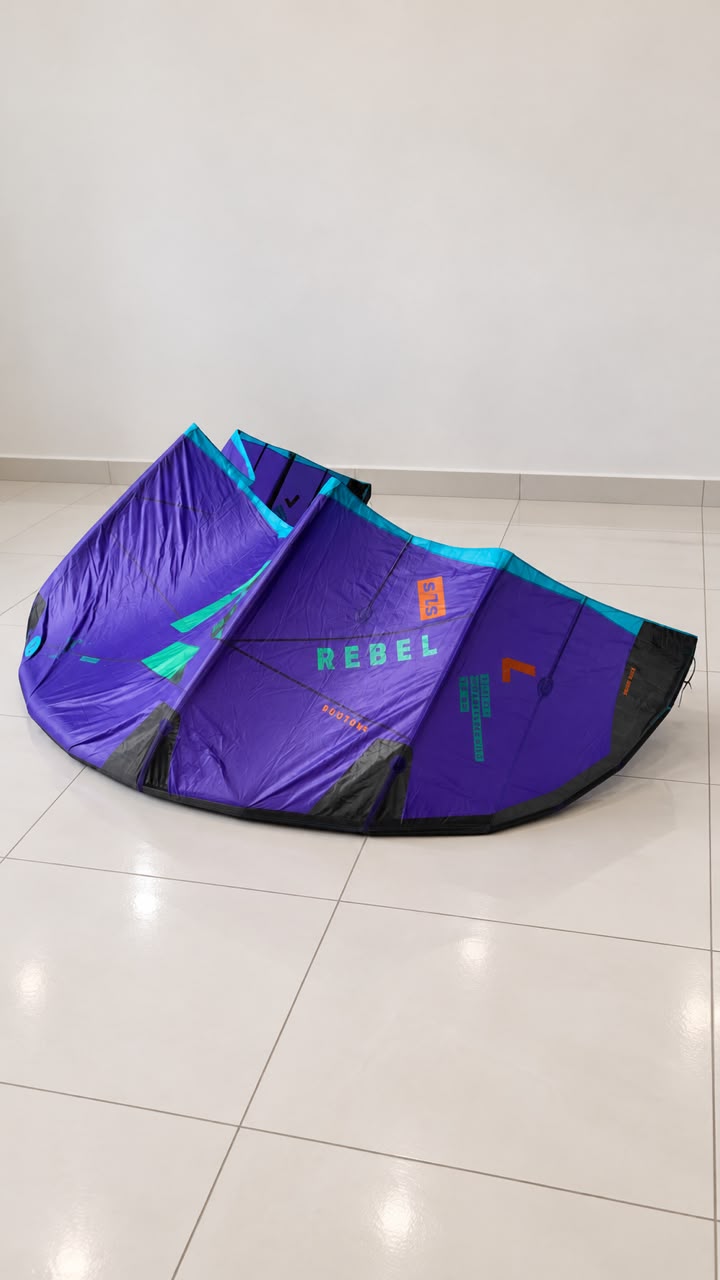
Duotone Rebel SLS 7m 2026
€450.00
The Duotone Rebel SLS 7m 2026 is offered in excellent condition and has been professionally inspected to confirm its overall quality and readiness for use. It has been carefully checked and has no tears, no punctures, no damage, and no previous repairs. The kite has been well maintained and is ready to use for many more sessions and jumps again.
Every major component has been inspected, including the main canopy, leading edge, five struts, bridle system, connection points, valves, inflation system, pigtails, and kite attachment points. The kite has also been checked for signs of excessive wear, abrasion, deformation, leaks, damaged stitching, and other visible defects.
Included components:
- Duotone Rebel SLS 7m 2026 kite
- Main canopy
- Leading edge
- Five struts
- Bridle system
- Pigtails and connection points
- Inflation valves
- Kite attachment points
- Storage/transport bag, if included
- Other included accessories, if applicable
No tears, repairs, or significant damage have been identified. The kite remains clean, well cared for, and in excellent overall condition.
The Duotone Rebel SLS 7m 2026 is ready to use and ready for many more kiteboarding sessions and jumps again. It is an excellent choice for big air, freeride, powered riding, jumping, and advanced aerial progression. A qualified professional should complete the appropriate pre-use inspection before flight.
Description
Duotone Rebel SLS 7m 2026
The Duotone Rebel SLS 7m 2026 has been developed for riders who want explosive big-air performance, controlled power, extended hangtime, and precise handling. A refined 5-strut construction has been used, while advanced Penta TX and Trinity TX materials have been incorporated to provide a strong and performance-focused structure. Consequently, a highly capable platform has been created for riders who want to push their freeride and big-air progression further
For the 2026 generation, important aerodynamic and bridle refinements have been introduced. A shorter chord has been used to create a sleeker profile, while the leading-edge sweep has been reduced to support faster climbs during loops. Furthermore, the front bridle has been designed without pulleys, allowing a more direct connection between bar input and kite response. Consequently, quicker reactions and more precise control can be provided during demanding maneuvers.
High-Performance Big Air Design
A performance-oriented design has been created for riders who prioritize height and airtime. As the kite is powered correctly, strong vertical lift can be generated rapidly. Consequently, powerful takeoffs and extended hangtime can be achieved by suitably skilled riders.
The 5-strut frame is used to provide a stable structural platform. Consequently, the kite can remain controlled during powered riding and aerial maneuvers. The aerodynamic profile has also been refined so that efficient airflow can be maintained across the canopy.
Key Product Highlights
- Duotone Rebel SLS 7m 2026
- 7 m² kite size
- High-performance freeride and big-air design
- 5-strut frame
- Penta TX construction
- Trinity TX canopy material
- Pulley-less front bridle
- Refined aerodynamic profile
- Shorter chord design
- Reduced leading-edge sweep
- Explosive vertical lift
- Extended hangtime
- Direct bar feedback
- Powerful looping capability
- Smooth “sheet and go” takeoffs
- Responsive handling
- Freeride versatility
- Big-air performance
- Recommended 22 m line length
- Recommended M bar width
- Approximately 2.65 kg without bag
7m Size Configuration
The 7 m configuration has been positioned within the Rebel SLS range for riders who need a smaller, more dynamic kite for stronger wind conditions.
According to the official specifications, the 7 m model is listed with a 19–38 knot wind range, a recommended 22 m line length, an M bar width, and an approximate weight of 2.65 kg without the bag. Actual suitability will depend on rider weight, board type, riding style, local wind conditions, and experience.
As wind strength increases, the smaller canopy can provide a responsive option for powered freeride and big-air sessions. Consequently, the 7 m size can become particularly useful as part of a multi-kite quiver.
Penta TX Construction
Advanced Penta TX material has been incorporated into the Rebel SLS construction.
As the frame is subjected to repeated aerodynamic loading, structural stiffness and weight are important considerations. Consequently, the use of advanced materials has been intended to support a combination of durability, responsiveness, and reduced weight.
The result is a kite that has been designed to remain stable while being exposed to the demanding loads associated with high-performance riding.
Trinity TX Canopy
Trinity TX material has also been incorporated into the Rebel SLS.
As the canopy needs to maintain an efficient aerodynamic shape, appropriate material characteristics are important. Consequently, the canopy has been designed to support the overall performance objectives of the Rebel SLS platform.
5-Strut Frame
A stable five-strut structure has been incorporated.
As the kite is powered and accelerated, the frame helps maintain the intended canopy shape. Consequently, predictable handling and stability can be supported during powered riding.
The five-strut platform is particularly suited to the Rebel SLS’s big-air focus, where controlled lift, hangtime, and aerial stability are important.
Explosive Lift
Powerful vertical lift is one of the defining characteristics of the 2026 Rebel SLS.
As the kite is positioned correctly during takeoff, vertical acceleration can be generated rapidly. Consequently, riders can be provided with the lift needed for high jumps.
The 2026 aerodynamic refinements have specifically been intended to improve vertical acceleration while preserving the Rebel’s characteristic hangtime.
Massive Hangtime
Extended airtime has been prioritized within the Rebel SLS design.
As the rider leaves the water, the kite can continue providing controlled support throughout the jump. Consequently, more time can be available for aerial positioning and trick execution.
The aerodynamic profile and stable 5-strut frame have been developed to support prolonged hangtime.
Sheet and Go Takeoff
The Rebel SLS has been designed around a relatively intuitive “sheet and go” concept.
As the bar is sheeted appropriately, power can be generated efficiently. Consequently, takeoffs can be performed with less complicated kite positioning.
This characteristic can be especially useful during repeated big-air attempts, where consistent takeoff behavior is valuable.
Direct Bar Feedback
A more direct bar connection has been developed for the 2026 model.
As pulley systems have been removed from the front bridle, bar inputs can be translated more directly into kite response. Consequently, the rider can receive clearer feedback during steering and powered maneuvers.
This direct response can be valuable when precision is required during jumps, loops, and directional changes.
Powerful Loops
The Rebel SLS has been engineered for powerful and controlled kite loops.
As the kite climbs quickly toward the edge of the wind window, the reduced leading-edge sweep can support faster movement during looping maneuvers. Consequently, more dynamic rotations can be achieved by appropriately skilled riders.
Looping should only be attempted by riders with appropriate training, experience, equipment, and suitable conditions.
Faster Kite Climb
A reduced leading-edge sweep has been introduced for the 2026 generation.
As the kite moves toward the edge of the wind window, the revised geometry can support faster climbing behavior. Consequently, the kite can be positioned more quickly for aerial maneuvers and loops.
Refined Aerodynamic Profile
A sleeker aerodynamic profile has been created through changes to the chord length.
As the chord has been shortened, a more streamlined shape is produced. Consequently, the kite can generate efficient upward propulsion while maintaining its high-performance character.
Freeride Performance
Although the Rebel SLS has a strong big-air identity, freeride performance has also been emphasized.
As the kite is powered through the window, controlled drive can be generated. Consequently, riders can combine cruising, edging, jumping, and directional riding within the same session.
Upwind riding can also be supported by the kite’s performance-oriented profile and controlled power delivery.
Upwind Capability
Efficient upwind riding can be valuable when maximizing time on the water.
As the kite generates forward drive, the rider can maintain an appropriate board angle against the wind.
Consequently, ground can be gained efficiently while preparing for another powered run or jump.
Responsive Handling
Responsive handling has been refined for the 2026 Rebel SLS.
As steering input is applied, the pulley-less bridle contributes to a more direct response.
Consequently, the rider can make precise corrections during powered riding, jumping, and looping.
Big-Air Progression
The Rebel SLS can be used as a progression platform for experienced riders who want to improve their jumping technique.
As takeoff timing, kite positioning, edging, and bar control are refined, greater height and hangtime can be developed.
Consequently, riders can progressively work toward more advanced aerial maneuvers.
Freeride Sessions
For everyday freeride use, the 7 m size can provide a dynamic option when wind conditions are appropriate.
As the kite is moved through the wind window, controlled power can be maintained.
Consequently, carving, edging, jumping, and general powered riding can be combined.
Kiteboard Compatibility
The Rebel SLS can be paired with suitable twin-tip and directional boards according to the rider’s preferred discipline.
As board characteristics change, the overall feel of the kite setup can also change.
Consequently, board selection should be matched to rider weight, wind strength, experience, and intended riding style.
Bar Selection
The official specification lists a 22 m recommended line length and M bar width for the 7 m Rebel SLS.
Using a compatible bar and correctly configured control system is essential.
Consequently, the kite should always be paired with manufacturer-approved or otherwise confirmed-compatible equipment.
Relaunch
Relaunch capability is an important consideration during kiteboarding.
As the kite reaches the water, appropriate bar and steering input can be used to bring it back into the air.
Consequently, session continuity can be improved when the rider is familiar with the correct relaunch procedure.
Kite Stability
Stable behavior is particularly valuable during big-air riding.
As the kite is loaded and unloaded repeatedly, the structural frame helps maintain its intended shape.
Consequently, controlled power delivery can be supported throughout the session.
Wind Management
The official 7 m Rebel SLS specification is listed at 19–38 knots, although actual safe use depends on rider weight, skill, board, bar configuration, local conditions, and manufacturer guidance.
As wind strength increases, the rider should continuously evaluate whether the kite remains appropriate.
Consequently, responsible kite selection and conservative judgment should always take priority over performance goals.
Pre-Session Inspection
Before every session, the kite and control system should be inspected carefully.
Particular attention should be given to:
- Canopy fabric
- Leading edge
- Struts
- Seams
- Bridle lines
- Pigtails
- Connection points
- Valves
- Inflation system
- Bar lines
- Safety-release system
Consequently, potential problems can be identified before launching.
Canopy Care
The canopy should be protected from unnecessary abrasion.
As sand, rocks, sharp objects, and rough surfaces can damage kite fabric, dragging should be avoided whenever possible.
Consequently, unnecessary wear can be reduced.
Leading Edge Care
The leading edge should be checked regularly for abrasions, punctures, deformation, and other damage.
As it forms a major structural component of the kite, its condition should be maintained carefully.
Consequently, professional assessment should be obtained if significant damage is suspected.
Storage
The kite should be stored clean and completely dry.
As prolonged moisture and excessive heat can contribute to material deterioration, appropriate storage conditions should be maintained.
Consequently, the kite can be better preserved between sessions.
Why Choose the Duotone Rebel SLS 7m 2026?
The Duotone Rebel SLS 7m 2026 has been created for riders who want a powerful combination of height, hangtime, direct control, and freeride versatility.
With its 5-strut frame, Penta TX and Trinity TX materials, pulley-less bridle, refined aerodynamic profile, shorter chord, and reduced leading-edge sweep, a highly performance-focused kite has been produced.
Furthermore, the 7 m configuration provides a dynamic option for stronger-wind sessions, while its big-air characteristics can be used for powerful jumps, controlled loops, and extended airtime.
A High-Performance Kite for Ambitious Riders
The Duotone Rebel SLS 7m 2026 represents a performance-oriented kite for riders who want to push their freeride and big-air abilities.
Explosive lift can be generated, hangtime can be extended, and direct steering feedback can be provided through the refined bridle system. Consequently, riders can be given the tools required for demanding aerial sessions.
For riders seeking a Duotone Rebel SLS 7m 2026 with powerful lift, responsive handling, controlled loops, strong hangtime, and freeride versatility, this configuration can provide a highly capable platform when correctly matched to the rider and conditions.
All manufacturer instructions, recommended setup procedures, safety requirements, and operating limitations should be followed before use. Kiteboarding involves inherent risks, and advanced jumping or looping should only be attempted by appropriately trained and experienced riders in suitable conditions.
Duotone Rebel SLS 7m 2026 – Detailed Performance and Practical Use
Designed for Powered Riding
The Duotone Rebel SLS 7m 2026 has been developed for riders who want a highly responsive kite for powered freeride and big-air sessions. Its performance characteristics can be particularly appreciated when the wind is strong enough to allow the kite to be loaded effectively.
As the rider builds speed and edges the board firmly against the water, increasing tension can be created between the kite, lines, and board. Consequently, substantial upward lift can be generated when the kite is redirected correctly.
Big-Air Takeoff
A controlled takeoff begins with sufficient board speed and effective edging.
As the kite is positioned appropriately and the rider releases the edge at the correct moment, upward acceleration can be produced. Consequently, the rider can leave the water with significant height.
The Rebel SLS has been designed to provide a powerful and relatively direct takeoff response, allowing experienced riders to focus on timing, kite positioning, and body control.
Explosive Vertical Lift
Strong vertical lift is one of the defining characteristics of the Rebel SLS platform.
As the kite is redirected through the appropriate part of the wind window, upward force can be generated rapidly. Consequently, substantial elevation can be achieved during suitable jumps.
Because powerful lift can be produced, precise timing and appropriate rider technique are required.
Hangtime
Extended airtime is another major strength of the Rebel SLS concept.
As the kite remains positioned correctly overhead after takeoff, lift can be maintained throughout a significant portion of the jump.
Consequently, additional time can be available for grabs, rotations, board movements, and other aerial techniques.
Jumping Progression
The 7 m size can be particularly useful for riders developing advanced jumping skills in stronger wind.
As takeoff technique improves, the rider can gradually increase height and control.
Consequently, more complex aerial maneuvers can be introduced progressively.
Jumping should always be performed within conditions appropriate for the rider’s experience and equipment.
Kite Positioning
Kite positioning has a major influence on jump performance.
As the kite is moved through the wind window, its lifting force changes.
Consequently, the rider can control the timing of takeoff, apex, and descent through coordinated bar and body movements.
Edging
Strong edging helps generate tension in the lines.
As the board is driven against the water, the rider can load the kite more effectively.
Consequently, greater energy can be stored before takeoff.
A balanced edge should be maintained rather than relying entirely on excessive physical force.
Pop
Controlled pop can be generated through a combination of board pressure, edging, kite position, and timing.
As the rider releases pressure from the board at the appropriate moment, the stored energy can be converted into vertical movement.
Consequently, higher and more controlled jumps can be achieved.
Landing
A successful landing requires accurate kite and board control.
As the rider approaches the water, the kite should be positioned to provide appropriate support.
Consequently, the descent can be softened and board contact can be managed more effectively.
The landing area should always be evaluated before initiating a large jump.
Big-Air Rotation
Rotational maneuvers require precise coordination.
As the rider initiates a rotation, the kite must remain appropriately positioned while the body and board rotate beneath it.
Consequently, controlled aerial rotation can be developed.
Board-Off Maneuvers
Advanced riders can use suitable conditions to develop board-off techniques.
As the board is released during the jump, the kite must continue providing sufficient support.
Consequently, additional time can be created for controlled board movements.
Such maneuvers require substantial experience and should be progressed gradually.
Grabs
Grabs can be incorporated into jumps when sufficient airtime is available.
As the rider reaches toward the board, the kite should remain under controlled steering input.
Consequently, the board can be brought closer to the body while aerial stability is maintained.
Kiteloops
The Rebel SLS has been designed with powerful looping performance in mind.
As the kite is redirected aggressively through the wind window, substantial horizontal and vertical forces can be produced.
Consequently, dynamic kiteloops can be performed by highly experienced riders.
Kiteloops should only be attempted after appropriate training and progressive practice.
Loop Timing
Timing is particularly important during a kiteloop.
As the kite begins its rotation, the rider’s height, speed, and kite position must be considered.
Consequently, the loop can be completed with greater control.
Incorrect timing can result in hard landings or loss of control, so appropriate progression is essential.
Direct Steering
The pulley-less front bridle introduced for the 2026 model contributes to a direct steering sensation.
As the bar is moved, steering input can be transferred more directly to the kite.
Consequently, the rider can receive clearer feedback during dynamic maneuvers.
Responsive Bar Feel
Direct bar feedback can be especially useful during powered riding.
As the kite moves through the wind window, the rider can feel changes in pressure through the bar.
Consequently, steering adjustments can be made more precisely.
Freeride Riding
Despite its strong big-air focus, the Rebel SLS can also be used for freeride sessions.
As the kite generates consistent power, the rider can combine cruising, edging, carving, jumping, and directional changes.
Consequently, a single kite can provide a versatile experience within its appropriate wind range.
Upwind Riding
Efficient upwind performance can help riders maximize their time on the water.
As the kite provides forward drive and the board is edged appropriately, progress against the wind can be achieved.
Consequently, the rider can regain ground after jumps and longer downwind runs.
Power Control
Power management becomes increasingly important as wind strength increases.
As the bar is adjusted, the kite’s effective angle and power can be influenced.
Consequently, the rider can regulate pull according to the current conditions.
Depower
Effective depower is important during gusty conditions.
As the bar is moved away from the rider, power can be reduced according to the control system.
Consequently, the rider can respond to changes in wind strength.
Depower should always be understood and practiced before riding in stronger conditions.
Gust Management
Strong wind can produce significant changes in kite power.
As gusts arrive, appropriate steering and depower inputs may be required.
Consequently, the kite can be kept within a manageable operating state.
The rider should never continue simply because the kite remains technically controllable if conditions are becoming unsuitable.
Relaunch
Relaunch is an important consideration for any inflatable kite.
As the kite reaches the water, the appropriate steering input can be used to move the canopy toward the edge of the wind window.
Consequently, the kite can be returned to the air when the procedure is performed correctly.
The exact relaunch procedure should be learned from the manufacturer’s instructions and practiced in suitable conditions.
Water Relaunch Practice
Relaunch skills should be practiced before attempting demanding riding.
As the rider becomes familiar with the kite’s behavior on the water, confidence can be developed.
Consequently, unexpected water landings can be managed more effectively.
Self-Rescue
The correct self-rescue procedure should be understood before riding.
As kiteboarding involves changing weather and water conditions, riders should know how to respond if the kite cannot be relaunched.
Consequently, appropriate emergency preparation can be maintained.
Manufacturer instructions and recognized kiteboarding safety training should always be followed.
Safety System
The control bar and safety-release system should be checked before every session.
As the safety system is an essential part of the complete kite setup, it should operate correctly and without obstruction.
Consequently, the rider can have access to the intended emergency-release function if required.
Bridle Inspection
The bridle should be inspected regularly.
As the 2026 Rebel SLS uses a pulley-less front bridle configuration, lines and attachment points should remain free from damage, knots, excessive wear, or deformation.
Consequently, reliable kite response can be supported.
Line Inspection
Flying lines should be checked before launch.
Particular attention should be given to:
- Fraying
- Cuts
- Knots
- Abrasion
- Uneven stretching
- Damaged connectors
- Pigtails
- Attachment points
Consequently, potential control-system problems can be identified before the kite is launched.
Canopy Inspection
The canopy should be examined carefully.
As the fabric is exposed to repeated inflation, wind loading, sand, water, and sunlight, gradual wear can develop.
Consequently, tears, punctures, abrasion, or damaged stitching should be identified early.
Leading Edge Inspection
The leading edge should be checked for:
- Abrasion
- Punctures
- Valve damage
- Deformation
- Damaged stitching
- Unusual wear
Consequently, structural problems can be addressed before they become more significant.
Strut Inspection
The struts should be inspected before use.
As they contribute to the kite’s structural shape, leaks, abrasions, or damaged seams can affect performance.
Consequently, suspected problems should be investigated before launching.
Inflation
Correct inflation is essential.
As the kite’s leading edge and struts require appropriate pressure to maintain their intended shape, the manufacturer’s recommended inflation procedure should be followed.
Consequently, structural stability and handling can be maintained.
Inflation Valves
Valves should be checked regularly.
As a damaged or leaking valve can reduce internal pressure, its condition should not be overlooked.
Consequently, potential leaks can be addressed before the session.
Sand Management
Sand should be kept away from the canopy whenever practical.
As repeated dragging across sand can cause abrasion, the kite should be carried rather than dragged whenever possible.
Consequently, fabric wear can be reduced.Duotone Rebel SLS 7m 2026
Salt-Water Care
After salt-water sessions, appropriate fresh-water rinsing should be performed according to manufacturer guidance.
As salt residue can accumulate around components and connections, proper cleaning can help reduce unnecessary deterioration.
Consequently, the equipment can be better preserved.Duotone Rebel SLS 7m 2026
Drying
The kite should be allowed to dry completely before long-term storage.Duotone Rebel SLS 7m 2026
As moisture trapped inside packed equipment can contribute to material deterioration, wet storage should be avoided.
Consequently, the canopy and internal components can be better protected.Duotone Rebel SLS 7m 2026
UV Protection
Prolonged ultraviolet exposure should be minimized.
As sunlight can gradually affect kite materials, the canopy should be protected whenever it is not being used.
Consequently, material longevity can be supported.Duotone Rebel SLS 7m 2026
Folding
The kite should be folded according to the manufacturer’s recommended procedure.
As unnecessary creasing and compression can place additional stress on the canopy, careful packing should be maintained.Duotone Rebel SLS 7m 2026
Consequently, the kite can be better preserved.Duotone Rebel SLS 7m 2026
Transportation
A suitable kite bag should be used during transportation.Duotone Rebel SLS 7m 2026
As sharp equipment, board edges, fins, and other objects can damage the canopy, separation should be maintained.
Consequently, accidental punctures and abrasion can be reduced.
Storage
The Rebel SLS should be stored in a clean, dry, and ventilated environment.Duotone Rebel SLS 7m 2026
Extreme heat, excessive moisture, chemicals, and prolonged sunlight should be avoided.Duotone Rebel SLS 7m 2026
Consequently, the canopy, leading edge, struts, and bridle components can be better preserved.
Long-Term Storage
For extended periods without use, the kite should be cleaned and dried thoroughly before storage.
As environmental residue can accelerate material deterioration, proper preparation is beneficial.
Consequently, the kite can remain in better condition between seasons.Duotone Rebel SLS 7m 2026
Post-Session Inspection
A quick inspection should be completed after each session.
As unusual impacts, hard landings, or contact with sharp surfaces can cause hidden damage, the canopy and structural components should be checked.Duotone Rebel SLS 7m 2026
Consequently, problems can be identified before the next outing.Duotone Rebel SLS 7m 2026
Professional Inspection
Professional assessment should be considered after significant impacts, unusual loading, suspected structural damage, or extensive use.
As not all deterioration is visible during a basic inspection, qualified evaluation can provide additional assurance.Duotone Rebel SLS 7m 2026
Consequently, safety-critical equipment can be returned to use with greater confidence.Duotone Rebel SLS 7m 2026
Suitable Rider Profile
The Rebel SLS 7m 2026 is best suited to riders who already possess established kiteboarding skills.
As the kite can generate strong power and substantial lift, experience with edging, jumping, depower, relaunching, and controlled landings is important.Duotone Rebel SLS 7m 2026
Consequently, riders should progress according to their ability rather than selecting the kite solely for its performance potential.Duotone Rebel SLS 7m 2026
Suitable Riding Styles
The Duotone Rebel SLS 7m 2026 can be considered for:
- Big air
- Freeride
- Powered freeride
- Jumping
- Kiteloops
- High-performance cruising
- Aerial progression
- Strong-wind riding
Multi-Kite Quiver
A 7 m kite can be particularly useful within a multi-size quiver.Duotone Rebel SLS 7m 2026
As wind strength changes, complementary kite sizes can be selected.Duotone Rebel SLS 7m 2026
Consequently, riders can maintain appropriate power across a broader range of conditions.
The 7 m should always be selected according to the rider’s weight, skill, board, local wind conditions, and manufacturer’s recommendations.Duotone Rebel SLS 7m 2026
Recommended Setup
For the 7 m model, the published specification includes a 22 m recommended line length and M bar width. The listed approximate kite weight is 2.65 kg without the bag. (duotonesports.com)
Using a compatible control system is essential.Duotone Rebel SLS 7m 2026
Consequently, the bar, lines, safety system, and kite should be confirmed as compatible before use.
Wind Range
The published specification lists the 7 m Rebel SLS at approximately 19–38 knots. This figure should not be interpreted as a universal safe operating range because rider weight, skill, board, water conditions, gustiness, and local hazards can significantly change the appropriate conditions. (duotonesports.com)Duotone Rebel SLS 7m 2026
Consequently, conservative judgment should always take priority.Duotone Rebel SLS 7m 2026
Product Benefits
- High-performance 7 m configuration
- Big-air focused design
- Extended hangtime potential
- Powerful vertical lift
- Strong looping potential
- Direct steering response
- Pulley-less front bridle
- 5-strut stability
- Penta TX construction
- Trinity TX canopy material
- Efficient aerodynamic profile
- Responsive freeride performance
- Suitable for experienced riders
- Strong-wind versatility
- Progression-oriented aerial performance
Why Choose the 2026 Rebel SLS 7m?
The Duotone Rebel SLS 7m 2026 has been refined for riders who want powerful jumping performance combined with precise kite control.Duotone Rebel SLS 7m 2026
A shorter chord, reduced leading-edge sweep, pulley-less front bridle, and advanced construction materials have been incorporated into the 2026 design. Consequently, faster kite movement, direct steering, strong lift, and dynamic looping performance can be supported. (duotonesports.com)
Furthermore, the kite can remain useful outside dedicated big-air sessions, making it a practical option for powered freeride riding when conditions are suitable.Duotone Rebel SLS 7m 2026
Built for Ambitious Sessions
The Rebel SLS 7m 2026 can be appreciated by riders who want to progress toward higher jumps, longer hangtime, more precise steering, and advanced aerial maneuvers.Duotone Rebel SLS 7m 2026
As the rider develops better edging, takeoff timing, kite control, and landing technique, the performance characteristics can be used progressively.Duotone Rebel SLS 7m 2026
Consequently, the kite can become a valuable component of a performance-focused quiver.Duotone Rebel SLS 7m 2026
Final Product Overview
The Duotone Rebel SLS 7m 2026 combines a stable 5-strut architecture with advanced materials and a refined aerodynamic profile.Duotone Rebel SLS 7m 2026
Powerful lift can be generated, long hangtime can be supported, and direct steering feedback can be provided. Consequently, the kite can offer a highly engaging experience for experienced freeride and big-air riders.Duotone Rebel SLS 7m 2026
For riders seeking a Duotone Rebel SLS 7m 2026 with explosive jumping potential, direct control, strong looping characteristics, and freeride versatility, this model represents a performance-focused option for suitable conditions.Duotone Rebel SLS 7m 2026
Before every session, the canopy, leading edge, struts, bridle, lines, valves, safety system, and connection points should be inspected carefully. Correct inflation, compatible bar equipment, suitable weather, and appropriate rider experience should always be confirmed before launching.


Reviews
There are no reviews yet.