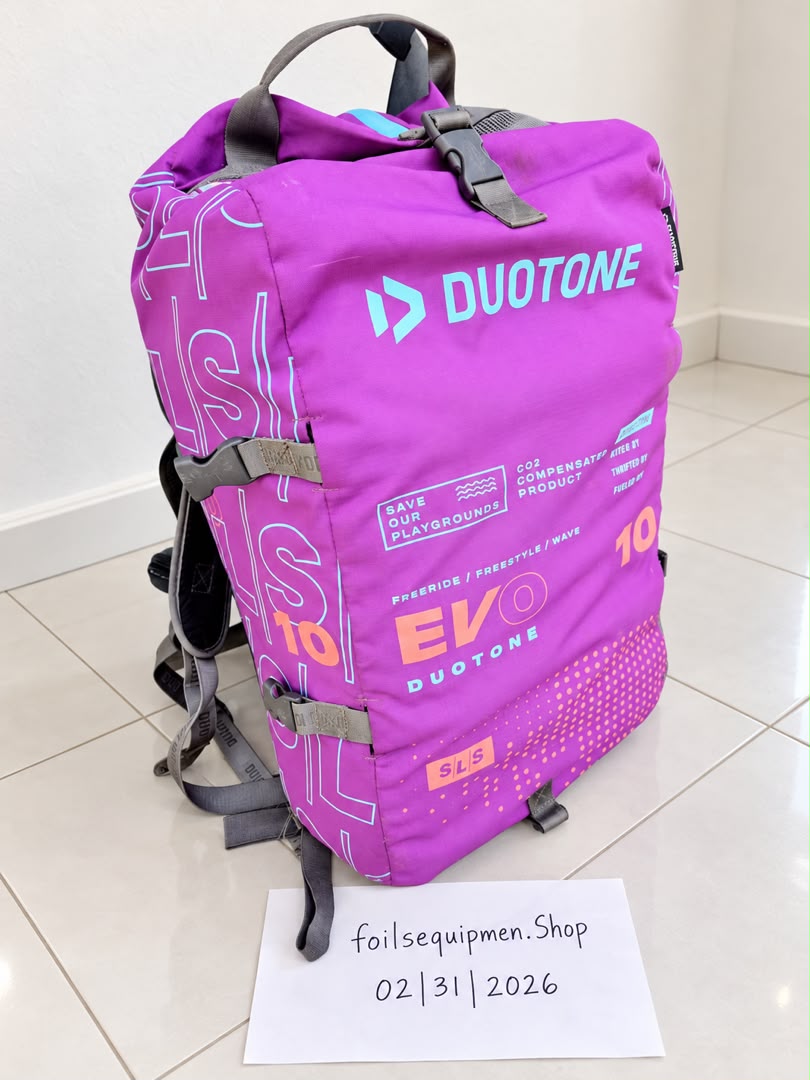
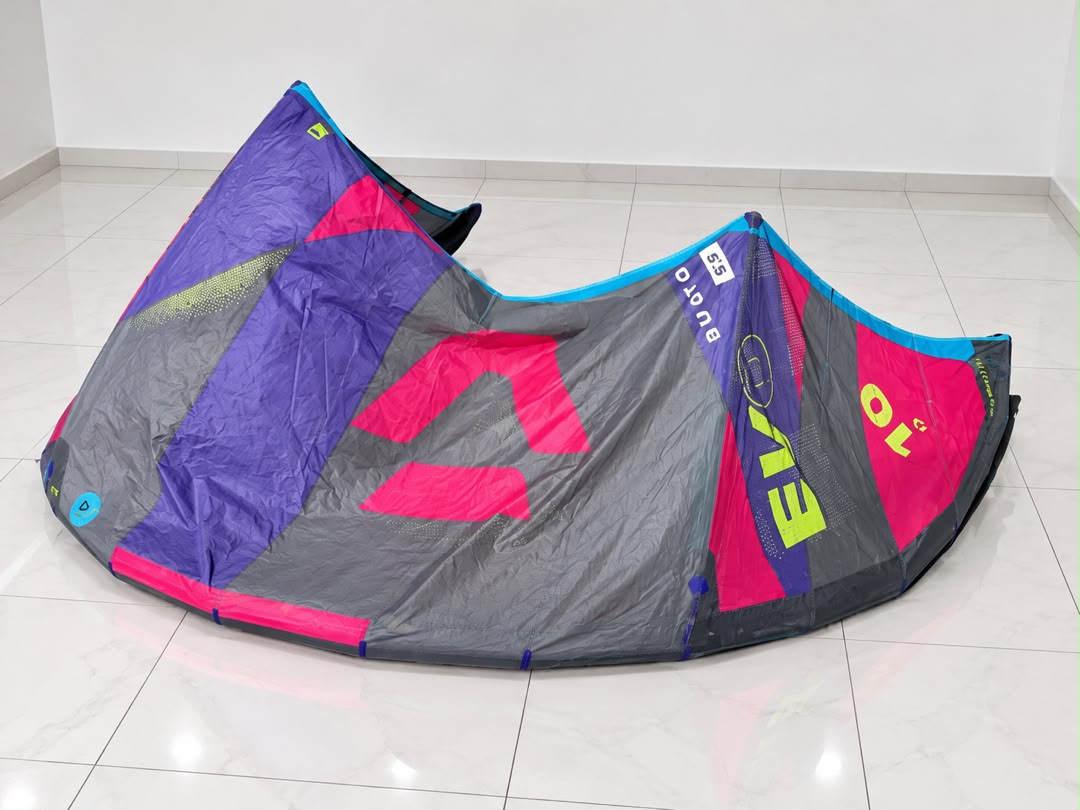
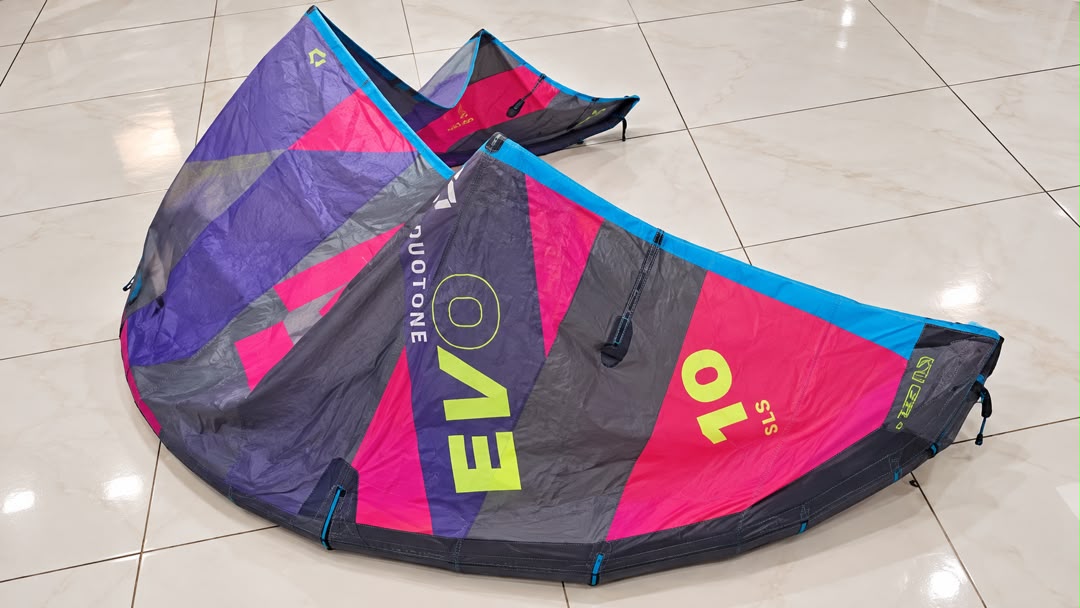
Duotone Evo SLS 10m
€400.00
The Duotone Evo SLS 10m is offered in excellent condition and has been professionally inspected to confirm its overall quality, condition, and readiness for use. It has been carefully checked and found to have no damage, no repairs, no tears, no punctures, and no significant structural defects. The kite has been well maintained and is ready for many more sessions, rides, and jumps.
Every component has been carefully inspected, including the 10m canopy, leading edge, struts, bridle system, inflation valves, bladder, seams, stitching, attachment points, and related hardware. The equipment has been checked for previous repairs, excessive wear, abrasion, leaks, deformation, and other visible defects.
Included components:
- Duotone Evo SLS 10m kite
- Main canopy
- Leading edge
- Struts
- Bridle system
- Inflation valves and bladder
- Attachment points
- Related hardware
- Storage/transport bag, if included
- Other included accessories
No tears, repairs, punctures, or significant damage have been found. The kite remains clean, solid, and well maintained.
The Duotone Evo SLS 10m is ready to use and ready for many more sessions, rides, and jumps again. It is an excellent option for freeride, carving, wave riding, transitions, jumping, big-air progression, and general kiteboarding. A complete pre-use inspection should always be performed before returning safety-critical equipment to the water.
Description
Duotone Evo SLS 10m – Versatile Freeride and Performance Kite
The Duotone Evo SLS 10m has been developed for riders seeking a versatile combination of power, control, stability, and responsive handling. A 10 m² configuration is provided, making this kite particularly well suited to freeride sessions, jumps, big-air progression, transitions, and general performance-oriented riding
With its SLS construction, weight can be reduced while structural performance is maintained. Consequently, the kite can be handled efficiently during steering, relaunching, jumping, and directional changes. Furthermore, the design is intended to provide accessible handling while still offering enough performance for riders who want to progress.
SLS Construction
The SLS construction is intended to provide an effective balance between durability, weight, and performance.
As the kite is loaded during powered riding, structural forces are transferred through the leading edge and struts. Consequently, a rigid and responsive framework can be maintained.
Moreover, reduced weight can help the kite respond quickly when steering input is applied.
Key Product Highlights
- Duotone Evo SLS 10m
- 10 m² kite size
- SLS performance construction
- Lightweight-oriented design
- Responsive steering
- Stable handling
- Efficient power delivery
- Controlled depower
- Easy relaunch characteristics
- Freeride applications
- Jumping and big-air potential
- Carving performance
- Transition-friendly handling
- Suitable for rider progression
- Versatile all-around configuration
10m² Configuration
A 10 m² kite provides a useful balance between power and maneuverability.
Consequently, it can be selected by riders who need sufficient power for reliable sessions while still wanting a manageable kite for turns and transitions.
The appropriate wind range will depend on rider weight, board type, skill level, water conditions, and local safety factors. Therefore, the 10 m² size should always be considered as part of the complete kite setup.
Responsive Steering
Responsive steering allows the kite to react efficiently to rider input.
As the bar is moved, the kite can change direction progressively. Consequently, controlled turns and transitions can be developed.
Furthermore, responsive steering can be valuable during jumping, carving, and wave-oriented riding.
Power Delivery
The Evo SLS has been designed to provide usable and predictable power.
As the kite is positioned within the wind window, power can be generated efficiently.
Consequently, board speed can be increased before the rider initiates a maneuver.
Once sufficient speed has been developed, the kite can be repositioned to maintain a balanced amount of pull.
Depower Control
Effective depower is important when wind strength changes.
As the bar is adjusted, the kite’s power can be regulated.
Consequently, the rider can manage gusts and changing wind conditions more effectively.
Proper technique remains essential, particularly when riding near the upper end of the appropriate wind range.
Freeride Performance
Freeride is one of the strongest applications for the Duotone Evo SLS 10m.
Cruising, carving, transitions, jumps, and general kiteboarding can all be supported.
Consequently, the 10 m² configuration can function as a versatile addition to a multi-kite quiver.
Jumping
The Evo SLS platform can be used for riders developing their jumping technique.
As speed and kite position are coordinated, upward lift can be generated.
Consequently, controlled jumps can be developed progressively.
The kite’s responsive handling can also assist with repositioning during aerial maneuvers.
Big-Air Progression
More advanced riders can use the kite for suitable big-air applications.
As the kite is sent through the wind window, lift can be generated when the timing and conditions are appropriate.
Consequently, experienced riders can work toward higher and more dynamic jumps.
Big-air riding should only be attempted with appropriate training, equipment, conditions, and safety procedures.
Carving
Carving requires smooth interaction between the board and kite.
As the rider initiates a turn, the kite can be steered to maintain useful power.
Consequently, controlled arcs can be developed while speed is carried through the turn.
The responsive handling can be particularly useful when linking several turns together.
Transitions
Transitions require the kite to be repositioned accurately.
As the rider changes direction, the kite can be moved through the wind window.
Consequently, the board can be redirected while sufficient power is maintained.
The 10 m² size can provide a useful balance between control and power during transitions.
Gybing
During a gybe, the kite needs to remain correctly positioned while the board changes direction.
As the rider moves through the turn, the kite can be steered progressively.
Consequently, a smoother exit can be achieved.
The responsive characteristics of the Evo SLS can be useful for riders developing faster gybes.
Jump Transitions
Jump transitions require greater coordination.
As the rider prepares for takeoff, the kite can be positioned to provide lift.
Once airborne, the kite can be redirected while the board is rotated.
Consequently, more advanced transition techniques can be developed.
Relaunch
Reliable relaunching is an important feature for recreational kiteboarding.
When the kite falls onto the water, appropriate bar and steering input can be used to encourage the kite back into the air.
Consequently, riding time can be recovered without requiring the rider to swim the kite back to shore.
Relaunch technique will depend on wind direction, water conditions, kite position, and rider experience.
Light-Wind Considerations
The 10 m² configuration can provide useful power in moderate conditions.
However, low-wind performance depends on several factors, including rider weight, board size, kite technique, and water conditions.
Consequently, a larger kite may be preferable when wind becomes very light.
Stronger-Wind Conditions
A 10 m² kite can also be useful when conditions become stronger, depending on the rider and setup.
As wind increases, appropriate depower and kite positioning become increasingly important.
Consequently, the rider can maintain better control.
The kite should never be used beyond its appropriate operating conditions.
Upwind Riding
Upwind performance depends on the interaction between kite, board, rider technique, and water conditions.
As the kite is positioned correctly, forward drive can be generated while the board maintains an efficient angle against the wind.
Consequently, ground can be gained upwind.
Board design and rider technique will strongly influence the achievable angle.
Downwind Riding
Downwind riding can be performed efficiently when the kite is positioned appropriately.
As the rider changes direction, the kite can be moved within the wind window.
Consequently, speed can be maintained while the board follows the desired course.
Wave Riding
The Evo SLS 10m can be used for suitable wave-riding applications.
As the rider approaches a wave, the kite can be repositioned to reduce excessive pull.
Consequently, more attention can be given to board and wave control.
The 10 m² size can provide useful power for riders who need additional drive between wave sections.
Kite Handling in Waves
Wave conditions can change rapidly.
As the rider moves across the wave face, the kite may need to be repositioned quickly.
Consequently, responsive steering can become valuable.
Riders should select conditions appropriate to their ability and equipment.
Foil Boarding
A 10 m² kite can potentially be used with suitable foil-board configurations when conditions and equipment are appropriate.
As the foil generates lift at lower board speeds, less kite power may be required.
Consequently, the kite can be flown more neutrally.
The appropriate kite size should be selected according to the foil, rider weight, and wind conditions.
Board Compatibility
Board choice has a major influence on kite performance.
A larger freeride board can provide easier acceleration and stability, while a smaller board can provide a more dynamic experience.
Consequently, the same 10 m² kite can feel different depending on the board being used.
Rider Weight
Rider weight should always be considered when selecting kite size.
A heavier rider generally requires greater power, while a lighter rider may require less.
Consequently, the 10 m² configuration should be matched to the rider’s weight, board, wind conditions, and intended discipline.
Bar and Lines
The kite should be used with a compatible control bar and correctly configured lines.
As steering and depower inputs are transferred through the bar system, correct setup is essential.
Consequently, line lengths, connections, safety systems, and bar components should be checked before every session.
Inflation
Correct inflation is important for maintaining the intended kite profile.
As the leading edge and struts are inflated to the manufacturer’s recommended pressure, the kite’s structure can be maintained.
Consequently, handling and stability can remain more consistent.
Under-inflation and over-inflation should both be avoided.
Leading-Edge Inspection
The leading edge should be inspected before every session.
Particular attention should be given to:
- Fabric
- Seams
- Stitching
- Inflation valve
- Bladder
- Attachment points
- Abrasion areas
- Leading-edge surface
Consequently, potential issues can be identified before launch.
Canopy Inspection
The canopy should be checked for tears, punctures, excessive wear, and damaged stitching.
As the canopy is repeatedly exposed to wind loading and environmental conditions, regular inspection should be maintained.
Consequently, developing problems can be identified early.
Bridle Inspection
The bridle system should be checked carefully.
Lines should be inspected for fraying, cuts, knots, abnormal wear, and other damage.
Consequently, potential control issues can be identified before use.
Any questionable bridle component should be professionally assessed.
Salt-Water Care
After salt-water use, the kite should be rinsed appropriately with fresh water.
Furthermore, it should be dried completely before long-term storage.
Consequently, salt accumulation can be minimized.
Sand Protection
Sand should be removed before packing whenever possible.
As sand becomes trapped against the canopy or valves, additional abrasion can occur.
Therefore, careful cleaning can help preserve the equipment.
UV Protection
Prolonged exposure to direct sunlight can contribute to material degradation.
Consequently, unnecessary UV exposure should be minimized when the kite is not being used.
The kite should be stored away from direct sunlight whenever practical.
Transportation
The kite should be transported in a suitable protective bag.
Sharp equipment should not be placed against the canopy.
Furthermore, excessive heat inside vehicles should be avoided.
Consequently, unnecessary punctures, abrasion, and material deterioration can be reduced.
Storage
The Duotone Evo SLS 10m should be stored in a clean, dry, and ventilated environment.
The kite should be completely dry before being packed away for extended periods.
Consequently, unnecessary moisture-related deterioration can be reduced.
Maintenance
Regular maintenance should be performed according to the manufacturer’s recommendations.
As flight hours accumulate, professional inspection can be valuable, particularly when the equipment has experienced heavy use, hard impacts, or unusual loading.
Consequently, the condition of the kite can be monitored more effectively.
Rider Progression
The Evo SLS 10m can support progression across several riding levels.
Basic Riding
Controlled power and board handling can be developed.
Freeride
Cruising and carving can be refined.
Transitions
Gybing and jumping transitions can be practiced.
Jumping
Aerial techniques can be developed progressively.
Advanced Riding
Higher-performance maneuvers can be explored by suitably experienced riders.
Consequently, the kite can remain useful as riding skills develop.
Practical Applications
The Duotone Evo SLS 10m can be considered for:
- Freeride kiteboarding
- Recreational kiteboarding
- Carving
- Jumping
- Big-air progression
- Transitions
- Gybing
- Wave riding
- Foil boarding
- Upwind riding
- Downwind riding
- General performance riding
Main Benefits at a Glance
- Duotone Evo SLS 10m
- 10 m² configuration
- SLS construction
- Lightweight-oriented design
- Responsive handling
- Efficient power delivery
- Controlled depower
- Relaunch capability
- Freeride versatility
- Carving performance
- Jumping potential
- Big-air applications
- Wave-riding potential
- Transition-friendly handling
- Rider progression
- Performance-focused design
Why Choose the Duotone Evo SLS 10m?
The Duotone Evo SLS 10m can be selected by riders who want a versatile kite that combines accessible handling with performance potential.
Its 10 m² size provides a practical balance between power and maneuverability, while the SLS construction is intended to reduce unnecessary weight and maintain responsive structural performance.
Furthermore, the kite can be adapted to several disciplines, including freeride, carving, jumping, transitions, wave riding, and suitable foil applications.
A Versatile Performance Kite
The Duotone Evo SLS 10m has been developed for riders who want dependable power, responsive handling, and broad riding potential.
Whether it is being used for freeride kiteboarding, carving, jumping, big-air progression, transitions, wave riding, foil boarding, or general recreational riding, the 10 m² configuration can provide a versatile platform when correctly matched to the rider and conditions.
For anyone seeking a Duotone Evo SLS 10m kite with lightweight-oriented construction, responsive steering, efficient power delivery, controlled depower, and versatile performance, this configuration offers a strong option for suitable riders.
Before every session, the canopy, leading edge, struts, valves, bladder, bridle, lines, bar, safety system, seams, stitching, and connection points should be carefully inspected. Correct inflation pressure should be maintained according to the manufacturer’s specifications, and the kite should always be used within conditions appropriate for the rider’s experience and complete equipment setup.
Duotone Evo SLS 10m – Practical Use and Performance
Designed for Versatile Riding
The Duotone Evo SLS 10m can be used across a broad range of kiteboarding disciplines. Its 10 m² configuration provides a useful balance between power, stability, and maneuverability, while its performance-oriented construction can support riders who want to progress beyond basic freeriding.
As riding skills develop, greater demands can be placed on kite control. Consequently, a responsive and predictable kite can be valuable during transitions, carving, jumping, and directional changes.
Freeride Sessions
Freeride remains one of the most practical applications for a 10 m² kite.
As the kite is positioned within the wind window, controlled power can be generated and transferred through the bar. Consequently, the board can be accelerated efficiently.
Once cruising speed has been established, the kite can be positioned more neutrally. Therefore, comfortable riding can be maintained without unnecessary steering input.
Cruising
Longer cruising sessions can be supported when wind conditions are appropriate.
As the rider travels across the water, the kite can be maintained in a stable position. Consequently, attention can be focused on board control and surroundings.
The 10 m² size can provide a practical compromise between power and handling for riders using an appropriately matched board.
Carving
Carving requires smooth coordination between the kite and board.
As the rider initiates a turn, the kite can be steered progressively. Consequently, power can be maintained while the board follows the intended arc.
Furthermore, responsive steering can make rapid direction changes easier to manage.
Aggressive Carving
More advanced carving requires precise control.
As the rider increases edge pressure, the kite can be redirected to maintain the desired pull.
Consequently, faster and tighter turns can be developed.
Technique remains critical, and advanced maneuvers should only be attempted within conditions appropriate for the rider.
Jumping
The Evo SLS 10m can be used for developing jumping skills.
As sufficient board speed is generated, the kite can be positioned to create lift.
Consequently, the rider can leave the water in a controlled manner.
Once airborne, appropriate kite steering can be used to manage the trajectory and prepare for landing.
Jump Progression
Jumping can be developed progressively.
Initially, controlled small jumps can be practiced. Subsequently, greater height and more complex movements can be introduced as skill improves.
Consequently, the kite can remain useful through several stages of progression.
Big-Air Riding
Experienced riders can use suitable conditions for more advanced big-air riding.
As the kite is sent through the wind window at the correct moment, significant lift can be generated.
Consequently, higher jumps can be performed.
However, big-air riding carries increased risk and should only be undertaken with suitable training, equipment, conditions, and safety preparation.
Jump Transitions
Jump transitions combine aerial movement with directional change.
As the kite is redirected during the jump, the board can be prepared for the new riding direction.
Consequently, more advanced transition techniques can be developed.
The rider’s timing and kite-control skills remain essential.
Gybing
Gybing requires coordination between board, kite, and body position.
As the rider changes direction, the kite can be steered through the wind window.
Consequently, a controlled exit can be achieved.
The 10 m² configuration can provide sufficient power for maintaining momentum during the maneuver when wind conditions are appropriate.
Fast Gybing
Advanced riders may increase gybing speed as technique improves.
As the board accelerates through the turn, precise kite positioning becomes increasingly important.
Consequently, responsive steering can be valuable.
The emphasis should remain on controlled execution rather than speed alone.
Transitions
Transitions are another strong application for the Evo SLS.
As the rider changes direction, the kite can be repositioned quickly.
Consequently, the new course can be established without excessive loss of speed.
The kite can therefore be used for both basic and advanced transition development.
Wave Riding
The Evo SLS 10m can be used for suitable wave-riding conditions.
As the rider approaches a wave, kite power can be adjusted according to the wave and wind.
Consequently, more control can be given to the board and wave line.
The kite can also be repositioned quickly when the rider moves across changing sections of the wave.
Wave Control
Wave riding requires careful management of power.
As the rider moves down the wave face, the kite can be moved toward a more neutral position.
Consequently, excessive pull can be reduced.
When additional power is required, the kite can be brought back into the wind window.
Downwind Riding
Downwind riding can be performed efficiently when the kite is appropriately positioned.
As the rider changes course, the kite can be moved to maintain controlled power.
Consequently, speed can be carried across the water.
The appropriate technique will depend on wind strength, board characteristics, and rider experience.
Upwind Performance
Upwind riding requires efficient edging and kite positioning.
As the kite provides forward drive, the board can be held against the water to create lateral resistance.
Consequently, the rider can make progress against the wind.
Board design, fin configuration, rider technique, and wind conditions will all influence performance.
Foil Boarding
The 10 m² kite can be used with suitable foil-board equipment when conditions are appropriate.
As the foil generates lift efficiently, less board speed may be required.
Consequently, the kite can be flown with reduced power once foil flight has been established.
The correct kite size should always be selected according to rider weight, foil efficiency, and wind strength.
Light-Wind Riding
A 10 m² kite can provide useful power in moderate conditions.
As the rider generates board speed, the kite can be worked through the wind window to maintain momentum.
Consequently, sessions can be continued when a smaller kite would provide insufficient power.
Nevertheless, extremely light conditions may require a larger kite or different equipment.
Gusty Conditions
Gusty wind requires active kite management.
As a gust arrives, the rider can adjust bar pressure and kite position.
Consequently, excessive power can be managed more effectively.
When the gust decreases, the kite can be repositioned to recover useful drive.
Stronger Wind
As wind strength increases, the 10 m² kite may become more powerful.
Consequently, appropriate depower and careful kite positioning become increasingly important.
The kite should always be used within its manufacturer’s recommended operating conditions and the rider’s ability.
Relaunching
Relaunch capability is important when the kite enters the water.
As appropriate steering input is applied, the kite can be encouraged toward the edge of the wind window.
Consequently, the canopy can be lifted from the water and relaunched.
Relaunch technique should be practiced in appropriate conditions before challenging sessions are attempted.
Water Relaunch Practice
Practicing relaunches can increase rider confidence.Duotone Evo SLS 10m
As the rider becomes familiar with the kite’s response, recovery can be performed more efficiently.
Consequently, less time can be spent waiting for the kite to return to the correct position.
Bar Control
The control bar provides the primary steering and depower interface.
As the bar is moved, steering and power inputs are transferred through the lines.
Consequently, correct bar technique is essential for predictable kite control.
The bar and lines should be checked before every session.Duotone Evo SLS 10m
Lines
The flying lines should be inspected regularly.
As lines are repeatedly loaded and exposed to sand, salt, UV radiation, and abrasion, deterioration can occur.Duotone Evo SLS 10m
Consequently, fraying, knots, cuts, or unusual stretching should not be ignored.
Bridle System
The bridle system should be inspected before use.Duotone Evo SLS 10m
As bridles contribute to kite steering and structural support, their condition is important.
Consequently, damaged or excessively worn bridle components should be professionally assessed.
Inflation
Correct inflation should always be followed.
As the leading edge and struts are inflated to the manufacturer’s specified pressure, the kite’s designed profile can be maintained.
Consequently, handling and stability can remain more predictable.
Under-inflation and over-inflation should both be avoided.Duotone Evo SLS 10m
Canopy Care
The canopy should be protected from unnecessary abrasion.Duotone Evo SLS 10m
As the kite is dragged across rocks, concrete, or rough ground, fabric damage can occur.
Consequently, careful handling should be maintained during setup and packing.
Leading Edge Care
The leading edge should be inspected for abrasion, cuts, and unusual wear.
Furthermore, sharp objects should be kept away from the inflated structure.
Consequently, puncture risks can be reduced.Duotone Evo SLS 10m
Salt-Water Maintenance
Salt water should be removed after use.Duotone Evo SLS 10m
As salt residue accumulates, unnecessary deterioration can occur.
Consequently, the kite should be rinsed appropriately and allowed to dry completely.
Sand Management
Sand should be removed before the kite is packed.Duotone Evo SLS 10m
As trapped sand can create abrasion when the canopy is folded, careful cleaning is recommended.
Consequently, unnecessary fabric wear can be minimized.Duotone Evo SLS 10m
UV Protection
Prolonged sunlight exposure can contribute to material deterioration.
Therefore, the kite should be protected from direct sunlight whenever it is not being used.
Consequently, canopy materials can be preserved more effectively.Duotone Evo SLS 10m
Transportation
The kite should be transported in an appropriate protective bag.
Sharp equipment should not be stored against the canopy.
Furthermore, excessive heat inside a vehicle should be avoided.
Consequently, unnecessary damage can be reduced.Duotone Evo SLS 10m
Storage
The Duotone Evo SLS 10m should be stored in a clean, dry, and ventilated environment.
The kite should be completely dry before long-term storage.
Consequently, moisture-related deterioration can be minimized.Duotone Evo SLS 10m
Pre-Session Inspection
A complete inspection should be performed before every session.
Particular attention should be given to:
- Canopy
- Leading edge
- Struts
- Bridle lines
- Flying lines
- Bar
- Safety release
- Inflation valves
- Bladder
- Seams
- Stitching
- Connection points
Consequently, potential problems can be identified before launch.
Rider Weight and Kite Size
Rider weight should always be considered when selecting a kite.
As rider weight increases, additional power may be required for comparable board acceleration.
Consequently, the 10 m² size may perform differently for different riders.
Board type, wind strength, riding style, and foil configuration should also be considered.
Board Selection
Board selection strongly influences kite performance.
A larger freeride board can provide earlier acceleration and greater stability.
Meanwhile, a smaller board can provide a more dynamic riding experience.
Consequently, the Evo SLS 10m should be paired with a board appropriate to the rider’s weight and intended discipline.Duotone Evo SLS 10m
Foil Selection
Foil efficiency can significantly affect the required kite size.Duotone Evo SLS 10m
As a larger or more efficient foil generates lift at lower speeds, the rider may require less kite power.
Consequently, the 10 m² configuration can be used differently depending on foil choice.
Rider Progression
The kite can support progression through multiple stages.
Basic Freeride
Controlled power and board handling can be developed.
Carving
More dynamic turns can be practiced.
Transitions
Gybing and directional changes can be refined.Duotone Evo SLS 10m
Jumping
Aerial techniques can be developed progressively.
Advanced Riding
Big-air and technical maneuvers can be explored by suitably experienced riders.
Consequently, the kite can remain useful as riding ability develops.Duotone Evo SLS 10m
Maintenance After Heavy Use
More frequent inspection should be considered after intensive sessions.
As repeated loading and environmental exposure accumulate, wear can become more noticeable.
Consequently, professional inspection may be appropriate when the kite has experienced heavy use or an unusual incident.Duotone Evo SLS 10m
After an Impact
The kite should be inspected after significant impact or abnormal loading.Duotone Evo SLS 10m
As damage may not always be immediately visible, critical components should be checked carefully.
Consequently, professional assessment should be obtained whenever structural condition is uncertain.Duotone Evo SLS 10m
Practical Applications
The Duotone Evo SLS 10m can be considered for:
- Freeride kiteboarding
- Recreational riding
- Carving
- Jumping
- Big-air progression
- Gybing
- Transitions
- Wave riding
- Foil boarding
- Upwind riding
- Downwind riding
- General performance riding
Main Advantages
- Duotone Evo SLS 10m
- 10 m² configuration
- SLS construction
- Lightweight-oriented design
- Responsive steering
- Stable handling
- Efficient power delivery
- Controlled depower
- Relaunch capability
- Freeride versatility
- Carving performance
- Jumping potential
- Big-air applications
- Wave-riding potential
- Transition-friendly handling
- Rider progression
Why Choose the Evo SLS 10m?
The Duotone Evo SLS 10m can be an excellent option for riders who want one versatile kite capable of supporting several riding disciplines.Duotone Evo SLS 10m
Its combination of responsive handling, useful power, controlled depower, and practical relaunch characteristics can make it suitable for riders progressing from freeride toward more technical riding.
Furthermore, the 10 m² size can be incorporated into a multi-kite quiver where complementary smaller and larger sizes are selected for different wind conditions.Duotone Evo SLS 10m
A Versatile Performance Kite
The Duotone Evo SLS 10m has been developed to provide a balanced combination of power, control, maneuverability, and progression potential.Duotone Evo SLS 10m
Whether it is being used for freeride, cruising, carving, jumping, big-air progression, wave riding, foil boarding, gybing, transitions, or general kiteboarding, its performance will depend on correct equipment matching and suitable conditions.
For riders seeking a Duotone Evo SLS 10m kite with responsive steering, efficient power delivery, controlled depower, stable handling, and broad riding applications, this 10 m² configuration provides a versatile performance-focused choice.
Before every session, the canopy, leading edge, struts, bridle, flying lines, bar, safety system, valves, bladder, seams, stitching, and connection points should be carefully inspected. Correct inflation pressure should be maintained according to the manufacturer’s specifications, and the kite should only be used within conditions appropriate for the rider’s experience and complete equipment setup.


Reviews
There are no reviews yet.