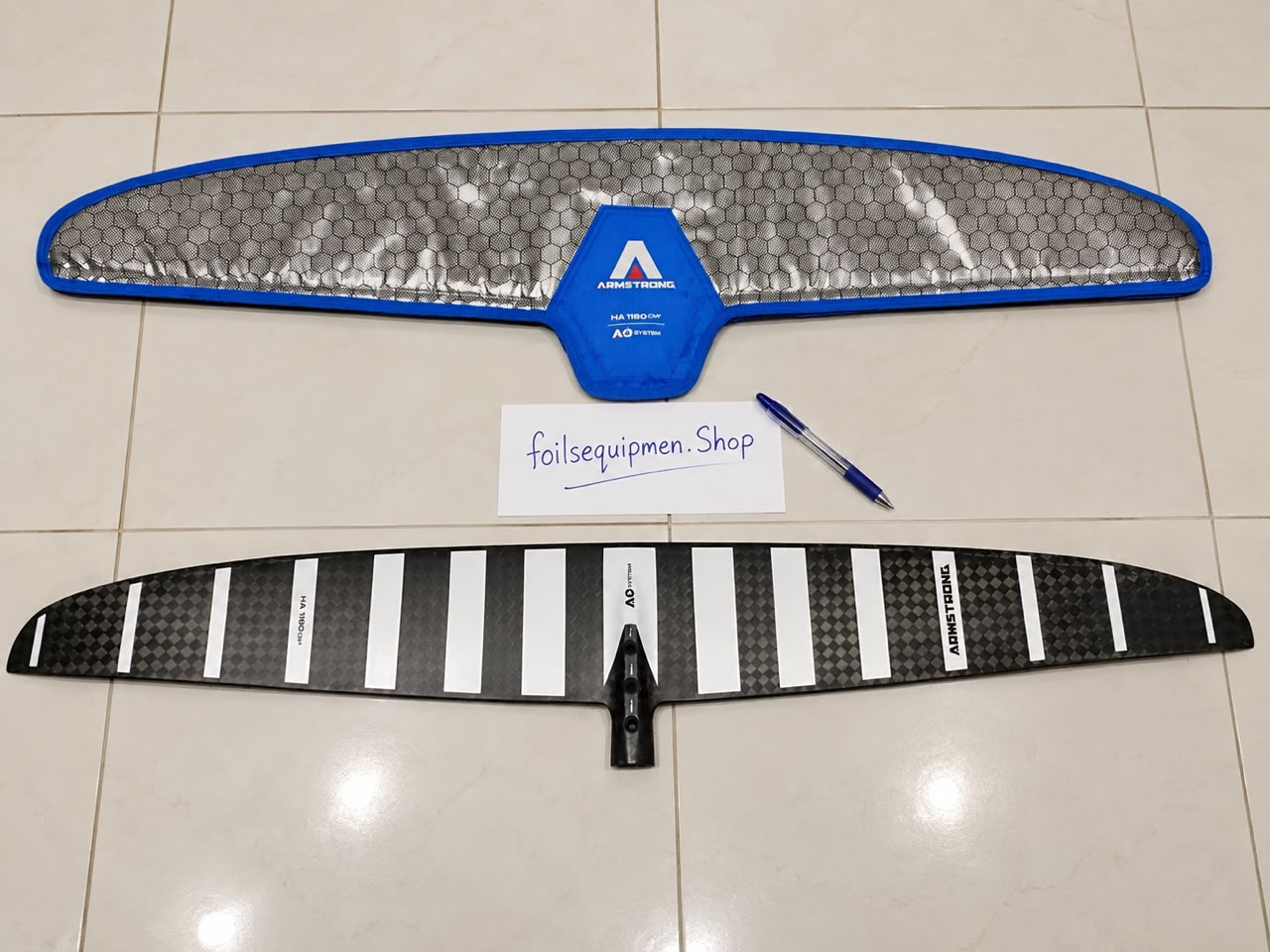


Armstrong HA 1180
€300.00
The Armstrong HA 1180 is offered in excellent condition and has been professionally inspected to confirm its overall quality, condition, and readiness for use. The front foil has been carefully checked and found to have no damage, no repairs, no cracks, no tears, and no structural issues. It has been well maintained and is ready for many more sessions and jumps.
Every component has been carefully inspected, including the front wing, leading edge, trailing edge, foil surface, mounting interface, fuselage connection, screws, bolts, and fittings. The foil has been checked for impact damage, deformation, previous repairs, and excessive wear.
Included components:
- Armstrong HA 1180 front foil
- Front-wing mounting interface
- Compatible mounting hardware
- Screws and bolts
- Fuselage connection fittings
- Protective storage equipment, if included
No cracks, repairs, structural damage, or significant defects are present. The foil remains clean, solid, and well maintained.
The Armstrong HA 1180 is ready to use and ready for many more foil sessions and jumps again. It is an excellent choice for wing foiling, surf foiling, downwind foiling, pumping, carving, and advanced glide-focused riding.
A final pre-use inspection should always be completed, and all mounting hardware should be correctly secured before entering the water.
Description
Armstrong HA 1180 – High Aspect Front Foil for Glide, Lift and Advanced Foiling
The Armstrong HA 1180 has been developed for riders seeking an advanced high-aspect front foil with exceptional glide, efficient low-speed lift, high-speed stability, and responsive handling. With an area of 1180 cm², a 1066 mm span, and a 9.63 aspect ratio, a powerful combination of efficiency and maneuverability is provided.
Designed as part of Armstrong’s HA High Aspect range, the HA 1180 has been engineered for riders who want to connect bumps, extend flights, pump efficiently, and maintain speed through turns. Consequently, the foil can be used across wing foiling, surf foiling, downwind foiling, and other advanced applications where glide and efficient lift are highly valued
High Aspect Design for Efficient Glide
A high-aspect outline is incorporated into the Armstrong HA 1180, allowing efficient lift to be generated while drag is reduced. As a result, speed can be maintained efficiently once the foil has become airborne.
Furthermore, the long 1066 mm span provides a substantial lifting platform while the 9.63 aspect ratio promotes efficient flight. Therefore, longer glides and smoother connections between sections can be achieved when appropriate technique and conditions are available.
Key Product Highlights
- Armstrong HA 1180 front foil
- 1180 cm² surface area
- 1066 mm wingspan
- 9.63 aspect ratio
- High Aspect performance design
- Excellent low-speed lift
- Long-distance glide potential
- Efficient pumping characteristics
- High-speed stability
- Responsive turning
- Suitable for wing foiling
- Suitable for surf foiling
- Suitable for downwind foiling
- Designed for experienced foil riders
- Armstrong A+ System compatibility
Low-Speed Lift
A major advantage of the HA design is the amount of lift that can be generated at relatively low speeds. Therefore, the HA 1180 can provide useful support during takeoff and slower sections of a session.
Because the foil section has been designed to generate strong low-end lift for its size, a smaller and more maneuverable foil can potentially be used across a broader range of conditions. Consequently, riders can spend more time flying and less time changing equipment.
Long-Range Glide Performance
Glide efficiency becomes particularly important when external power is reduced. Whether a rider is connecting ocean bumps, linking waves, or continuing after a wing has been depowered, efficient glide can provide significant advantages.
The Armstrong HA 1180 has been designed around this principle. As speed is carried through the foil, energy can be retained efficiently, allowing longer flight sections to be connected.
Furthermore, reduced drag can help preserve forward momentum. Consequently, experienced riders can explore longer connections and more fluid lines.
Efficient Pumping
Pumping is an important technique for advanced foil riders. Therefore, a front wing must respond efficiently to changes in rider pressure.
The HA design has been developed to provide low-speed lift together with efficient glide. As a result, pumping movements can be converted into useful forward movement when the rider’s technique and equipment setup are appropriate.
Moreover, the HA 1180 can provide a useful platform for riders who want to develop more efficient pumping rather than relying entirely on external power.
Active Pitch Stability
High-aspect foils can sometimes demand greater pitch control. Therefore, Armstrong’s trailing-edge reflex has been incorporated into the HA design.
This feature has been designed to provide active pitch stability, allowing control to be maintained at speed and during maneuvers. Consequently, the foil can feel more predictable when it is being pushed through demanding turns or higher-speed sections.
For riders progressing into high-aspect foiling, this characteristic can be particularly valuable.
High-Speed Stability
The Armstrong HA 1180 has not been designed solely for low-speed performance. Instead, a broad operating range has been created.
As speed increases, stability can be maintained while the foil continues to generate efficient lift. Consequently, riders can transition from slow takeoff and pumping into faster freeride or downwind sections without requiring an immediate equipment change.
Furthermore, high-speed stability can provide confidence when the foil is being used in open-water conditions.
Responsive Turning
Despite its high-aspect configuration, the HA range has been developed to retain a lively and responsive feel through turns.
When rider pressure is transferred through the board and mast, the foil can be rolled into a turn. Consequently, connected carving can be performed without the handling becoming excessively sluggish.
Moreover, the HA 1180 can be used for riders who want to combine efficient straight-line glide with responsive directional changes.
Wing Foiling Applications
The Armstrong HA 1180 can be used in wing-foil setups where efficient glide and low-speed lift are prioritized.
During takeoff, useful low-end lift can assist the rider in becoming airborne. Once flying, the foil can be accelerated and allowed to glide efficiently.
As the rider approaches a transition or weaker wind section, the efficient foil profile can help preserve momentum.
Therefore, the HA 1180 can be particularly useful for riders who want to maximize flight time and explore longer foil connections.
Surf Foiling Applications
Surf foiling requires a front wing that can generate lift while remaining efficient through turns. Therefore, the HA 1180 can be considered for experienced surf foilers who want extended glide and smooth energy retention.
Once a wave has provided sufficient speed, the foil can carry momentum through sections of the wave. Consequently, longer lines can be connected while the rider works with the natural energy of the water.
Furthermore, the foil’s responsive characteristics can be used to redirect the board during turns.
Downwind Foiling
Downwind foiling places considerable emphasis on glide efficiency. Instead of relying continuously on a wing or tow source, the rider must capture and connect energy from bumps and moving water.
Because of this, the Armstrong HA 1180 can be particularly attractive for experienced downwind foilers.
The high-aspect profile can allow speed to be carried efficiently between bumps. Consequently, connections can be extended when the rider has developed appropriate pumping, positioning, and reading skills.
Pump Foiling and Connection Riding
Efficient connection between bumps can be enhanced when drag is minimized. Therefore, the HA 1180 can be used by riders developing advanced pumping and glide techniques.
A controlled pumping rhythm can be established while the foil remains airborne. As a result, energy can be transferred progressively rather than through excessive movement.
Additionally, the 1180 cm² area provides substantial lift while the high aspect ratio keeps the platform performance-oriented.
Who Is the HA 1180 Designed For?
The Armstrong HA 1180 is intended primarily for riders with established foil skills. Armstrong describes the HA range as its highest-performance foil family and indicates that it is best suited to riders who already have confidence on HS foils.
It can therefore be considered for:
- Experienced wing foilers
- Advanced surf foilers
- Downwind foil riders
- Pump-foil enthusiasts
- Riders developing long-distance glide
- Experienced riders seeking efficient low-speed lift
- Foilers progressing toward high-aspect equipment
Beginners may find a more forgiving foil better suited to initial learning.
Armstrong A+ System Integration
The HA 1180 is integrated into Armstrong’s A+ foil system. The A+ System has been designed to connect the mast, fuselage, front foil, and stabilizer into a rigid and modular assembly.
Consequently, compatible components can be combined to create a complete foil setup suited to different disciplines.
The system is also designed around precise connections and torsional stiffness. Therefore, direct feedback can be maintained between rider input and foil response.
Complete Setup Considerations
The performance of the Armstrong HA 1180 will depend on the complete foil configuration.
Mast length, fuselage choice, stabilizer size, board characteristics, rider weight, and environmental conditions should all be considered.
A suitable stabilizer can influence pitch control and turning behavior. Meanwhile, mast length can affect clearance, leverage, and overall handling.
Therefore, the HA 1180 should be selected as part of a complete system rather than considered independently.
Maintenance and Care
Regular inspection should be performed before every session. The leading edge, trailing edge, foil surface, mounting area, fuselage connection, screws, and hardware should be checked carefully.
After salt-water use, appropriate rinsing should be performed. Furthermore, the foil should be dried before storage.
Impacts should be avoided whenever possible, particularly around the leading and trailing edges. Any crack, deformation, unusual movement, or structural concern should be professionally assessed before the foil is returned to the water.
Main Advantages at a Glance
- 1180 cm² high-aspect front foil
- 1066 mm span
- 9.63 aspect ratio
- Excellent low-speed lift
- Long glide potential
- Efficient pumping
- High-speed stability
- Responsive turning
- Active pitch stability
- Wing-foil compatibility
- Surf-foil capability
- Downwind-foil potential
- Advanced performance characteristics
- A+ System integration
Why Choose the Armstrong HA 1180?
The Armstrong HA 1180 has been developed for riders who want to push beyond conventional foil cruising and explore more efficient glide-based riding.
A high-aspect platform is combined with low-speed lift, high-speed stability, responsive turning, and efficient pumping. Consequently, the foil can support a wide variety of advanced riding applications.
Whether the objective is to connect bumps while downwind foiling, extend surf-foil runs, improve wing-foil glide, or develop more efficient pumping, the HA 1180 can provide a highly capable platform.
A High-Aspect Foil for Advanced Progression
The Armstrong HA 1180 represents a performance-oriented approach to high-aspect foiling. Its 1180 cm² area, 1066 mm span, and 9.63 aspect ratio have been designed to combine lift, glide efficiency, stability, and maneuverability.
For experienced riders seeking low-speed lift, long glide, efficient pumping, high-speed control, and responsive turning, the HA 1180 provides a versatile front foil for demanding wing, surf, downwind, and advanced foil sessions.
Armstrong HA 1180 – Advanced Foiling Performance
Built for Efficient Long-Distance Flight
Greater efficiency is required when foil riding is extended beyond conventional freeride sessions. Therefore, the Armstrong HA 1180 has been designed for riders who want to maintain speed, connect bumps, and maximize time spent in flight.
A high-aspect configuration is used to reduce drag while maintaining useful lift. Consequently, momentum can be preserved more effectively once the foil has accelerated.
Furthermore, the 1180 cm² area provides substantial lift, while the long span allows the wing to remain efficient through longer glide sections.
Advanced Glide Characteristics
Glide efficiency becomes especially important when external power is reduced. Whether the rider is moving between ocean bumps, connecting wave sections, or continuing after a powered run, momentum must be retained efficiently.
The HA 1180 has been developed around this requirement. As speed is carried through the foil, efficient lift generation can allow the rider to continue flying without requiring constant pumping.
Consequently, longer connections can be achieved when suitable technique and conditions are available.
Moreover, the high-aspect profile can provide a smooth sensation during sustained flight.
Low-Speed Performance
A large front-wing area can provide valuable low-speed lift. Therefore, the 1180 cm² HA 1180 can be used when efficient takeoffs and slower-speed flight are required.
As the rider approaches foil speed, lift can be generated progressively. Consequently, the transition from board-on-water riding to sustained flight can be made more efficiently.
Furthermore, the low-speed capability can be useful when energy is being captured from small bumps or weak wave sections.
This characteristic can also be beneficial during advanced pumping, where maintaining flight at lower speeds is essential.
Efficient Pumping
Pumping requires a careful combination of pitch control, weight transfer, and foil response. Because of this, an efficient front wing can make a significant difference.
The Armstrong HA 1180 has been designed to generate useful lift while maintaining low drag. Consequently, rider input can be converted into forward movement efficiently when correct pumping technique is used.
Furthermore, the foil can be used for longer pumping sequences where maintaining speed is more important than generating explosive acceleration.
Pumping Applications
The HA 1180 can be considered for:
- Connecting ocean bumps
- Downwind foil progression
- Pump foiling
- Linking wave sections
- Maintaining flight through wind lulls
- Advanced wing-foil pumping
- Long-distance foil sessions
High-Speed Efficiency
High-aspect foils are often selected for their ability to maintain speed efficiently. Therefore, the HA 1180 can provide a strong platform for riders who want to move from slower glide into faster flight.
As speed increases, drag can remain relatively low. Consequently, momentum can be retained with less unnecessary energy loss.
Furthermore, the foil can remain controlled when higher speeds are reached, provided that the complete setup has been matched correctly to the rider and conditions.
Turning and Carving
High-aspect foils can be designed around efficiency without eliminating turning capability. Therefore, the HA 1180 has been developed to provide a balance between glide and responsive handling.
As pressure is shifted through the board, the foil can be rolled into a turn. Consequently, directional changes can be made while forward momentum is retained.
Moreover, the foil can be used for connected carving when sufficient rider skill and speed are available.
Active Pitch Stability
Pitch control becomes increasingly important when a long-span foil is being ridden at speed. Therefore, active pitch stability has been incorporated into the HA design.
The trailing-edge reflex is intended to assist with pitch control and stability. Consequently, the rider can be provided with a more predictable platform during acceleration, glide, and turning.
This can be particularly valuable during advanced maneuvers where the foil is being pushed through changing loads.
Downwind Foiling
Downwind foiling places strong emphasis on glide, acceleration, and energy management. Therefore, the Armstrong HA 1180 can be an attractive option for experienced riders pursuing this discipline.
As the rider approaches an ocean bump, speed can be generated through efficient positioning. Once the foil is lifted, the high-aspect design can allow momentum to be carried into the next section.
Consequently, more efficient connections between bumps can be developed.
The rider’s ability to read water movement remains essential, however, because foil performance alone cannot replace correct positioning and technique.
Surf Foiling
Surf foiling requires efficient lift and predictable turning. Because of this, the HA 1180 can be used for advanced surf sessions where longer glide is desired.
Once a wave has generated sufficient speed, the foil can carry momentum through the section. Consequently, longer lines can be connected while the rider works with the natural energy of the wave.
Furthermore, the responsive handling can allow direction to be changed without sacrificing excessive speed.
Wing Foiling
The HA 1180 can also be used in wing-foiling configurations where low-speed lift and glide efficiency are prioritized.
During takeoff, the larger surface area can assist with early foil lift. Once airborne, the rider can reduce wing input and allow the foil to carry speed efficiently.
As a result, longer periods of flight can be achieved with reduced reliance on continuous wing power.
This can be especially useful when wind strength becomes inconsistent or when riders want to develop foil-first riding techniques.
Pump Foiling
Pump foiling demands efficient lift and minimal drag. Therefore, the HA 1180 can provide an effective platform for experienced riders developing continuous pumping.
Weight can be transferred rhythmically through the board while the foil is maintained at an efficient angle of attack.Armstrong HA 1180
Consequently, forward movement can be maintained without requiring excessive wing or wave energy.Armstrong HA 1180
However, the rider’s technique remains a major factor in pumping performance.
Choosing the Correct Stabilizer
The stabilizer should be selected carefully when the HA 1180 is being assembled into a complete setup.Armstrong HA 1180
A stabilizer with more area can provide additional pitch support and stability, while a smaller stabilizer can create a more responsive configuration.Armstrong HA 1180
Therefore, stabilizer selection should be based on rider preference, experience, mast length, fuselage configuration, and intended discipline.Armstrong HA 1180
Mast and Fuselage Considerations
Mast length can influence the overall feel of the HA 1180.
A longer mast can provide additional clearance and leverage, while a shorter mast can provide a more accessible setup for certain conditions.
Similarly, fuselage configuration can influence pitch balance, turning response, and overall stability.
Consequently, the front wing should always be considered together with the rest of the Armstrong foil system.Armstrong HA 1180
Rider Skill and Progression
The Armstrong HA 1180 is best suited to riders who already have reliable foil control.
Intermediate-to-Advanced Riders
The wing can be used to develop longer glides, efficient pumping, and improved high-aspect control.
Advanced Riders
Downwind connections, surf-foil runs, high-speed carving, and advanced pumping can be explored.
Experienced Foilers
Long-distance glide, advanced bump connection, and highly efficient foil techniques can be developed.Armstrong HA 1180
Therefore, the HA 1180 can remain useful as rider ability continues to progress.
Equipment Matching
The final performance of the Armstrong HA 1180 will depend on several factors.
Rider weight, board volume, mast length, stabilizer size, fuselage configuration, wind strength, wave energy, and riding technique should all be considered.Armstrong HA 1180
Consequently, the same front wing can feel significantly different when used with different supporting components.Armstrong HA 1180
Proper equipment matching should therefore be prioritized.Armstrong HA 1180
Maintenance and Care
Regular inspection should be performed before every session.
Particular attention should be given to:
- Leading edge
- Trailing edge
- Foil surface
- Mounting interface
- Fuselage connection
- Screws and hardware
- Signs of impact or deformation
After salt-water use, the foil should be rinsed appropriately and dried before storage.
Furthermore, impacts against rocks, sand, or hard surfaces should be avoided. Any crack, deformation, or unusual movement should be professionally assessed before the foil is used again.
Key Performance Advantages
- 1180 cm² high-aspect front wing
- 1066 mm wingspan
- 9.63 aspect ratio
- Efficient glide
- Strong low-speed lift
- Excellent pumping potential
- High-speed efficiency
- Active pitch stability
- Responsive carving
- Downwind capability
- Surf-foiling potential
- Wing-foiling versatility
- Advanced performance platform
Why the HA 1180 Is Different
The Armstrong HA 1180 has been developed around efficiency rather than simply maximum lift.
Its high-aspect geometry allows the foil to maintain speed effectively, while the substantial 1180 cm² area provides useful lift during slower sections.Armstrong HA 1180
Consequently, riders can explore a different style of foiling where glide, momentum, and energy conservation become central to the experience.Armstrong HA 1180
A High-Aspect Platform for Serious Foil Progression
The Armstrong HA 1180 provides an advanced combination of low-speed lift, efficient glide, high-speed stability, pumping capability, and responsive turning.
For wing foilers, surf foilers, downwind riders, and experienced pump foilers, a broad range of advanced applications can be supported.
Ultimately, the HA 1180 is best suited to riders who want to spend more time flying, carry speed more efficiently, and develop a more refined high-aspect foil technique.
Reviews
There are no reviews yet.