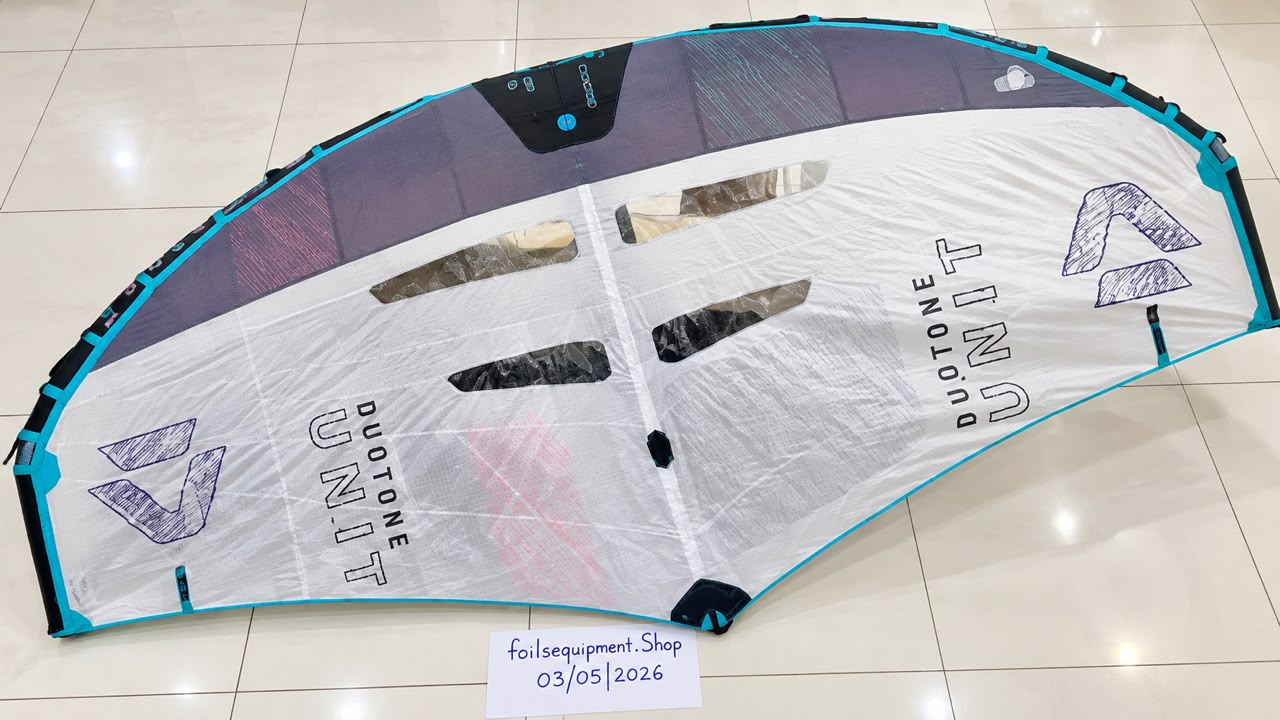

5m Duotone Unit
€250.00
The Duotone Unit 5m is offered in excellent condition and has been professionally inspected to confirm its overall quality, condition, and readiness for use. It has been carefully checked and is reported to have no tears, no punctures, no damage, and no previous repairs. The wing has been well maintained and is ready for many more sessions, flights, and jumps again.
Every major component has been carefully inspected, including the main canopy, leading edge, strut, seams, valves, inflation system, connection points, leash attachment, and control areas. The wing has also been checked for abrasion, excessive wear, deformation, air leakage, damaged stitching, and other visible defects.
Included components:
- Duotone Unit 5m wing
- Main canopy
- Leading edge
- Strut
- Inflation valve
- Connection points
- Leash attachment point
- Storage/transport bag, if included
- Fusion handles or boom, if included
- Other included accessories, if applicable
No tears, repairs, or significant damage have been identified during inspection. The wing remains clean, well cared for, and in excellent overall condition.
The Duotone Unit 5m is ready to use and ready for many more wing-foiling sessions, freeride, wave riding, carving, pumping, and suitable jumps again. A qualified professional should always complete the appropriate pre-use inspection before returning safety-critical equipment to the water.
Description
5m Duotone Unit
Duotone Unit 5m
The Duotone Unit 5m has been developed as a versatile wing for riders who want a balanced combination of power, control, stability, and maneuverability. For the 2026 generation, the design has been refined to provide more efficient power generation, improved drift stability, and sharper steering when riding waves. Consequently, a highly adaptable wing has been created for freeride, freestyle, wave riding, and downwind-oriented sessions
A more intuitive on/off power response has been introduced, allowing power to be engaged or reduced with greater predictability. Furthermore, the Unit can be configured with either Fusion handles or the Fusion boom, allowing the setup to be adapted to individual riding preferences. The wing itself is supplied without handles or boom, so the appropriate Fusion control system needs to be selected separately.
5m Configuration
The 5m size has been positioned as a versatile mid-range option within the 2026 Unit collection.
According to published specifications, the 5.0m Unit 2026 is listed with a 10–25 knot recommended wind range, approximately 2.36 kg of weight without handles or boom, a 335 cm wingspan, and a maximum inflation pressure of 8 PSI. A compatible L-size Fusion handle or L-size Fusion boom is specified for this size.
Actual suitability will depend on rider weight, board volume, foil size, riding style, wind consistency, and local conditions. Consequently, the published range should be treated as a reference rather than a guarantee for every rider.
Key Product Highlights
- Duotone Unit 5m
- 5.0 m² wing size
- 2026 Unit generation
- Freeride performance
- Freestyle capability
- Wave-riding versatility
- Downwind applications
- Direct and intuitive power delivery
- Improved drift stability
- Enhanced wave steering
- Optimized sheeting angles
- Compact and balanced outline
- MOD3 S canopy
- Fusion handle compatibility
- Fusion boom compatibility
- Approximately 2.36 kg without handles or boom
- Approximately 335 cm wingspan
- Maximum inflation pressure: 8 PSI
- Recommended wind range: approximately 10–25 knots
Direct Handling
Direct handling has been emphasized throughout the 2026 Unit design.
As the rider applies input through the control system, the wing can respond intuitively. Consequently, power can be adjusted smoothly while the rider maintains control of the board and foil.
This characteristic can be especially useful during transitions, wave riding, carving, and freestyle maneuvers.
Intuitive Power Development
A refined on/off power response has been incorporated into the Unit.
As power is required, it can be engaged progressively. Conversely, when less pull is desired, the wing can be depowered more intuitively.
Consequently, energy management can be made easier across changing conditions.
Optimized Sheeting Angles
The 2026 Unit has been redesigned around optimized sheeting angles.
A reduced profile depth has been incorporated through the center, while increased profile has been provided around the quarter-span areas. Consequently, efficient power generation and improved responsiveness can be achieved across the wing.
The result is intended to be a more effective connection between the rider and the available wind.
Instant Power Delivery
Power can be generated efficiently as the wing is positioned correctly.
As the wing is sheeted in, the aerodynamic profile can produce useful forward drive. Consequently, the rider can accelerate the board and generate foil lift.
This can be particularly beneficial when starting from slower speeds or when moving through lighter sections of wind.
Improved Top-End Performance
Top-end control has also been considered within the updated profile.
As wind strength increases, the wing can be managed through appropriate sheeting and positioning.
Consequently, a broader range of usable conditions can be supported, although the rider’s weight and skill level remain important factors.
Drift Stability
Improved drift stability has been introduced for the 2026 Unit.
As the wing is flagged while riding a wave or swell, stability becomes increasingly important.
Consequently, the canopy can remain more controlled while the rider concentrates on the foil, wave face, and direction of travel.
Wave Steering
Wave steering has been refined to provide improved maneuverability.
As the rider moves across a wave face, the wing can be positioned more neutrally.
Consequently, the rider can focus more attention on carving and wave selection.
Wave Riding
The Unit 5m can be used effectively for suitable wave-riding sessions.
As a wave is approached, the wing can provide the required power for acceleration. Once the rider is established on the wave, the wing can be depowered or flagged as appropriate.
Consequently, the foil can become the primary source of movement while the wing remains manageable in the rider’s hands.
Freeride Foiling
Freeride remains one of the principal applications of the Unit.
As the rider cruises across open water, consistent power can be generated through the wing.
Consequently, longer runs, comfortable cruising, carving, and transitions can be incorporated into a single session.
Freestyle
Freestyle riding requires responsive handling and predictable power.
As the rider prepares for a maneuver, the wing can be positioned to provide the desired amount of lift and control.
Consequently, rotations, jumps, transitions, and other suitable freestyle movements can be developed.
Jumping
The Unit can also be used for suitable jumping applications.
As the rider generates sufficient speed and pop, the wing can contribute to upward lift.
Consequently, airtime can be achieved.
Jumping should only be attempted by riders with suitable experience, equipment, water depth, and environmental conditions.
Hangtime
Controlled lift can be useful during aerial maneuvers.
As the wing remains correctly positioned during a jump, support can be maintained.
Consequently, additional time can be available for board control and aerial positioning.
Carving
Carving is supported by the Unit’s balanced handling.
As the rider leans into a turn, the wing can be steered progressively.
Consequently, smooth directional changes can be maintained without excessive movement.
Tight Turns
Tighter turns can be developed by experienced riders.
As more pressure is transferred through the board and foil, the wing can be repositioned to follow the desired trajectory.
Consequently, dynamic riding lines can be created.
Pumping
Pumping can be used when wind power becomes inconsistent.
As the rider coordinates board movement with wing positioning, additional momentum can be generated.
Consequently, foil flight can potentially be maintained through weaker sections.
Technique remains essential, and pumping results will vary according to rider skill and foil configuration.
Downwind Riding
Downwind foiling places greater emphasis on efficient glide and controlled wing handling.
As the rider moves with swell or wind-generated energy, the wing can be flagged or repositioned.
Consequently, the rider can focus on connecting sections of moving water.
Light-Wind Performance
The 5m Unit is listed for approximately 10–25 knots, providing a useful range for many riders.
In lighter wind, efficient pumping and appropriate foil selection can become increasingly important.
Consequently, the overall system should be matched carefully to rider weight and board characteristics.
Stronger Wind
As wind approaches the upper end of the recommended range, power management becomes increasingly important.
Consequently, the rider should monitor gusts and maintain sufficient control.
Published wind ranges should never be interpreted as universal safe limits because conditions and rider characteristics vary.
Compact Handling
A compact outline has been developed across the Unit range.
As unnecessary swing weight is minimized, maneuverability can be improved.
Consequently, transitions, carving, and wave maneuvers can feel more controlled.
MOD3 S Canopy
The 2026 Unit is constructed with a MOD3 S canopy.
The material has been designed to provide strength, durability, and direct power transmission while maintaining reliable performance across changing wind conditions.
Consequently, the canopy has been positioned as an important part of the wing’s overall performance and durability characteristics.
Fusion Handle Option
The Unit can be configured with compatible Fusion handles.
As handles provide direct grip positions, riders can select the setup according to their preferred riding style.
Consequently, a more personalized connection with the wing can be achieved.
Fusion Boom Option
Alternatively, a Fusion boom can be selected.
As a boom provides multiple grip positions, it can be useful for riders who prefer greater hand-placement flexibility.
Consequently, the same wing can be adapted to different riding preferences.
Control Preference
The choice between handles and boom is largely dependent on riding style.
Wave-focused riders may prefer the simplicity and direct feel of handles, while riders who regularly switch hand positions may appreciate the versatility of a boom.
Consequently, the control system can be selected according to personal preference and intended use.
Important Equipment Note
The Unit 2026 wing is supplied without handles or boom.
Consequently, a compatible Fusion handle set or Fusion boom should be obtained separately unless the specific listing being sold includes these components.
5m Wingspan
The published wingspan for the 5m Unit is approximately 335 cm.
As the wingspan influences the overall handling and projected area of the wing, it contributes to the way the wing behaves during flight.
Consequently, the 5m configuration can provide a useful balance between power and maneuverability.
Inflation Pressure
The listed maximum inflation pressure for the 5m Unit is 8 PSI.
The wing should always be inflated according to the manufacturer’s instructions and the pressure specified for the exact model.
Consequently, the intended structural shape and handling characteristics can be maintained.
Pre-Session Inspection
A complete inspection should be performed before every session.
Particular attention should be given to:
- Canopy fabric
- Leading edge
- Strut
- Seams
- Valves
- Handles or boom
- Connection points
- Leash attachment
- Inflation system
- Control areas
Consequently, potential issues can be identified before entering the water.
Canopy Care
The canopy should be protected from unnecessary abrasion.
As sand, rocks, shells, and rough surfaces can damage wing fabric, dragging should be avoided whenever possible.
Consequently, unnecessary wear can be reduced.
Leading Edge Care
The leading edge should be checked for abrasion, punctures, deformation, and damaged stitching.
As it forms an important structural section of the wing, its condition should be maintained carefully.
Consequently, suspected damage should be professionally assessed before further use.
Strut Inspection
The strut should be inspected for damage and possible air leakage.
As the strut contributes to the wing’s shape, pressure retention is important.
Consequently, any unusual deflation or visible damage should be investigated.
Valve Inspection
Inflation valves should be checked before use.
As air leakage can affect structural pressure, damaged valves should not be ignored.
Consequently, reliable inflation can be maintained.
Salt-Water Maintenance
After salt-water use, appropriate fresh-water rinsing should be performed.
As salt residue can accumulate on the wing and fittings, regular cleaning can help reduce unnecessary deterioration.
Consequently, the equipment can be better preserved.
Drying
The wing should be dried thoroughly before extended storage.
As moisture trapped inside packed equipment can contribute to deterioration, wet storage should be avoided.
Consequently, the canopy and structural components can remain in better condition.
UV Protection
Prolonged exposure to direct sunlight should be minimized.
As ultraviolet radiation can contribute to material degradation, the wing should be kept protected whenever it is not being used.
Consequently, long-term material condition can be supported.
Transportation
A suitable protective bag should be used during transportation.
As the canopy can be damaged by sharp equipment, fins, boards, and other objects, contact should be minimized.
Consequently, accidental punctures and abrasion can be reduced.
Storage
The Unit 5m should be stored clean, dry, and protected from excessive heat.
As prolonged exposure to moisture, chemicals, and sunlight can affect materials, suitable storage conditions should be maintained.
Consequently, the wing can remain ready for future sessions.
Rider Progression
The Unit 5m can support progression across multiple disciplines.
Freeride
Comfortable cruising and efficient riding can be developed.
Wave Riding
Drift control and wave steering can be practiced.
Freestyle
Handling and rotational skills can be developed.
Jumping
Controlled aerial techniques can be introduced by experienced riders.
Downwind
Efficient wing handling can be practiced while connecting moving water.
Consequently, the wing can remain useful as rider skills develop.
Practical Applications
The Duotone Unit 5m can be considered for:
- Wing foiling
- Freeride
- Freestyle
- Wave riding
- Downwind foiling
- Carving
- Pumping
- Jumping
- Coastal sessions
- Open-water cruising
- Rider progression
Main Benefits at a Glance
- 5.0 m² configuration
- Direct handling
- Intuitive power delivery
- Improved drift stability
- Enhanced wave steering
- Efficient power generation
- Optimized sheeting angles
- Compact handling
- MOD3 S canopy
- Fusion boom compatibility
- Fusion handle compatibility
- Freeride versatility
- Freestyle capability
- Wave-riding performance
- Downwind potential
- Approximately 2.36 kg without handles or boom
- Approximately 335 cm wingspan
- 8 PSI maximum inflation pressure
- Approximately 10–25 knot published wind range
Why Choose the Duotone Unit 5m?
The Duotone Unit 5m can be an excellent choice for riders seeking one wing that can cover multiple riding disciplines.
A balanced combination of direct power, intuitive handling, drift stability, and wave steering has been developed for the 2026 generation. Consequently, the wing can transition naturally between freeride cruising, freestyle sessions, wave riding, and downwind foiling.
Furthermore, the availability of both Fusion handles and Fusion boom options allows the control system to be adapted to the rider’s preferred style.
A Versatile Wing for Modern Foiling
The Duotone Unit 5m has been created to provide balanced performance across a broad range of riding conditions.
Its 5m configuration provides a practical combination of power and maneuverability, while the refined profile allows direct and intuitive power management. Consequently, riders can enjoy a responsive wing that remains versatile across freeride, freestyle, wave, and downwind applications.
For riders seeking a Duotone Unit 5m with improved drift stability, direct handling, efficient power generation, wave steering, and flexible control options, the 2026 Unit provides a highly capable platform.
Before every session, the canopy, leading edge, strut, valves, seams, control system, leash connection, and all other relevant components should be inspected carefully. Manufacturer inflation pressures, operating recommendations, compatible accessories, and safety procedures should always be followed.
Duotone Unit 5m – Performance and Practical Use
Balanced Power Delivery
The Duotone Unit 5m has been developed to provide a controlled combination of power and maneuverability. As the wing is positioned correctly into the wind, useful forward drive can be generated without requiring excessive input.
Consequently, acceleration can be developed progressively, allowing the rider to establish foil flight with greater control.
Takeoff Performance
A smooth takeoff can be achieved when the wing is matched correctly to the rider, board, foil, and prevailing wind.
As power is applied, the board can be accelerated across the water. Consequently, the foil can begin producing enough lift to raise the board above the surface.
Once flight has been established, the wing can be positioned more neutrally to maintain a comfortable riding stance.
Power Control
Power management is an important part of the Unit’s riding experience.
As the wing is sheeted in, increased aerodynamic force can be generated. Conversely, when the wing is sheeted out, the amount of pull can be reduced.
Consequently, the rider can adjust power according to wind strength, riding direction, and maneuver requirements.
Freeride Performance
Freeride sessions can be supported through the Unit’s balanced handling.
As the rider moves across open water, consistent power can be maintained while the board and foil provide the primary connection with the water.
Consequently, cruising, carving, transitions, and small jumps can be combined naturally.
Carving
Carving is one of the areas where the Unit 5m can be particularly enjoyable.
As the rider initiates a turn, the wing can be repositioned while pressure is transferred through the board and foil.
Consequently, smooth arcs can be maintained without unnecessary steering movement.
Tight Carving
More aggressive carving can be introduced as rider confidence develops.
As the rider increases pressure through the board, the foil can be rolled into a tighter line.
Consequently, faster and more dynamic turns can be achieved.
The appropriate amount of input will depend on rider skill, speed, foil configuration, and water conditions.
Wave Riding
Wave riding is a strong application for the Unit.
As the rider approaches a suitable wave, the wing can provide acceleration and positioning power. Once the wave begins providing sufficient energy, the wing can be flagged or depowered.
Consequently, attention can be shifted toward the wave face and foil control.
Drift Performance
Drift stability is particularly useful during wave riding.
As the wing is allowed to sit behind or beside the rider while the wave is followed, stable canopy behavior becomes important.
Consequently, the rider can concentrate more closely on the foil and wave without constantly correcting the wing.
Wave Steering
Improved steering behavior can be useful when changing direction on a wave.
As the wing is repositioned, the rider can maintain a more neutral power state.
Consequently, wave lines can be followed with greater freedom.
Downwind Foiling
Downwind riding places considerable emphasis on glide and wing management.
As the rider moves with the swell, the wing can be depowered and repositioned.
Consequently, the foil can be used to connect sections of moving water while the wing remains available when additional power is required.
Swell Riding
Swell riding can provide a particularly fluid experience.
As each swell approaches, the rider can adjust foil height and direction while managing the wing position.
Consequently, momentum can be maintained across multiple sections.
Pumping
Pumping can be used when additional speed is required.
As the rider coordinates body movement, board pressure, and wing position, forward momentum can be increased.
Consequently, weaker wind sections can sometimes be crossed more efficiently.
Flat-Water Pumping
Flat-water sessions can be used to develop pumping technique.
As repeated pressure changes are introduced through the board and foil, momentum can be generated.
Consequently, balance and timing can be improved without relying entirely on strong wind.
Freestyle
Freestyle riding requires precise control.
As the rider prepares for a maneuver, the wing can be positioned to provide appropriate support.
Consequently, transitions, rotations, jumps, and other suitable techniques can be developed.
Jumping
Suitable jumps can be performed by experienced riders.
As speed and upward force are generated, the board can leave the water.
Consequently, aerial maneuvers can be explored.
Jumping should only be attempted with appropriate experience, sufficient water depth, suitable equipment, and safe conditions.
Small Jumps
Smaller jumps can be used to develop aerial confidence.
As the rider becomes familiar with the wing’s power response, timing and landing control can be improved.
Consequently, more advanced aerial techniques can be approached progressively.
Higher Jumps
Higher jumps require greater awareness of wind strength and landing conditions.
As the wing generates additional lift, the rider must maintain control of both wing and foil.
Consequently, sufficient experience should be established before attempting larger aerial maneuvers.
Transitions
Transitions can be performed efficiently when the wing is controlled correctly.
As the rider changes direction, the wing can be repositioned while the foil remains engaged.
Consequently, the board can continue moving smoothly through the maneuver.
Gybing
Foil gybing requires coordination between the wing, board, and foil.
As the rider enters the turn, speed should be maintained while the wing is transitioned to the new side.
Consequently, the turn can be completed without unnecessary touchdown.
Tack Practice
Tacking requires accurate timing and balance.
As the rider moves the wing across the wind window, the board and foil must follow the new direction.
Consequently, the maneuver can be completed when adequate speed and control are maintained.
Touchdown Recovery
Touchdowns can occur during learning or difficult water conditions.
As the board returns toward the water, the rider should remain relaxed and maintain appropriate control.
Consequently, the transition back onto the surface can be managed more smoothly.
Foil Height Management
Maintaining consistent foil height is essential.
As front-foot pressure is increased, the foil can be encouraged downward. Conversely, rear-foot pressure can increase lift.
Consequently, the rider can make subtle adjustments to maintain stable flight.
Wing Positioning
Wing positioning affects both power and balance.
As the wing is moved higher or lower within the wind window, the direction and amount of pull can change.
Consequently, appropriate positioning can improve overall riding efficiency.
One-Handed Riding
Experienced riders may use one-handed wing control during suitable cruising and wave conditions.
As the wing is placed into a neutral position, one hand can sometimes be released.
Consequently, additional freedom can be provided for carving and wave riding.
One-handed riding should only be attempted when sufficient control has already been developed.
Handle Configuration
Compatible Fusion handles can provide direct connection points for the rider.
As the rider changes hand position, steering and sheeting can be controlled through the handle arrangement.
Consequently, the setup can feel direct and predictable.
Boom Configuration
A compatible Fusion boom can provide multiple grip positions.
As the rider moves the hands along the boom, different control positions can be achieved.
Consequently, the wing can be adapted to riders who prefer boom-based control.
Choosing Handles or Boom
The preferred control system can depend on riding discipline.
Handles can provide a simple and direct connection, while a boom can provide flexible hand placement.
Consequently, riders can select the configuration that best matches their technique and intended use.
Important Configuration Note
The Duotone Unit 2026 is sold without handles or boom according to published product information.
Consequently, the appropriate compatible Fusion control system should be confirmed before purchase if one is not already included with the particular listing.
Wind Range
The published 5m specification indicates approximately 10–25 knots as a reference range.
As wind conditions vary in strength and consistency, the appropriate operating range will also vary according to rider weight, ability, board, foil, and local conditions.
Consequently, the rider should always use conservative judgment rather than relying solely on a numerical wind range.
Light-Wind Use
In lighter wind, efficient technique becomes increasingly important.
As the available aerodynamic force decreases, the rider may need to generate speed through pumping and careful foil management.
Consequently, appropriate foil and board selection becomes particularly important.
Strong-Wind Use
When wind increases, power management becomes more important.
As gusts arrive, the rider may need to adjust sheeting and wing position.
Consequently, control can be maintained more effectively when the rider remains within suitable conditions.5m Duotone Unit
Gust Management
Gusty conditions require active awareness.5m Duotone Unit
As wind speed changes rapidly, the amount of force produced by the wing can change as well.
Consequently, riders should maintain sufficient room for error and avoid conditions beyond their ability.5m Duotone Unit
Water Conditions
The Unit 5m can be used across a variety of suitable water environments.5m Duotone Unit
Flat Water
Stable conditions can be useful for learning and freeride practice.5m Duotone Unit
Chop
More active pitch and balance control can be required.5m Duotone Unit
Swell
Efficient glide and wing management can be emphasized.5m Duotone Unit
Waves
Drift and neutral wing positioning can become particularly valuable.5m Duotone Unit
Consequently, the same wing can support different riding experiences as the environment changes.
Pre-Session Inspection
A complete inspection should be completed before every session.5m Duotone Unit
The following should be examined:
- Canopy fabric
- Leading edge
- Strut
- Seams
- Valves
- Handles or boom
- Leash connection
- Attachment points
- Inflation system
- Control areas
Consequently, visible problems can be identified before launching.5m Duotone Unit
Leading Edge
The leading edge should be checked for abrasion, punctures, deformation, and unusual wear.
As it provides an important part of the wing’s structure, its condition should be maintained carefully.
Consequently, significant damage should be professionally assessed before use.5m Duotone Unit
Strut
The strut should be inspected for cuts, abrasion, damaged seams, and signs of air leakage.
As internal pressure helps maintain the wing’s intended shape, leaks should not be ignored.
Consequently, the wing can be kept in better operating condition.5m Duotone Unit
Canopy
The canopy should be inspected for tears, punctures, abrasion, and damaged stitching.
As the fabric is exposed to repeated inflation and environmental conditions, gradual wear can develop.
Consequently, early identification of damage is important.5m Duotone Unit
Valves
Inflation valves should be checked regularly.5m Duotone Unit
As leakage can affect internal pressure and wing shape, damaged valves should be addressed before use.5m Duotone Unit
Consequently, reliable inflation can be maintained.5m Duotone Unit
Handles and Boom
The selected control system should be checked before entering the water.5m Duotone Unit
As handles and boom components receive repeated loading during riding, their attachment points should remain secure.5m Duotone Unit
Consequently, potential control problems can be identified before launching.5m Duotone Unit
Leash Connection
The leash attachment point should be inspected carefully.
As it forms part of the rider’s connection to the wing, excessive wear or damage should not be overlooked.5m Duotone Unit
Consequently, the attachment should remain reliable before every session.5m Duotone Unit
Inflation Pressure
The published maximum pressure for the 5m Unit is 8 PSI.
The wing should be inflated according to the manufacturer’s instructions and the pressure requirements for the exact model.5m Duotone Unit
Consequently, the intended canopy shape and handling characteristics can be supported.5m Duotone Unit
Salt-Water Care
After salt-water use, the wing should be rinsed appropriately with fresh water.
As salt residue can accumulate on fabric, valves, handles, and fittings, regular cleaning can help reduce unnecessary deterioration.5m Duotone Unit
Consequently, the equipment can be better preserved.5m Duotone Unit
Sand Care
Sand should be kept away from the canopy whenever possible.
As repeated dragging can cause abrasion, the wing should be carried rather than pulled across rough surfaces.5m Duotone Unit
Consequently, unnecessary fabric wear can be reduced.5m Duotone Unit
Drying
The wing should be completely dried before long-term storage.
As moisture can remain inside the canopy and around fittings, wet storage should be avoided.
Consequently, material condition can be preserved more effectively.5m Duotone Unit
UV Protection
Prolonged exposure to direct sunlight should be minimized.5m Duotone Unit
As ultraviolet radiation can gradually affect canopy materials, the wing should be stored out of direct sunlight when not in use.
Consequently, the useful life of the equipment can be supported.5m Duotone Unit
Folding
The wing should be folded according to the manufacturer’s recommended method.
As unnecessary creasing and compression can place additional stress on the material, careful packing should be maintained.5m Duotone Unit
Consequently, the canopy can be preserved between sessions.5m Duotone Unit
Transportation
A suitable protective bag should be used during transportation.5m Duotone Unit
As sharp objects and hard equipment can damage the canopy, contact should be prevented.
Consequently, accidental punctures and abrasion can be minimized.
Storage
The Unit 5m should be stored in a clean, dry, and ventilated location.5m Duotone Unit
Extreme heat, moisture, chemicals, and prolonged sunlight should be avoided.5m Duotone Unit
Consequently, the canopy, strut, valves, and control components can remain in better condition.5m Duotone Unit
Professional Inspection
Professional inspection should be considered after significant impact, abnormal loading, suspected damage, or extensive use.5m Duotone Unit
As some deterioration may not be visible during a basic inspection, qualified assessment can provide additional assurance.5m Duotone Unit
Consequently, safety-critical concerns can be addressed before the next session.5m Duotone Unit
Rider Progression
The Unit 5m can support progression across multiple riding disciplines.5m Duotone Unit
Freeride Progression
Balance, cruising, and carving can be developed.
Foiling Progression
Takeoff and foil-height control can be refined.5m Duotone Unit
Wave Progression
Drift and wave steering can be practiced.5m Duotone Unit
Freestyle Progression
Transitions, jumps, and suitable maneuvers can be developed.5m Duotone Unit
Downwind Progression
Swell connection and efficient wing handling can be improved.5m Duotone Unit
Consequently, the wing can remain useful as riding ability increases.5m Duotone Unit
Product Benefits
- Duotone Unit 5m
- 5.0 m² configuration
- 2026 generation
- Direct handling
- Intuitive power response
- Efficient power delivery
- Improved drift stability
- Enhanced wave steering
- Freeride versatility
- Freestyle capability
- Wave-riding potential
- Downwind suitability
- Pumping capability
- Carving performance
- Jumping potential
- MOD3 S canopy
- Fusion handle compatibility
- Fusion boom compatibility
- Approximately 2.36 kg without handles or boom
- Approximately 335 cm wingspan
- Maximum listed inflation pressure of 8 PSI
Why Choose the Duotone Unit 5m?
The Duotone Unit 5m can be an excellent choice for riders who want a versatile wing capable of supporting several styles of foiling.5m Duotone Unit
Its direct power response, compact handling, drift characteristics, and wave-oriented steering make it suitable for riders who want to move comfortably between freeride, carving, freestyle, wave riding, and downwind sessions.5m Duotone Unit
Furthermore, the ability to use compatible Fusion handles or a Fusion boom allows the control setup to be adapted to individual preferences.5m Duotone Unit
A Versatile Wing for Progression
The Duotone Unit 5m has been created to provide a practical combination of control, power, maneuverability, and versatility.5m Duotone Unit
As riding skills improve, the wing can be used for increasingly technical applications, including carving, pumping, wave riding, transitions, jumping, and downwind foiling.5m Duotone Unit
Consequently, the 5m Unit can become a valuable part of a rider’s equipment collection when correctly matched to body weight, foil, board, wind conditions, and experience.5m Duotone Unit
Before every session, the canopy, leading edge, strut, valves, control system, leash attachment, seams, and connection points should be inspected carefully. Correct inflation pressure, compatible Fusion hardware, suitable conditions, and appropriate rider experience should always be confirmed before entering the water.


Reviews
There are no reviews yet.