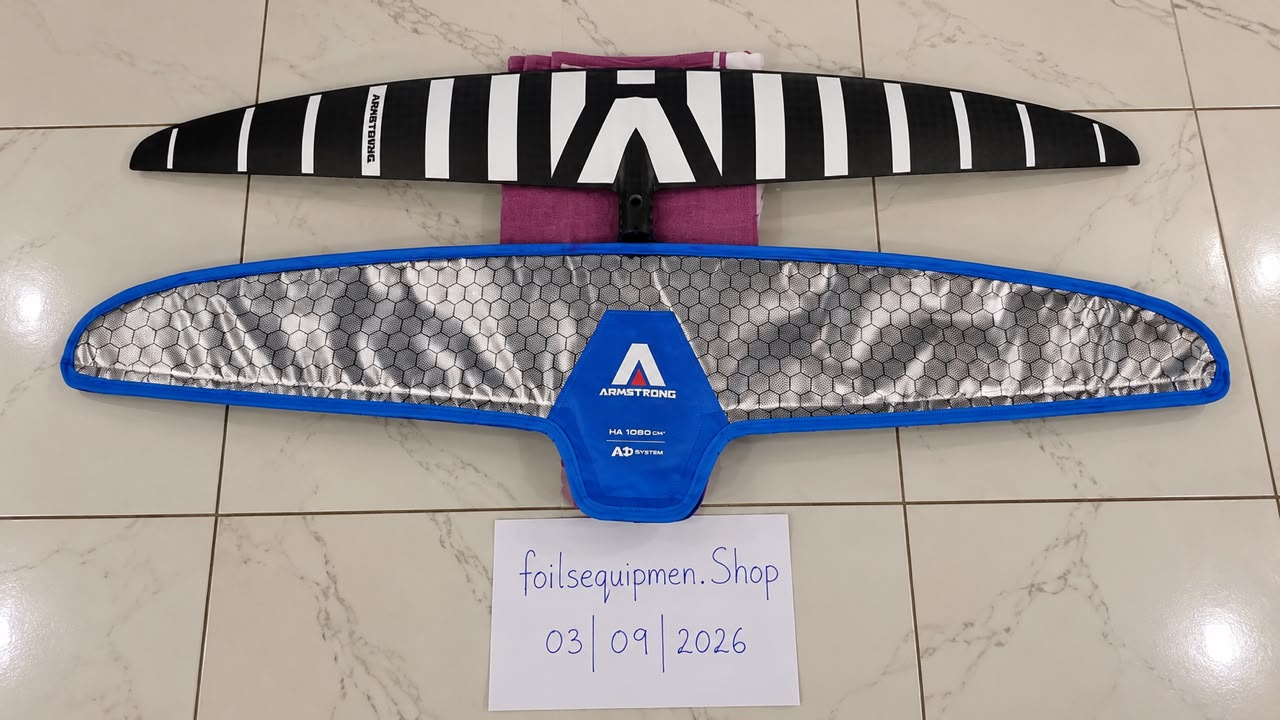
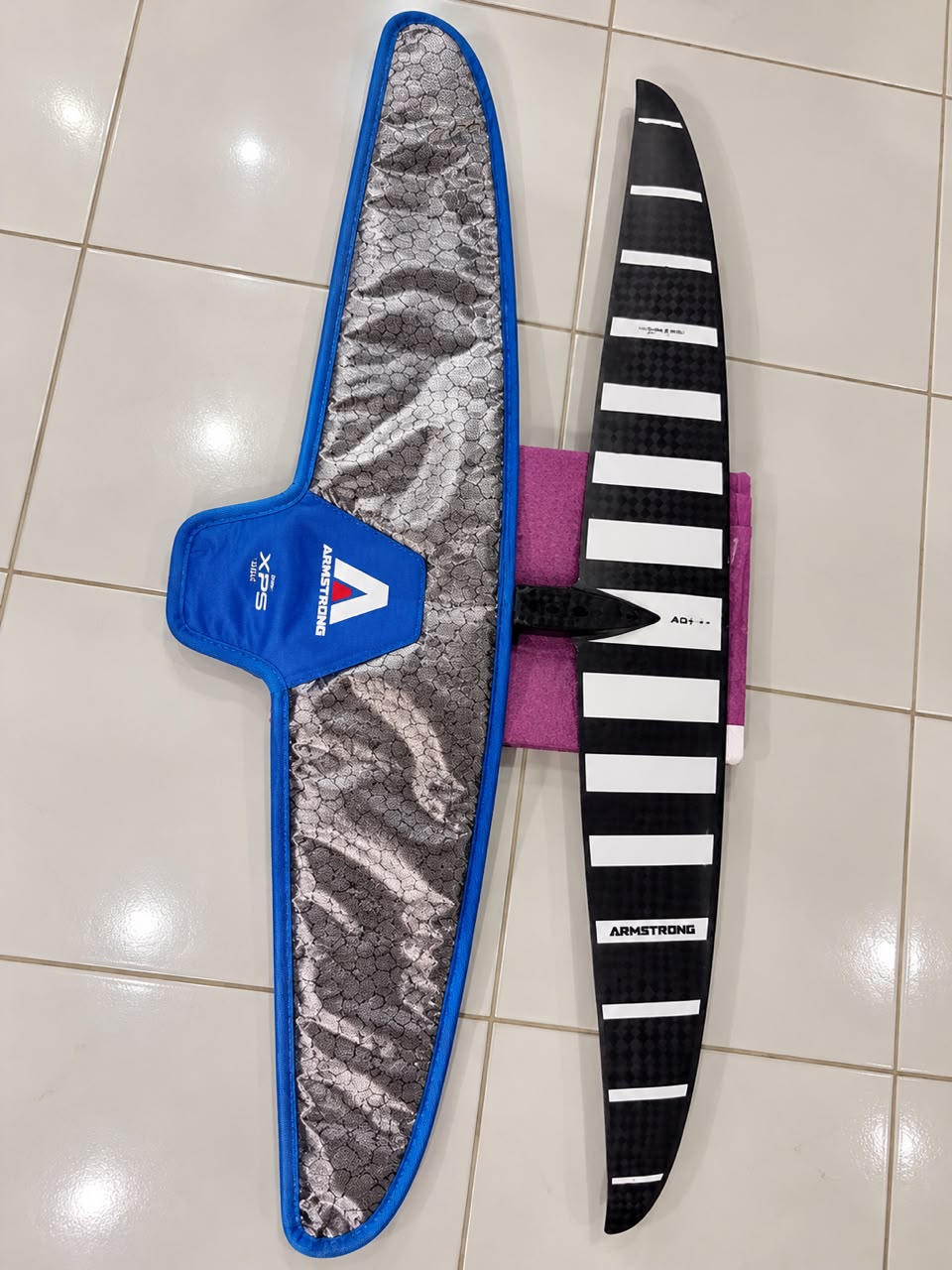
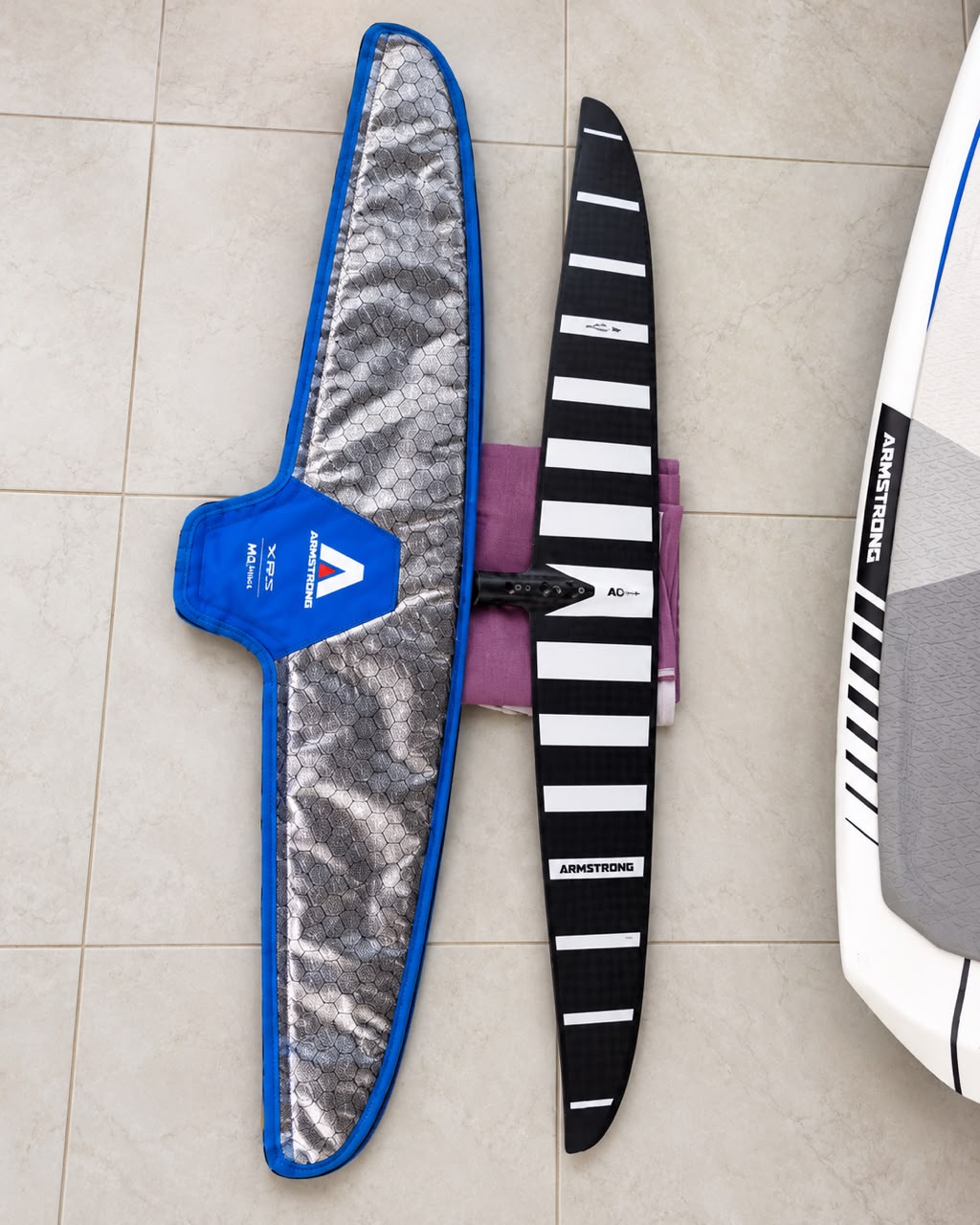
foil front Armstrong HA V2 1080
€500.00
The Armstrong HA V2 1080 Front Foil is offered in excellent condition and has been carefully inspected by a professional to confirm its overall condition and readiness for use. No tears, cracks, structural damage, or previous repair work have been identified. The foil has been well maintained and handled with care, with all important areas checked before being offered for sale.
Included Components
- Armstrong HA V2 1080 front wing
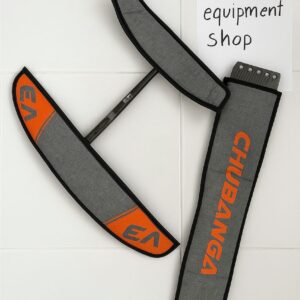
- Original protective cover
- M6 mounting screws
- Titanium barrel nut
- Armstrong A+ System connection hardware
- Any additional accessories shown with the listing
The leading edge, trailing edge, wing tips, carbon surface, mounting points, and connection interface have all been carefully inspected. Furthermore, the supplied hardware has been checked, and the foil has been kept in clean and excellent overall condition.
No significant damage, cracks, dents, or repair marks have been reported. Consequently, it can be considered a well-maintained option for riders seeking a high-performance front wing.
The Armstrong HA V2 1080 is ready to use again for wing foiling, surf foiling, downwind foiling, pump foiling, carving, and swell riding. It can also be used for jumps and more dynamic riding by an experienced rider with the correct complete foil setup and appropriate conditions.
A final pre-use inspection is recommended before returning the equipment to the water.
Description
foil front Armstrong HA V2 1080
Armstrong HA V2 1080 Front Foil
Exceptional glide and responsive carving have been combined in the Armstrong HA V2 1080 Front Foil. A high-aspect design has been developed for riders who want efficient flight, low-speed lift, easy pumping, and smooth performance through turns.
A 1,080 cm² surface area, 1,020 mm wingspan, and 9.63 aspect ratio are provided. Consequently, a strong balance between lift, glide, speed, maneuverability, and pumping efficiency can be achieved
The HA V2 range has been designed for intermediate through expert riders and has been developed for applications including wing foiling, surf foiling, downwind foiling, and dock-start/pump-style riding.
High-Aspect Performance
A high-aspect outline has been incorporated into the HA V2 1080.
As the span is extended relative to the foil area, efficient glide and reduced induced drag can be supported. Consequently, speed can be carried more effectively between turns, bumps, and pumping movements.
The design has also been refined to avoid the overly demanding feel sometimes associated with high-aspect foils. Therefore, a useful combination of performance and accessibility can be provided.
Key Product Highlights
- Armstrong HA V2 1080 Front Foil
- 1,080 cm² surface area
- 1,020 mm wingspan
- 9.63 aspect ratio
- High-aspect performance design
- Premium Toray carbon-fibre construction
- Armstrong A+ System compatibility
- Evolutive foil section
- Flat profile
- Trailing-edge reflex
- Excellent glide efficiency
- Low-speed lift
- Easy pumping characteristics
- Responsive carving
- Strong pitch stability
- Smooth rail-to-rail transitions
- Suitable for wing foiling
- Suitable for surf foiling
- Suitable for downwind foiling
- Suitable for pump and dock-start applications
- Protective cover included
- Mounting hardware included
1,080 cm² Surface Area
A 1,080 cm² area has been provided for the HA V2 1080.
As sufficient lifting surface is combined with a high-aspect outline, efficient takeoff and sustained flight can be supported without creating the bulk associated with much larger front wings.
Consequently, the foil can be used across a broad range of conditions while maintaining a performance-focused character.
1,020 mm Wingspan
A 1,020 mm span has been incorporated.
As the span contributes to the high-aspect geometry, efficient glide can be maintained while responsive turning remains available.
Consequently, a useful balance between stability and maneuverability can be created.
9.63 Aspect Ratio
An aspect ratio of 9.63 is provided.
As a relatively high aspect ratio is used, improved aerodynamic efficiency can be achieved compared with lower-aspect designs.
Consequently, longer glide phases and more efficient connections between sections can be experienced.
Evolutive Foil Section
An evolutive section shape has been developed across the wingspan.
As the section is adjusted at different points along the foil, water flow can be optimized across the entire wing.
Consequently, consistent lift can be maintained through different speeds and bank angles.
Low-Speed Lift
Strong low-speed lift has been retained despite the high-aspect configuration.
As lift is maintained effectively at slower speeds, takeoff can be achieved without requiring excessive speed.
Consequently, the HA V2 1080 can remain accessible to riders progressing into high-aspect foiling.
Easy Pumping
Efficient pumping has been incorporated into the design.
As the foil can remain within an effective lift zone at slower speeds, pumping effort can be reduced.
Consequently, energy can be conserved during longer foil sessions.
Endless Glide
Glide efficiency is one of the defining characteristics of the HA V2 range.
As the high-aspect outline allows speed to be carried efficiently, the foil can continue moving forward after a pumping movement or wave connection.
Consequently, longer sections can be connected with fewer corrective inputs.
Pumping Power Zone
The foil has been designed to remain effective within the pumping power zone.
As efficient lift and glide are combined, the rider can maintain altitude while generating forward speed.
Consequently, pumping can become smoother and more energy efficient.
Carving Performance
Responsive carving has been prioritized.
As the profile has been refined for efficient turning, rail-to-rail transitions can be performed smoothly.
Consequently, the foil can remain highly engaging during surf and wing sessions.
Flat Profile
A relatively flat profile has been incorporated.
As the profile contributes to responsive turning, the foil can be directed efficiently through carves.
Consequently, a lively and connected riding sensation can be achieved.
Pitch Stability
Pitch stability has been carefully developed.
As trailing-edge reflex is used, control can be maintained more effectively at speed and during maneuvers.
Consequently, riders can be provided with a larger margin for maintaining the desired foil height.
Trailing-Edge Reflex
Trailing-edge reflex represents an important part of the HA design.
As stability is generated without sacrificing the high-aspect character, predictable pitch control can be provided.
Consequently, the foil can be pushed harder during turns while remaining controllable.
High-Speed Control
High-speed control has been improved through the combination of aspect ratio, foil section, and reflex.
As the foil remains stable as speed increases, confidence can be maintained during powered winging and faster surf sections.
Consequently, experienced riders can explore the upper portion of the foil’s performance range.
Responsive Handling
Responsiveness has been retained despite the long span.
As the foil responds efficiently to rider input, directional changes can be introduced without excessive delay.
Consequently, technical riding and progressive carving can be performed more naturally.
Rail-to-Rail Transitions
Smooth transitions can be produced through the combination of the high-aspect outline and refined profile.
As the foil rolls progressively from one side to the other, a fluid carving sensation can be achieved.
Consequently, wave riding can be made more dynamic.
Wave Riding
The HA V2 1080 is well suited to riders who want to stay connected with moving swell.
As glide is maintained efficiently, the rider can remain on foil between sections.
Consequently, smaller energy sources can potentially be connected without constant pumping.
Surf Foiling
Surf foiling can be supported by the combination of low-speed lift and responsive carving.
As the foil can remain efficient at lower speeds while still responding to directional inputs, wave sections can be followed smoothly.
Consequently, riders can focus on line selection and carving rather than simply maintaining flight.
Wing Foiling
Wing foiling is another key application.
As the foil provides early lift and efficient glide, longer runs can be supported.
Furthermore, the responsive turning characteristics can be used during gybes, carves, and powered conditions.
Consequently, a versatile high-performance front wing can be created.
Downwind Foiling
Downwind foiling can benefit significantly from the HA V2 1080’s glide characteristics.
As speed can be carried efficiently, bumps can be connected more effectively.
Consequently, less energy can be spent maintaining flight between individual swell sections.
Downwind Connections
Successful downwind riding depends heavily on maintaining momentum.
As the HA V2 1080 has been designed to glide efficiently, the rider can be provided with more opportunity to connect one bump to another.
Consequently, smoother lines can be developed as technique improves.
Dock Starting
Dock-start use can be considered for sufficiently experienced riders.
As the foil is designed around efficient glide and pumping, sustained flight can be developed after launch.
However, the HA V2 1080 is not intended as a beginner dock-start foil. Consequently, appropriate experience and equipment selection should be used before attempting this discipline.
Pump Foiling
Pump foiling can be supported through the efficient low-speed characteristics.
As the foil retains lift during slower sections, pumping technique can be developed without relying entirely on high speed.
Consequently, riders can focus on cadence, pitch control, and energy conservation.
Pumping Efficiency
Efficient pumping is achieved through coordinated foil and rider movement.
As unnecessary vertical movement is minimized, more of the rider’s energy can be directed into forward momentum.
Consequently, longer distances can be covered with less fatigue.
Low-Wind Winging
The HA V2 1080 can be useful when early lift is valuable.
As sufficient surface area is combined with efficient foil geometry, earlier takeoff can be supported.
Consequently, riders can access lighter conditions when the complete board, wing, mast, and foil setup is appropriately matched.
Powered Conditions
The foil can also be used in stronger conditions.
As pitch stability and high-speed control have been incorporated, the foil can remain composed as speed increases.
Consequently, riders can continue using the same front wing as conditions become more powerful.
Intermediate Riders
The HA range has been positioned for intermediate through expert riders.
As the HA V2 1080 provides more stability and low-speed accessibility than might traditionally be expected from a high-aspect design, progression can be supported.
Consequently, riders moving from mid-aspect foils can gradually adapt to high-aspect performance.
Advanced Riders
Advanced riders can take advantage of the foil’s efficiency and responsiveness.
As the high-aspect profile allows speed and glide to be maintained, more demanding maneuvers can be attempted.
Consequently, the HA V2 1080 can remain useful as riding ability develops.
Expert Riders
Expert riders can benefit from the combination of speed, glide, carving, and pumping.
As the foil remains responsive under demanding inputs, high-performance riding can be supported.
Consequently, the HA V2 1080 can be integrated into a performance-oriented quiver.
Premium Carbon Construction
Premium Toray high and intermediate modulus carbon fibre has been used throughout the HA construction.
As high-quality carbon construction provides stiffness while controlling weight, direct rider feedback can be achieved.
Consequently, efficient energy transfer and precise handling can be supported.
Stiffness
High torsional and bending loads are experienced by high-aspect foils.
As the HA V2 construction has been engineered around these loads, structural stiffness can be maintained during aggressive carving.
Consequently, precise control can be retained when the foil is pushed hard.
Lightweight Performance
Weight has been carefully controlled through the carbon construction.
As unnecessary mass can reduce responsiveness, the lightweight design allows the foil to react efficiently to rider input.
Consequently, a connected feel can be maintained.
Armstrong A+ System
The HA V2 1080 has been designed around Armstrong’s A+ System.
As the A+ architecture connects compatible masts, fuselages, front foils, and stabilizers into one modular ecosystem, equipment can be configured according to different disciplines.
Consequently, the foil can be integrated into a broader Armstrong setup rather than functioning as an isolated component.
Modular Foil Setup
The A+ System allows different compatible components to be combined.
As mast, fuselage, front-wing, and stabilizer choices can be changed, the handling characteristics of the complete foil can be adapted.
Consequently, one rider can create multiple configurations around the same equipment platform.
Mast Selection
Mast selection should be based on the intended discipline and water conditions.
As mast length influences clearance, leverage, and handling, the appropriate compatible Armstrong mast should be selected.
Consequently, the HA V2 1080 can be configured for winging, surf, downwind, or other suitable applications.
Stabilizer Selection
The stabilizer should be selected according to the desired handling characteristics.
As stabilizer size and geometry influence pitch stability and turning behavior, the complete setup should be tuned rather than selected by front-wing size alone.
Consequently, the HA V2 1080 can be adapted to different rider preferences.
Fuselage Selection
A compatible Armstrong fuselage should be used.
As fuselage geometry influences the relationship between front foil and stabilizer, the correct configuration can provide more predictable handling.
Consequently, the complete A+ System can operate as intended.
Board Selection
The board should be selected according to rider ability and discipline.
As board volume and dimensions affect takeoff, stability, and pumping, the HA V2 1080 should be paired with a board that complements its performance characteristics.
Consequently, the foil can be used more effectively.
Rider Weight
Rider weight should be considered when selecting the complete setup.
As heavier riders generally require greater lift while lighter riders can use smaller front wings, board, mast, stabilizer, and foil choices should be considered together.
Consequently, more predictable takeoff and handling can be achieved.
Takeoff Performance
Early lift has been retained within the high-aspect design.
As sufficient lift is generated at relatively low speed, takeoff can be achieved efficiently when the board and mast configuration are appropriate.
Consequently, less acceleration distance may be required.
Takeoff Technique
A controlled takeoff should be performed.
As the foil generates lift progressively, the rider can transition from displacement to foil flight while maintaining pitch control.
Consequently, unnecessary ventilation and touchdown can be reduced.
Pump Cycle
A smooth pump cycle should be developed.
As the foil responds to coordinated pitch inputs, the rider can generate vertical movement that is converted into forward speed.
Consequently, a more efficient pumping rhythm can be established.
Glide Recovery
Small losses of speed can be recovered through pumping.
As low-speed lift remains available, the rider can rebuild momentum without immediately touching down.
Consequently, more of each session can be spent flying.
Breach Recovery
A controlled recovery can be made following a minor breach.
As the foil’s pitch characteristics have been refined for stability, control can be regained when appropriate technique is applied.
Consequently, small mistakes can be managed more effectively.
Carving Through Swell
Swell can be followed with smooth directional changes.
As the foil has been optimized for flowing turns, the rider can transition from one line to another without unnecessary resistance.
Consequently, wave energy can be utilized more effectively.
Connecting Swell Lines
Efficient glide is particularly useful when swell lines are separated.
As momentum is preserved between sections, fewer pumping movements may be required.
Consequently, longer connections can be achieved.
Long Sessions
Efficient pumping and glide can help reduce fatigue.
As less effort may be required to remain airborne, the rider can distribute physical energy more effectively.
Consequently, longer sessions can be enjoyed.
Learning Progression
A gradual progression should be followed
As the HA V2 1080 combines performance with relatively accessible low-speed characteristics, riders can work progressively on takeoff, pumping, carving, and high-speed control.
Consequently, technical development can be achieved without immediately requiring the smallest high-aspect foil.
Gybes
The foil can be used for progressive gybing.
As pitch stability is maintained through speed changes, transitions can be made more predictably.
Consequently, riders can work toward cleaner powered and unpowered gybes.
Tacks
Tacking can also be supported by the responsive handling.
As the foil responds efficiently to weight transfer, directional changes can be completed with controlled inputs.
Consequently, technical maneuvers can be developed.
Carve Turns
Carve turns can be performed with progressive pressure.
As the foil rolls smoothly, the rider can maintain a continuous line through the turn.
Consequently, a fluid riding sensation can be achieved.foil front Armstrong HA V2 1080
Wave Exit
Efficient glide can be especially useful when exiting a wave section.foil front Armstrong HA V2 1080
As momentum is retained, the rider can continue toward the next available energy source.
Consequently, additional pumping can be delayed until it becomes necessary.
Equipment Maintenance
Regular maintenance should be performed.
As high-performance carbon foils are exposed to substantial loads and impacts, careful inspection should be maintained after every session.foil front Armstrong HA V2 1080
Consequently, potential problems can be identified early.foil front Armstrong HA V2 1080
Leading Edge Inspection
The leading edge should be checked for impacts and surface damage.
As contact with rocks, sand, boards, or hard surfaces can damage carbon structures, any suspected structural issue should be professionally assessed.foil front Armstrong HA V2 1080
Consequently, damaged equipment can be prevented from being returned to use prematurely.
Trailing Edge Inspection
The trailing edge should be handled carefully.foil front Armstrong HA V2 1080
As thin foil sections can be vulnerable to impact, unnecessary contact with hard surfaces should be avoided.foil front Armstrong HA V2 1080
Consequently, the profile can be preserved.foil front Armstrong HA V2 1080
Wing Tip Protection
The wing tips should be protected during transportation.foil front Armstrong HA V2 1080
As tips can be exposed to accidental impacts, the supplied cover should be used whenever possible.
Consequently, unnecessary cosmetic and structural damage can be reduced.foil front Armstrong HA V2 1080
Hardware Inspection
All mounting hardware should be checked regularly.foil front Armstrong HA V2 1080
As loose or damaged hardware can affect the foil connection, appropriate installation procedures should be followed.
Consequently, secure assembly can be maintained.foil front Armstrong HA V2 1080
Salt-Water Care
After salt-water sessions, appropriate rinsing should be performed.foil front Armstrong HA V2 1080
As salt residue can accumulate around hardware and connection points, regular cleaning can reduce contamination and corrosion.foil front Armstrong HA V2 1080
Consequently, the complete foil system can remain in better condition.
Sand Protection
The foil should not be dragged across sand.foil front Armstrong HA V2 1080
As abrasive particles can scratch surfaces and enter connection interfaces, careful beach handling should be practiced.foil front Armstrong HA V2 1080
Consequently, unnecessary wear can be minimized.
Transportation
The protective cover should be used during transportation.
As the front wing can be damaged by impacts with other equipment, appropriate protection should be maintained.foil front Armstrong HA V2 1080
Consequently, the foil can arrive at the water in better condition.foil front Armstrong HA V2 1080
Storage
The foil should be stored in a dry and protected location.
As prolonged exposure to moisture, heat, or direct sunlight can affect equipment materials, controlled storage should be preferred.foil front Armstrong HA V2 1080
Consequently, long-term serviceability can be supported.foil front Armstrong HA V2 1080
Used HA V2 1080
When a used HA V2 1080 is being purchased, the foil should be inspected carefully.foil front Armstrong HA V2 1080
Particular attention should be given to
- Leading edge
- Trailing edge
- Wing tips
- Carbon surface
- Connection interface
- Mounting holes
- Previous impact marks
- Hardware
- Protective cover
- Storage history
Consequently, the actual condition of the foil can be evaluated before purchase.foil front Armstrong HA V2 1080
Included Components
The standard HA front-foil package includes a protective cover and mounting hardware.
The manufacturer’s published HA listing specifies two M6 28.5 mm 316 stainless countersunk screws with rainbow titanium coating, two M6 19.5 mm 316 stainless countersunk screws with gold titanium coating, and one M6 8 mm titanium barrel nut.foil front Armstrong HA V2 1080
Additional components such as a mast, fuselage, and stabilizer should only be considered included when specifically stated in the individual listing.foil front Armstrong HA V2 1080
Protective Cover
A protective cover is provided.foil front Armstrong HA V2 1080
As protection can be maintained during transportation and storage, unnecessary contact with hard surfaces can be avoided.foil front Armstrong HA V2 1080
Consequently, the front wing can be kept in better condition between sessions.
Product Specifications
The published HA1080 specifications include:
- Model: Armstrong HA V2 1080
- Type: High Aspect front foil
- Surface area: 1,080 cm²
- Span: 1,020 mm
- Aspect ratio: 9.63
- Construction: Toray high/intermediate modulus carbon fibre
- Connection: Armstrong A+ System
- Primary disciplines: Wing, surf, downwind
- Additional application: Pump/dock-start use for experienced riders
- Protective cover: Included
- Mounting hardware: Included
Main Performance Benefits
- High-aspect efficiency
- Excellent glide
- Low-speed lift
- Easy pumping
- Responsive carving
- Strong pitch stability
- Efficient swell connection
- Smooth rail-to-rail transitions
- High-speed control
- Premium carbon construction
- Lightweight performance
- A+ System compatibility
- Wide application range
- Suitable for intermediate to expert riders
Ideal Applications
The HA V2 1080 can be considered for:
- Wing foiling
- Surf foiling
- Downwind foiling
- Swell riding
- Pump foiling
- Dock starting
- Long-distance foil sessions
- Carving
- Performance progression
- Low-wind winging
Why Choose the HA V2 1080?
A distinctive combination of glide, lift, carving, stability, and pumping efficiency has been created with the HA V2 1080.foil front Armstrong HA V2 1080
As the high-aspect outline provides efficient flight while the evolutive section maintains useful lift across different speeds and bank angles, the foil can remain effective across a broad range of riding conditions.foil front Armstrong HA V2 1080
Furthermore, trailing-edge reflex has been used to provide pitch stability without removing the responsive character expected from a performance high-aspect foil.foil front Armstrong HA V2 1080
Consequently, the HA V2 1080 can be positioned as a versatile performance front wing for riders who want to progress beyond conventional low- and mid-aspect foil designs.foil front Armstrong HA V2 1080
Final Product Overview
The Armstrong HA V2 1080 Front Foil has been engineered to provide a strong balance between high-aspect glide and practical low-speed performance.foil front Armstrong HA V2 1080
With its 1,080 cm² area, 1,020 mm span, 9.63 aspect ratio, refined foil section, flat profile, trailing-edge reflex, and premium Toray carbon construction, a highly efficient and responsive platform can be provided.foil front Armstrong HA V2 1080
Consequently, riders can be supported across wing foiling, surf foiling, downwind riding, pumping, and swell connection.foil front Armstrong HA V2 1080
For intermediate through expert riders seeking long glide, efficient pumping, responsive carving, strong pitch stability, and a versatile high-performance foil, the HA V2 1080 can provide an excellent addition to a modern foil quiver.foil front Armstrong HA V2 1080
The foil should always be paired with compatible Armstrong A+ components and inspected before every session. Any significant impact, grounding event, collision, or suspected carbon damage should be professionally assessed before the foil is returned to the water.foil front Armstrong HA V2 1080


Reviews
There are no reviews yet.