


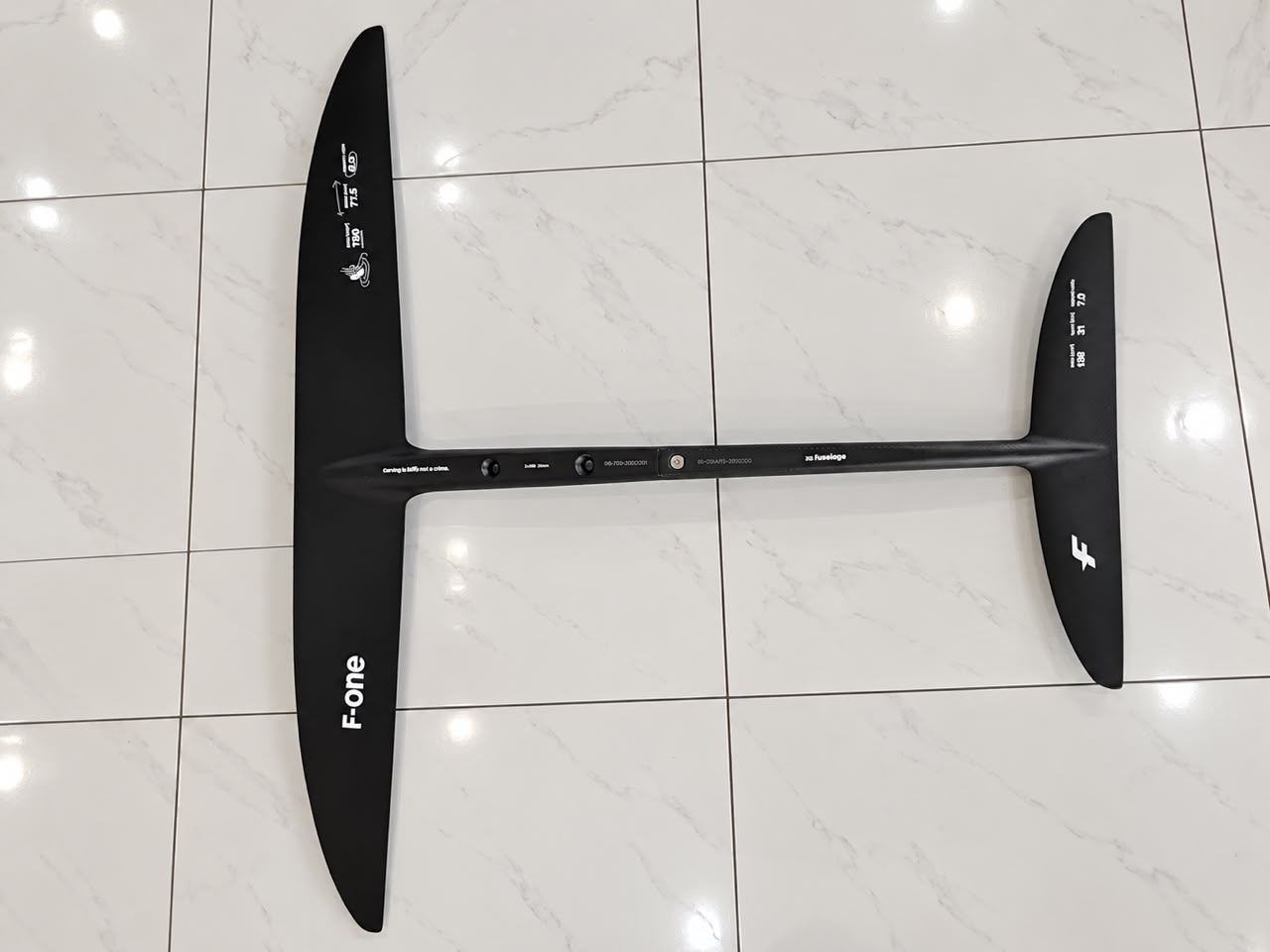
F-One sk8 750 v3 for T2 mast
€550.00
The F-One SK8 750 V3 for T2 Mast is offered in excellent condition and has been professionally inspected to confirm its overall quality, condition, and readiness for use. The foil has been carefully checked and found to have no damage, no repairs, no cracks, no delamination, and no significant structural defects. It has been well maintained and is ready for many more sessions and rides.
Every component has been thoroughly inspected, including the front wing, T2 mast, fuselage, stabilizer, mounting plate, screws, bolts, washers, connection points, and carbon surfaces. Critical areas have been checked for impact marks, scratches, excessive wear, corrosion, loose hardware, cracks, and previous repairs.
Included components:
- F-One SK8 750 V3 front wing
- T2 mast
- Fuselage
- Rear stabilizer
- Mounting hardware
- Screws and bolts
- Washers and connection hardware
- Protective/storage bag, if included
- Related accessories, if included
No cracks, tears, repairs, or significant structural damage are present. The components remain clean, solid, and well maintained.
The F-One SK8 750 V3 for T2 Mast is ready to use and ready for many more sessions and rides again. It is an excellent choice for experienced riders interested in high-speed foiling, wing foiling, prone foiling, wave riding, swell riding, carving, pumping, and downwind performance. A complete professional inspection should always be completed before returning safety-critical equipment to use.
Description
F-One SK8 750 V3 for T2 Mast – Speed, Maneuverability and Foiling Performance
The F-One SK8 750 V3 for T2 Mast has been designed for riders seeking a responsive hydrofoil setup with an emphasis on speed, carving, pumping, and dynamic wave performance. A compact front-wing configuration is provided so that efficient acceleration can be combined with agile handling and controlled turning.
Developed for riders who have already established solid foil control, this setup can be particularly appealing for advanced wing foiling, prone foiling, downwind riding, surf foiling, and performance-oriented sessions. Consequently, a balanced combination of speed and maneuverability can be achieved when the front wing is matched correctly with the T2 mast, fuselage, stabilizer, board, and rider
High-Performance SK8 Design
The SK8 platform has been developed around efficient foil geometry and responsive handling. Therefore, the F-One SK8 750 V3 can be selected when a more dynamic riding experience is desired.
A compact surface area allows reduced drag to be prioritized. Consequently, acceleration and higher-speed flight can be achieved more efficiently than with larger beginner-oriented front wings.
Furthermore, the design can provide a lively feeling during carving and directional changes.
Key Product Highlights
- F-One SK8 750 V3
- 750 cm² front-wing configuration
- Designed for use with compatible T2 mast systems
- Performance-oriented hydrofoil design
- Responsive handling
- High-speed potential
- Efficient glide
- Dynamic carving
- Pumping capability
- Wave and swell applications
- Downwind foiling potential
- Advanced wing-foil performance
- Prone-foil applications
- Suitable for experienced riders
T2 Mast Compatibility
The T2 mast is an important part of the complete foil configuration.
When compatible components are combined correctly, stiffness and control can be maintained through the mast and fuselage connection. Consequently, rider input can be transferred efficiently into the foil.
Moreover, a properly matched mast can help the front wing perform consistently during acceleration, carving, pumping, and higher-speed riding.
Before purchase or assembly, compatibility between the SK8 750 V3, mast, fuselage, stabilizer, and mounting hardware should always be confirmed.
Efficient Speed
Speed is one of the main characteristics sought from a compact performance front wing.
As water flow remains attached efficiently across the foil, drag can be reduced. Consequently, the rider can maintain speed with less unnecessary resistance.
The F-One SK8 750 V3 can therefore be suited to riders who want to progress toward faster foil riding.
Furthermore, speed can be carried effectively through transitions and turns when appropriate technique is used.
Responsive Carving
Carving performance can be enhanced by a compact front-wing configuration.
As pressure is transferred through the board, mast, and fuselage, the foil can be directed into a turn. Consequently, dynamic arcs can be created across the water.
The SK8 concept is particularly appealing to riders who want a foil that feels responsive rather than excessively stable.
Moreover, controlled carving can be combined with speed for a more engaging riding experience.
Pumping Performance
Foil pumping can be used to maintain momentum when external propulsion becomes limited.
As pressure is alternated through the board and foil, lift can be maintained through coordinated rider movement. Consequently, forward speed can be preserved between sections of swell.
The SK8 750 V3 can be incorporated into a pumping-oriented setup by experienced riders.
However, pumping performance will be influenced by rider technique, foil loading, stabilizer choice, board design, and water conditions.
Wave Riding
Wave riding requires a foil that can maintain momentum while remaining responsive.
Once wave energy is captured, the rider can reduce reliance on external propulsion. Consequently, the foil’s glide and turning characteristics become increasingly important.
The F-One SK8 750 V3 can be used for suitable wave-foiling applications where responsive carving and speed are desired.
Furthermore, the compact front wing can allow the rider to redirect the foil efficiently while following changing wave energy.
Swell Riding
Swell riding demands efficient glide and controlled transitions between bumps.
As one swell section loses energy, speed must be maintained until another section can be reached. Therefore, efficient foil performance becomes particularly valuable.
The SK8 750 V3 can support this type of riding when the complete setup has been appropriately matched.
Consequently, experienced riders can work on connecting swell sections while maintaining controlled foil height.
Downwind Foiling
Downwind foiling requires efficient acceleration and responsive control.
As the rider moves onto a bump, speed can be generated through the combination of foil lift and wave energy. Consequently, the foil must remain predictable while the rider moves between sections.
The SK8 750 V3 can be considered for advanced downwind applications where speed and maneuverability are prioritized.
Furthermore, pumping can be incorporated when additional energy is required to connect sections.
Wing Foiling
Advanced wing foilers can benefit from a compact front wing when higher speed and maneuverability are prioritized.
As the wing generates forward power, the foil can accelerate until sufficient lift is established. Consequently, the rider can transition into efficient flight.
Once airborne, the SK8 750 V3 can provide responsive handling for carving, transitions, and speed-oriented riding.
The 750 cm² size is generally better suited to experienced riders than beginners who require maximum low-speed lift and stability.
Prone Foiling
Prone foiling can place significant emphasis on pumping efficiency and maneuverability.
Without continuous power from a kite or wing, the rider must generate and maintain momentum through wave energy and foil technique.
Therefore, a compact and efficient front wing can be particularly valuable.
The F-One SK8 750 V3 can be incorporated into suitable prone-foil setups where the rider has sufficient experience to control a smaller performance-oriented wing.
Takeoff Characteristics
Takeoff technique becomes increasingly important with smaller front wings.
Sufficient speed must be generated before the foil can produce the desired lift. Consequently, board selection and rider technique can have a major influence on takeoff performance.
A suitable board can help provide the required acceleration, while an appropriately matched mast and stabilizer can support predictable foil behavior.
Therefore, the SK8 750 V3 should be considered as part of a complete system rather than as an isolated component.
Advanced Rider Progression
The F-One SK8 750 V3 can support several stages of advanced foil progression.
Speed Development
Higher-speed control can be developed progressively.
Carving
More dynamic turns can be practiced while maintaining foil control.
Pumping
Efficient energy transfer can be refined.
Wave Riding
Wave energy can be combined with foil glide.
Downwind Riding
Swell connection and speed management can be developed.
Consequently, the foil can remain useful as technical ability continues to improve.
Board Compatibility
Board selection can significantly influence performance.
A larger board may provide easier takeoff, while a smaller performance board can create a more responsive setup.
Therefore, the appropriate board should be selected according to rider weight, discipline, experience, and local conditions.
For advanced riders, a compact board can complement the SK8 750 V3’s speed-oriented characteristics.
Stabilizer Selection
The stabilizer influences pitch control, turning response, and overall balance.
A smaller stabilizer can create a looser and more maneuverable feeling. Meanwhile, a larger stabilizer may provide additional pitch stability.
Consequently, stabilizer selection should be made according to the rider’s discipline and preferred handling characteristics.
Compatibility with the specific F-One system should always be verified.
Mast Length
Mast length also influences the complete foil setup.
A longer mast can provide additional clearance and can be useful in deeper water. Conversely, a shorter mast can provide easier access in shallower conditions.
Therefore, mast selection should be based on water depth, discipline, rider experience, and board configuration.
The T2 mast should be used only with components confirmed as compatible with the selected foil system.
High-Speed Stability
High-speed foiling requires controlled pitch and roll.
As speed increases, even small rider inputs can have a noticeable effect. Consequently, a responsive front wing should be managed progressively.
The SK8 750 V3 can provide direct feedback to experienced riders.
Furthermore, appropriate stabilizer selection can help achieve the desired balance between maneuverability and stability.
Maintenance and Inspection
A complete inspection should be performed before every session.
Particular attention should be given to:
- Front wing
- Leading edge
- Trailing edge
- Mast
- Fuselage
- Stabilizer
- Mounting plate
- Screws
- Bolts
- Washers
- Connection points
- Carbon surfaces
- Signs of impact
- Signs of cracks or delamination
Any suspected carbon damage should be professionally assessed before the foil is returned to use.
Carbon Care
Carbon components should be protected from unnecessary impacts.
The front wing should not be dropped onto hard surfaces, particularly on the leading or trailing edge. Consequently, avoidable structural or cosmetic damage can be reduced.
After salt-water sessions, appropriate rinsing should be performed.
Furthermore, the foil should be dried completely before long-term storage.
Transportation and Storage
During transportation, the front wing, mast, fuselage, and stabilizer should be adequately protected.
Sharp objects should not be allowed to contact carbon surfaces. Moreover, excessive pressure should not be placed on the wing during storage.
A suitable foil bag can provide additional protection during travel.
Consequently, the components can be kept in better condition between sessions.
Main Benefits at a Glance
- F-One SK8 750 V3
- 750 cm² front-wing size
- T2 mast compatibility
- Performance-focused design
- Responsive handling
- High-speed potential
- Efficient glide
- Dynamic carving
- Pumping capability
- Wave riding
- Swell riding
- Downwind foiling
- Advanced wing foiling
- Prone foiling
- Suitable for experienced riders
Why Choose the F-One SK8 750 V3 for T2 Mast?
The F-One SK8 750 V3 for T2 Mast can be an excellent choice for experienced riders who want to combine speed, maneuverability, and efficient foil performance.
Its compact 750 cm² configuration can provide a responsive feel, while the appropriate T2 mast and compatible foil components can create a rigid and efficient overall system.
Furthermore, the foil can be used across several advanced disciplines, including wing foiling, prone foiling, wave riding, swell riding, and downwind foiling.
A Dynamic Hydrofoil for Advanced Riding
The F-One SK8 750 V3 for T2 Mast has been designed for riders who want to progress beyond basic foil cruising.
High-speed riding can be combined with responsive carving, efficient pumping, wave riding, and downwind performance. Meanwhile, the compact front-wing configuration can provide the agility required for more technical riding.
For riders seeking an F-One SK8 750 V3 for T2 Mast for high-speed foiling, advanced wing foiling, prone foiling, wave riding, swell connection, carving, pumping, and downwind riding, this front wing can provide a capable performance-oriented platform.F-One sk8 750 v3 for T2 mast
Before every session, the complete foil assembly should be inspected carefully, with particular attention given to carbon surfaces, mounting hardware, connection points, and signs of impact or structural damage. The setup should always be used with compatible components and within the rider’s demonstrated level of experience.F-One sk8 750 v3 for T2 mast
F-One SK8 750 V3 for T2 Mast – Advanced Riding Applications
Performance-Oriented Foiling
The F-One SK8 750 V3 for T2 Mast has been developed for riders who want a more responsive and performance-focused foil setup. Greater emphasis can be placed on speed, carving, glide, and pumping efficiency, while a compact front-wing size can be used to reduce unnecessary drag.F-One sk8 750 v3 for T2 mast
As the rider becomes comfortable at higher speeds, the foil can be loaded progressively through the board and mast. Consequently, acceleration and directional control can be developed without relying on excessive steering movements.
Furthermore, the rigid connection provided by a compatible mast and fuselage can help maintain precise feedback during demanding riding.F-One sk8 750 v3 for T2 mast
High-Speed Riding
Higher-speed foiling requires accurate pitch and roll control.
As speed increases, smaller rider movements can produce noticeable changes in foil behavior. Therefore, a progressive riding style should be maintained.F-One sk8 750 v3 for T2 mast
The SK8 750 V3 can provide a responsive platform for riders who want to explore faster foil flight.
Moreover, efficient water flow across the front wing can allow speed to be carried through longer runs and transitions.
Advanced Carving
Carving can be performed by combining body position, board pressure, and foil loading.
As pressure is transferred toward one side of the board, the foil can be directed into a turn. Consequently, smooth and controlled arcs can be created.F-One sk8 750 v3 for T2 mast
The compact front-wing configuration can make directional changes feel more immediate.
Furthermore, speed can be maintained through the turn when the rider’s technique is properly coordinated.F-One sk8 750 v3 for T2 mast
Tight Directional Changes
A performance-oriented foil can be particularly useful when quick changes of direction are required.
As the rider shifts weight and adjusts pressure through the board, the foil can respond rapidly. Consequently, tighter lines can be developed.
However, aggressive directional changes should be introduced progressively because higher-speed foil riding increases the consequences of mistakes.
Pumping Efficiency
Pumping can be used to preserve momentum when external propulsion is reduced.
The rider can load and unload the foil through coordinated movements. Consequently, forward speed can be maintained between sections of swell.
The F-One SK8 750 V3 can be incorporated into a pumping-oriented setup for riders who already have strong foil fundamentals.
Moreover, pumping technique can be refined gradually to improve efficiency rather than relying on excessive physical effort.
Connecting Swell
Swell connection requires efficient glide and controlled speed management.
As one bump becomes weaker, the rider can use the remaining momentum to approach another section. Consequently, longer uninterrupted runs can be developed.
The SK8 750 V3 can be used for this type of advanced riding when the complete setup is appropriately matched.
Furthermore, its maneuverability can allow direction to be adjusted as the swell changes.
Downwind Performance
Downwind foiling can be demanding because the rider is constantly responding to moving water.
As a bump is approached, acceleration can be generated through coordinated pumping and positioning. Consequently, the rider can move onto the next section.
An efficient front wing can help speed remain available between individual bumps.
Therefore, the SK8 750 V3 can be considered for experienced riders who want to develop more dynamic downwind techniques.
Wave-Foiling Performance
Wave foiling benefits from a front wing that can combine glide and maneuverability.
Once the rider is carried by wave energy, the need for external power can be reduced. Consequently, the foil’s ability to maintain momentum becomes important.
The SK8 750 V3 can be used to follow wave faces and make controlled directional changes.
Furthermore, its compact configuration can allow experienced riders to place the foil precisely during turns.
Prone Foiling
Prone foiling places considerable emphasis on takeoff efficiency, pumping, and glide.
The rider must generate sufficient speed during the paddle and takeoff sequence. Consequently, equipment matching becomes particularly important.
Once the foil is flying, efficient pumping can be used to maintain momentum.
The SK8 750 V3 can be suited to advanced prone riders who are comfortable managing a smaller performance-oriented front wing.
Wing Foiling
Advanced wing-foil riders can use the SK8 750 V3 when speed and maneuverability are prioritized.
As power from the wing is converted into board speed, the foil can generate sufficient lift for takeoff. Once flight has been established, the rider can reduce unnecessary wing movement and concentrate on foil control.
Consequently, faster and more dynamic wing-foil sessions can be developed.
Takeoff Technique
A smaller front wing requires adequate speed before full lift is generated.
Therefore, board choice, wing power, rider weight, and technique should all be considered.
As sufficient speed is reached, progressive rear-foot pressure can be applied to establish controlled lift. Consequently, the board can rise without excessive pitch changes.
Experienced riders will generally find this process easier because speed and foil height can be managed more accurately.
Pitch Control
Pitch control is essential with a responsive front wing.
As the rider moves forward or backward on the board, the foil’s angle of attack can change. Consequently, lift can increase or decrease.
The T2 mast and compatible fuselage can provide a direct connection through which these changes can be felt.
Therefore, subtle body movements should be preferred over abrupt corrections.
Roll Control
Roll control is influenced by rider position, front-wing geometry, mast stiffness, and stabilizer selection.
As pressure is applied to either side of the board, the foil can respond accordingly.
Consequently, smooth carving can be developed when rider input remains controlled.
Furthermore, an appropriate stabilizer can be used to fine-tune the balance between stability and maneuverability.
Stabilizer Selection
The rear stabilizer plays an important role in the complete foil system.
A smaller stabilizer can produce a looser and more maneuverable feeling. Conversely, a larger stabilizer can provide greater pitch stability.
Therefore, stabilizer selection should be based on the intended discipline and rider preference.
Compatibility with the relevant F-One system should always be confirmed before assembly.
Mast Selection
Mast length can influence handling, clearance, and overall foil behavior.
A longer mast can provide greater clearance in deeper water, while a shorter mast can be useful where reduced height or shallower conditions are preferred.F-One sk8 750 v3 for T2 mast
Consequently, mast selection should be based on water depth, discipline, board configuration, and experience.F-One sk8 750 v3 for T2 mast
The T2 mast should be paired only with components confirmed to be compatible with the selected SK8 system.F-One sk8 750 v3 for T2 mast
Board Selection
Board characteristics can strongly influence takeoff and handling.
A larger board can provide additional stability and easier acceleration. Meanwhile, a smaller board can create a more direct and dynamic feel.
Consequently, experienced riders may prefer a compact board when using a performance-oriented 750 cm² front wing.F-One sk8 750 v3 for T2 mast
Wind Conditions
Wind strength should always be evaluated together with the complete equipment configuration.
A rider using a large wing and large board may achieve earlier takeoff than someone using a smaller setup.F-One sk8 750 v3 for T2 mast
Therefore, the SK8 750 V3 should be selected according to the rider’s weight, skill, foil configuration, and intended conditions.F-One sk8 750 v3 for T2 mast
Sudden changes in wind and water movement should always be anticipated.
Rider Progression
The F-One SK8 750 V3 can support several advanced progression goals.
Speed
Higher-speed control can be developed progressively.
Carving
Dynamic turns can be refined through controlled foil loading.F-One sk8 750 v3 for T2 mast
Pumping
Energy transfer can be improved through efficient technique.F-One sk8 750 v3 for T2 mast
Downwind Riding
Swell connection and speed management can be practiced.
Wave Foiling
Wave energy can be combined with glide and carving.F-One sk8 750 v3 for T2 mast
Consequently, the foil can remain valuable as technical ability continues to develop.
Pre-Session Inspection
A complete inspection should be performed before every session.
Particular attention should be given to:
- Front wing
- Leading edge
- Trailing edge
- T2 mast
- Fuselage
- Stabilizer
- Mounting plate
- Screws
- Bolts
- Washers
- Connection points
- Carbon surfaces
- Signs of impact
- Cracks or delamination
Any suspected structural or carbon damage should be professionally assessed before use.
Hardware Maintenance
Foil hardware should be kept clean and properly maintained.
After salt-water use, appropriate rinsing should be performed. Furthermore, mounting screws and connection points should be inspected regularly.F-One sk8 750 v3 for T2 mast
Damaged or unsuitable hardware should not be used.F-One sk8 750 v3 for T2 mast
Consequently, the structural integrity of the complete assembly can be better preserved.
Carbon Protection
Carbon hydrofoil components should be protected from unnecessary impact.
The front wing should not be dropped onto hard surfaces, especially along the leading or trailing edge.F-One sk8 750 v3 for T2 mast
Furthermore, the mast and fuselage should be protected during transportation.
A suitable foil bag can reduce the possibility of accidental damage between sessions.
Storage and Transportation
The complete foil should be stored in a dry and protected environment.
Before long-term storage, all components should be cleaned and dried appropriately.
During transportation, the front wing, mast, fuselage, and stabilizer should be protected from contact with hard or abrasive objects.F-One sk8 750 v3 for T2 mast
Consequently, cosmetic and structural damage can be minimized.
Key Performance Advantages
- F-One SK8 750 V3
- 750 cm² front wing
- T2 mast compatibility
- Performance-oriented geometry
- Responsive handling
- High-speed potential
- Efficient glide
- Dynamic carving
- Pumping capability
- Wave riding
- Swell riding
- Downwind applications
- Advanced wing foiling
- Prone foiling
- Suitable for experienced riders
Why Choose the F-One SK8 750 V3 for T2 Mast?
The F-One SK8 750 V3 for T2 Mast can be an excellent option for experienced riders who want a responsive foil setup with strong speed and maneuverability.
Its compact front-wing configuration can reduce drag while supporting dynamic carving and efficient glide. Meanwhile, the compatible T2 mast can provide the rigid connection required for precise rider input.F-One sk8 750 v3 for T2 mast
Furthermore, the foil can be used across several advanced disciplines, including wing foiling, prone foiling, wave riding, swell riding, pumping, and downwind foiling.F-One sk8 750 v3 for T2 mast
A Dynamic Performance Foil
The F-One SK8 750 V3 for T2 Mast has been developed for riders who want to progress toward faster and more technical foil riding.F-One sk8 750 v3 for T2 mast
High-speed flight can be combined with carving, pumping, wave riding, and swell connection. Consequently, a versatile performance platform can be created when the foil is correctly matched to the rider and complete equipment system.F-One sk8 750 v3 for T2 mast
For riders seeking an F-One SK8 750 V3 for T2 Mast for advanced wing foiling, prone foiling, wave riding, downwind foiling, pumping, carving, and high-speed performance, this setup can provide a responsive foundation for demanding sessions.
Before every session, the complete assembly should be inspected carefully, with particular attention given to carbon surfaces, mounting hardware, connection points, and signs of impact or structural damage. The foil should always be used with compatible components and within conditions appropriate for the rider’s demonstrated experience.


Reviews
There are no reviews yet.